
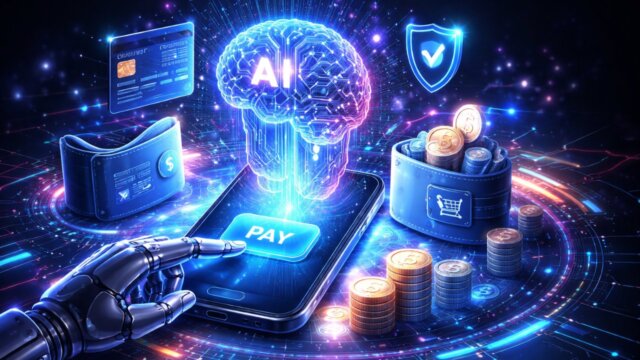
- AI Payments Take Center Stage as X402, MCP, and ERC-8004 Build the Base Layers of Trust for the Agent Economy, unlocking secure machine-led commerce.
- This shift is known as the “Agent Economy,” where AI systems serve as economic actors rather than mere tools.
- Three key technologies are facilitating this transformation: x402, Model Context Protocol (MCP), and ERC-8004, which address payment, collaboration, and trust respectively.
The world of artificial intelligence is entering a decisive new chapter. For years, AI dazzled users by writing essays, generating images, and automating repetitive tasks. But now, a deeper transformation is unfolding—one that could redefine how digital systems interact with money, services, and trust itself. At the heart of this shift lies a powerful idea: AI payments. As AI systems evolve from content generators into autonomous agents capable of making independent decisions, executing transactions, and completing complex workflows, the infrastructure supporting them must evolve too. This emerging environment is often called the Agent Economy—a digital marketplace where AI systems operate not merely as tools but as economic actors. Three foundational technologies—x402, Model Context Protocol (MCP), and ERC-8004—are quietly shaping this future. Together, they are building the base layers of payment, collaboration, and trust that autonomous AI agents will rely on. And at the core of this ecosystem is a simple yet transformative concept: seamless, programmable, and verifiable AI payments.
The Rise of the Agent Economy
To understand why this matters, we must first examine the broader transition underway. In the traditional internet economy, humans initiate transactions. We click buttons, confirm payments, and verify identities. Even when automated systems assist us, human approval remains central. But AI agents are different. These systems can:
- Discover services.
- Evaluate costs and benefits.
- Decide on actions.
- Initiate transactions.
- Complete tasks without direct human intervention.
This evolution demands infrastructure that supports machine-to-machine commerce. Payments must happen instantly. Trust must be verifiable. Identity must be cryptographically secure. Without these foundations, the Agent Economy cannot scale. That’s where x402, MCP, and ERC-8004 enter the picture.
x402: A Simple Protocol Powering Real-Time AI Payments
Among the three, x402 focuses on one critical layer: payment. x402 is an HTTP-based payment protocol designed to allow APIs to accept stablecoins directly. While the core concept dates back nearly 25 years, it gained renewed momentum when Coinbase formalized a modern standard in May 2025. At its core, x402 introduces a powerful yet minimal design:
- Payments are completed through HTTP requests.
- It supports instant stablecoin settlement.
- Developers can enable paid APIs with just one line of code.
This simplicity reflects what some industry leaders call the Paradox of Simplicity—the idea that transformative innovation often arises from minimal design after systems grow overly complex. In today’s landscape, AI agents are uniquely positioned to benefit from this structure. Unlike humans, they require:
- Instant confirmation.
- Automated execution.
- Machine-readable transactions.
- Zero manual friction.
With x402, an AI agent can directly send stablecoin payments to an API endpoint, receive immediate access to a service, and proceed without interruption. This direct mechanism is rapidly becoming foundational to the future of AI payments.
Google’s AP2: Expanding AI Payments Into Mainstream Infrastructure
On September 16, 2025, Google unveiled a new open-source system called Agent Payments Protocol (AP2). This move marked a significant milestone in the evolution of AI payments. AP2 supports transactions between AI agents and allows multiple payment methods:
- Credit cards
- Debit cards
- Instant bank transfers
- Stablecoins
The protocol builds upon Google’s earlier Agent2Agent framework released in April and introduces a key innovation: mandates. Mandates function as tamper-proof digital contracts. They record what a user authorized an AI agent to do. Each mandate is signed with verifiable credentials, ensuring transparency and traceability. In effect, AP2 creates a neutral transaction layer—one that bridges traditional finance and blockchain-based assets. Google is collaborating with:
- Ethereum Foundation
- MetaMask
- Coinbase
This collaboration signals a growing convergence between AI systems and decentralized finance. According to Coinbase engineering director Erik Reppel, this development enables AI agents to “transmit value”—a phrase that captures the essence of machine-driven commerce. The deeper implication? AI payments are no longer experimental. They are becoming interoperable, standardized, and embedded into global infrastructure.
MCP: Giving AI Agents the Ability to Discover and Decide
Payment alone is not enough. AI agents must also discover services, compare options, and integrate external tools. That’s where MCP comes in. Proposed in 2024 by Anthropic, Model Context Protocol (MCP) standardizes how large language models connect to external tools and data. When MCP integrates with x402, AI agents gain full commercial capability:
- Discover paid services.
- Compare pricing and quality.
- Evaluate return on investment.
- Execute stablecoin payments.
- Complete tasks autonomously.
Imagine a trading agent searching for premium market data. Using MCP, it can identify multiple providers, assess cost and reliability, pay in USDC via x402, and instantly retrieve the necessary data. This transformation hints at a future where APIs shift from traditional SaaS models toward a dynamic microservice marketplace—one optimized for machine-to-machine interaction. In this emerging environment, AI payments become the fuel powering continuous automated workflows.
ERC-8004: The Trust Layer on Ethereum
If x402 answers “How do agents pay?” and MCP answers “How do agents collaborate?”, ERC-8004 addresses a more fundamental question: “Why should anyone trust this agent?” ERC-8004 is a proposed standard that embeds identity and reputation directly on Ethereum. Its framework includes:
- Unique on-chain identity for each AI agent.
- Recorded transaction history.
- Documented success rates.
- Third-party verifications.
- Publicly accessible reputation scores.
Consider a typical transaction in the Agent Economy:
- A user grants an AI agent control over specific digital assets.
- The agent locates a data provider via MCP.
- It checks the provider’s ERC-8004 record.
- If reputation metrics are strong, payment is executed through x402.
- Both parties receive updated on-chain reputation entries.
Developer Chen Pin describes ERC-8004 as an extension of earlier decentralized reputation concepts, comparing it to Soulbound Tokens and UniRep systems. In simple terms, if AI services function like restaurants, ERC-8004 acts as the global review directory. It combines rating logic similar to Google Maps, Yelp, and Uber Eats—allowing agents to make informed decisions instantly. Trust becomes programmable. And programmable trust is essential for scalable AI payments.
From Intelligence to Identity: The KYA Problem
Despite the promise, adoption remains gradual. In venture firm a16z’s annual forecast, Sean Neville, co-founder of Circle and now head of Catena Labs, identified a critical bottleneck. The shift in AI commerce is not just about intelligence—it’s about identity. In finance and enterprise systems, non-human identities already outnumber human workers by ratios as high as 96 to 1. Yet most of these identities lack:
- Legal accountability.
- Verified ownership.
- Traceable credentials.
This challenge has given rise to a new concept: Know Your Agent (KYA). KYA extends the principles of Know Your Customer (KYC) into the world of autonomous systems. It ensures that an AI agent:
- Has verified ownership.
- Operates within defined limits.
- Carries traceable audit logs.
- Can be legally accountable.
Without KYA, businesses risk fraud, unclear liability, and regulatory conflicts. Many companies may simply block AI agents at their firewalls until these identity gaps are resolved.
Skyfire and the Push for Verifiable AI Commerce
One company addressing this challenge is Skyfire, incubated by a16z and backed by Coinbase and Circle. Skyfire is building a dedicated payment network tailored for AI agents, scheduled to launch its KYA verification system in October 2025. Each AI agent will receive:
- A dedicated digital wallet.
- Settlement capability in USDC.
- A verified identity badge (blue checkmark).
- Permission controls and behavior logs.
- Full audit trails.
The company has already partnered with enterprise giants such as Salesforce and OpenAI. Skyfire’s approach reinforces a crucial point: scalable AI commerce depends on secure identity infrastructure. And without trusted identity, AI payments cannot achieve mainstream adoption.
Why Adoption Remains Slow—But Momentum Is Building
Despite the excitement, real-world usage of x402 and related standards remains limited. Some early profit experiments have leaned toward meme-based token concepts rather than enterprise-grade products. Yet history suggests foundational protocols often take time before explosive growth occurs. Early internet payment layers also experienced slow adoption before e-commerce surged. Today, the ingredients are aligning:
- Stablecoins offer instant settlement.
- AI agents require automated microtransactions.
- Enterprises demand compliance frameworks.
- Blockchain networks provide transparent trust layers.
As these elements converge, the Agent Economy moves from theoretical to practical. The shift is subtle but profound. Instead of humans initiating every payment, AI systems will negotiate, validate, transact, and reconcile value transfers on their own. In this world, APIs become marketplaces. Services become machine-readable. Identity becomes cryptographic. Reputation becomes public and verifiable. And money flows not through clicks—but through code.
The Future of AI Payments and the Agent Economy
The intersection of x402, MCP, ERC-8004, AP2, and KYA signals a structural transformation in digital infrastructure. AI agents are evolving into independent participants in global commerce. They can search, decide, pay, and verify—all autonomously. For this ecosystem to function at scale, it requires:
- Instant settlement protocols.
- Standardized tool discovery systems.
- On-chain identity frameworks.
- Reputation registries.
- Compliance-ready verification models.
Each component strengthens the others. The result is an emerging architecture where AI payments operate seamlessly across blockchain networks, traditional banking rails, and enterprise systems. This is not just a crypto narrative. Nor is it purely an AI story. It is the convergence of programmable money, autonomous intelligence, and decentralized trust.
The rise of the Agent Economy represents one of the most significant technological transitions of this decade. As AI systems move beyond content creation into autonomous action, the infrastructure enabling their participation in commerce becomes critical. x402 simplifies machine-native payments. MCP standardizes service discovery and execution. ERC-8004 embeds trust and reputation directly on-chain. AP2 bridges traditional and crypto finance. KYA ensures identity and accountability. Together, these frameworks lay the groundwork for scalable, secure, and verifiable AI payments—the financial backbone of autonomous digital agents. While adoption may still be in its early stages, the trajectory is clear. The tools are being built. The standards are forming. The partnerships are expanding. And the Agent Economy is steadily moving from vision to reality. The question is no longer whether AI agents will participate in commerce. The real question is how quickly global infrastructure adapts to support them. And based on current momentum, that adaptation has already begun.
Disclaimer: CryptopianNews shares this for learning and info only. It’s not meant to be financial or investment advice. Crypto markets change a lot and move quickly. Investing in them can be risky. You should always look into things yourself. Talk to a trained financial advisor before making any choices about investing.

- AI Payments and the New Trust Layer for the Agent Economy - February 19, 2026
- Bitcoin to $1 Million? Institutional Adoption and Elite Forecasts Signal Massive BTC Future - February 19, 2026
- Wall Street Eyes XRP Ledger for Institutional Finance - February 16, 2026