
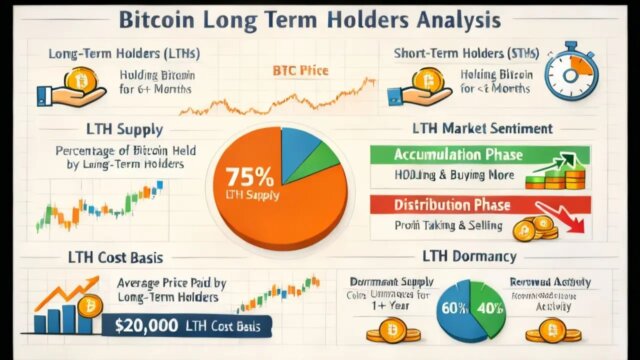
- Bitcoin long term holders are increasingly selling coins, indicating a significant market shift.
- This trend of heavy selling predates current higher prices and distinguishes this bull market from previous ones.
- Research from CryptoQuant shows a surge in the sale of very old coins (UTXOs untouched for two years or more) since 2024.
- The highest revived supply from long-term holders in Bitcoin’s history was noted in 2024-2025, comparable to the end of the 2017 bull market.
A Changing Chapter in Bitcoin’s Ownership Landscape
Bitcoin is entering a period where its most patient and historically committed investors are behaving in a way that breaks from tradition. Over the years, Bitcoin’s bull cycles often involved long-term holders — a segment of investors who typically accumulate and rarely sell — quietly sitting through market volatility until explosive tops. This time, the data suggests a different script. In recent years, a wave of older and previously inactive Bitcoin supply has returned to the market. Market analytics, on-chain research firms, and investor commentary all point to an evolving cycle where seasoned holders are selling more coins at a faster pace and at higher prices than in any previous bullish phase. For analysts, this emerging trend has become one of the most important on-chain signals heading into 2026, especially as Bitcoin’s performance relative to other major assets has cooled.
The Surge in Revived Coins: Historical Context
Over the past two years, aggregate data from blockchain analytics platforms has highlighted a dramatic increase in the movement of coins that had been dormant for multiple years. These revived coins — sometimes classified through the measurement of Unspent Transaction Outputs (UTXOs) — serve as a reliable proxy for long-term supply behavior. Before 2024, the most dramatic return of long-dormant supply occurred near Bitcoin’s euphoric end-of-cycle tops, such as the 2017 peak near $20,000. At that time, the revived supply was interpreted as long-term holders cashing out into intense demand. However, in 2024 and 2025, the return of old supply did not coincide with a typical vertical blow-off top. Instead, it unfolded gradually throughout a sustained bullish environment, creating a new distribution pattern that continues to fascinate analysts.
Long-Term Holders Sell More Than Ever Before
For much of Bitcoin’s history, long-term holders tended to accumulate during consolidation phases and distribute during peak euphoria. But on-chain research now shows that long-term holders have been selling heavier and earlier than in prior cycles, creating a unique supply profile not observed during previous bull markets. This trend began taking shape as early as late 2023 and accelerated throughout 2024 and 2025, setting several new records. According to aggregated on-chain models, the revived supply from holders aged two years or older reached levels that were previously unseen. Some analysts called it the most aggressive long-term holder distribution phase in Bitcoin’s historical data.
2026 Outlook: Is This Distribution Over or Just Paused?
Though revived supply peaked in 2024–2025, early 2026 analytics show that the trend has slowed, though it has not reversed entirely. On-chain analysts are currently split on whether the slowdown signals exhaustion or the early stages of a re-accumulation phase. Some suggest that long-term holders want to see how macro conditions and Bitcoin’s relative performance evolve before recommitting. Others argue that a bear phase has already begun forming beneath the surface as Bitcoin struggles to outperform other major assets.
Bitcoin’s Underperformance Raises New Questions for the Cycle
From Q4 2025 onward, Bitcoin began to lag relative to a basket of other risk assets. While analysts remain divided, many attribute this underperformance to a combination of:
- fatigue from previous cycle gains,
- reduced retail inflows,
- heightened competition from alternative assets,
- and unprecedented selling from long-term supply.
Market commentators warn that if this performance trend continues into 2026, Bitcoin may face a longer and more structurally challenging consolidation year compared to past cycles. Current price expectations vary widely, with some forecasting deeper retracements from the $90,000 region.
Cycle Theory Under Debate
For over a decade, Bitcoin traders relied on a quasi-predictable four-year cycle theory rooted in the halving event. But the structure of modern crypto markets, combined with new investor classes, ETF flows, regulatory shifts, and institutional frameworks, has called this model into question. Today, analysts debate whether:
- Bitcoin still follows a halving-driven rhythm,
- Bitcoin has entered a multi-asset macro framework,
- or Bitcoin has matured enough to behave independently of fixed supply narratives.
What makes the current cycle especially interesting is the behavior of the very investors who once reinforced the four-year cycle — the long-term holders themselves.
Bitcoin’s evolving market structure shows that not only price cycles, but also investor identity cycles are shaping its trajectory. Long-term holders, once the quiet backbone of each bull cycle, have become a headline story as revived supply breaks historical norms. Whether this trend represents exhaustion, strategic rebalancing, or a prelude to future accumulation remains an open question, but analysts widely agree that the behavior of this group offers one of the clearest windows into Bitcoin’s long-term evolution.
Disclaimer: CryptopianNews shares this for learning and info only. It’s not meant to be financial or investment advice. Crypto markets change a lot and move quickly. Investing in them can be risky. You should always look into things yourself. Talk to a trained financial advisor before making any choices about investing.

- Bitcoin Long Term Holders Analysis Breaking Old Patterns - January 22, 2026
- QCP Asia Market Outlook: Bonds, Bitcoin & Tariffs - January 21, 2026
- Inside the NYSE tokenized securities platform Launch - January 19, 2026