
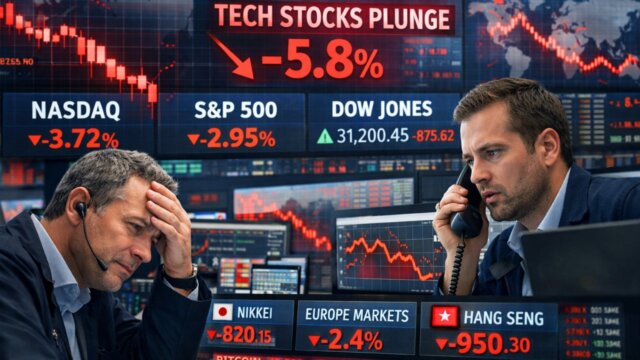
- Global markets are sensitive to investor sentiment, particularly with major technology stock declines.
- The Nasdaq Composite experienced a significant drop, contrasting with the more stable S&P 500 and Dow Jones Industrial Average.
- Currency trading indicated a shift towards safe-haven assets during market volatility, impacting emerging economies.
- The cryptocurrency sector, particularly Bitcoin, fell to its lowest level in sixteen months, reflecting macroeconomic influences on digital assets.
Main Market Report
Recent sessions have shown how sensitive global markets have become to shifts in investor sentiment, particularly when major technology stocks experience rapid declines. Traders in New York, London, Tokyo, and Hong Kong reported heavier-than-usual selling volumes as portfolio managers sought to reduce exposure to high-growth sectors and rebalance toward defensive assets.
One of the most visible reactions in global markets was the steep drop in the Nasdaq Composite, an index heavily weighted toward technology companies. Several large firms recorded significant losses, pulling the index lower and creating a stark contrast with the more stable performance of the S&P 500 and the Dow Jones Industrial Average. These broader indexes, which include a more diversified mix of industries, absorbed the shock more effectively and avoided similar levels of decline.
Currency trading also reflected the cautious mood. Investors often move toward safe-haven currencies during periods of volatility, and this pattern appeared again as demand rose for assets perceived as more stable. Analysts monitoring global markets noted that such movements can amplify the effects of stock market declines by tightening financial conditions in emerging economies, where currency stability is crucial for trade and investment.
The cryptocurrency sector mirrored the uncertainty seen in global markets, with Bitcoin falling to its lowest level in roughly sixteen months. Market strategists say this decline underscores how digital assets are increasingly influenced by macroeconomic factors rather than operating in isolation. When interest rates rise or liquidity tightens, speculative investments tend to face stronger selling pressure, and cryptocurrencies are no exception.
Energy stocks provided one of the few bright spots during the turbulent trading period. Higher oil prices supported earnings expectations for several major producers, attracting investors who were rotating out of technology and into sectors linked to physical commodities. This shift highlighted a broader trend in global markets, where capital is moving toward industries perceived as more resilient in an environment of inflation and higher borrowing costs.
Another key theme shaping investor behavior is the growing importance of economic data. Inflation figures, employment statistics, and manufacturing indicators are now driving daily market movements to a greater extent than corporate announcements alone. Traders say this reflects a transition from a liquidity-driven market to one guided more by fundamentals, where interest rate expectations play a decisive role in asset pricing.
Geopolitical developments have also contributed to the cautious atmosphere. Ongoing tensions in several regions, combined with concerns about trade restrictions and energy supply, continue to create uncertainty for multinational companies. These factors influence everything from shipping costs to currency stability, making it more difficult for businesses to plan long-term investments.
Despite the volatility, some analysts see opportunities emerging. Periods of market stress often lead to more reasonable valuations, allowing long-term investors to identify companies with strong balance sheets and sustainable growth prospects. While short-term traders may focus on daily price swings, pension funds and institutional investors typically take a longer view, using corrections as entry points rather than reasons to exit entirely.
Market participants are also paying closer attention to corporate guidance. Earnings calls and forward-looking statements now carry greater weight, as investors seek clarity on how companies plan to navigate higher costs and changing consumer demand. Firms that demonstrate adaptability and disciplined financial management are more likely to retain investor confidence, even in uncertain conditions.
Looking ahead, economists expect volatility to remain elevated in the near term. Central banks continue to signal that controlling inflation remains a priority, and this could mean maintaining tighter monetary policies for longer than previously anticipated. For traders and long-term investors alike, the message is clear: risk management and diversification are becoming essential tools in navigating an increasingly complex financial landscape.
Disclaimer: CryptopianNews shares this for learning and info only. It’s not meant to be financial or investment advice. Crypto markets change a lot and move quickly. Investing in them can be risky. You should always look into things yourself. Talk to a trained financial advisor before making any choices about investing.

- XRP Best Performing Cryptocurrency Beats Rivals in Volatile Times - February 20, 2026
- Why the CLARITY Act crypto Bill Is Stuck in 2026 - February 19, 2026
- What Is Post-Quantum Readiness on Ethereum and Why It Matters in 2026 - February 19, 2026