

- Bitcoin has followed similar post-halving patterns across multiple market cycles.
- Fear and doubt often appear near major highs, yet long-term trends have remained upward.
- Historical price action suggests investor psychology plays a major role in market movements.
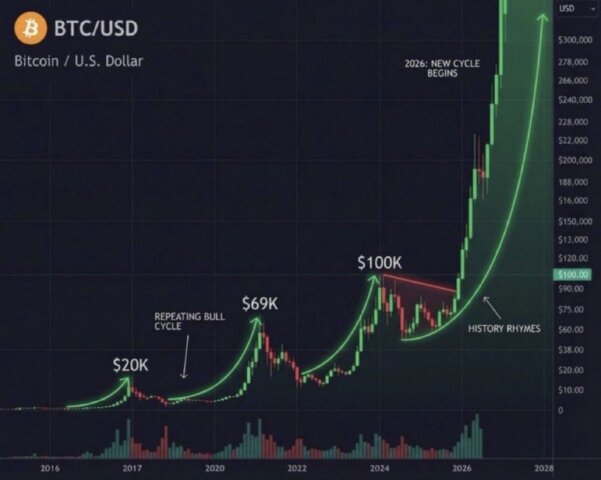
The cryptocurrency market is known for its volatility, but one thing continues to stand out: recurring patterns. Every few years, Bitcoin experiences a major rally, followed by corrections and widespread skepticism. Yet, despite the fear, the asset has consistently recovered and reached new highs over time. This repeating behavior has led many investors to closely study the bitcoin cycle and its impact on long-term price movements. When looking at previous market peaks, the similarities are difficult to ignore. In 2017, Bitcoin reached nearly $20,000 before many declared the rally finished. The same happened in 2021 after the $69,000 peak. More recently, after crossing the $100,000 mark, critics once again suggested the market had reached its limit. However, history suggests that strong trends often continue after periods of uncertainty.
Understanding the Bitcoin Cycle and Market Psychology
The bitcoin cycle is often linked to the network’s halving events, which reduce the supply of new coins entering circulation. As supply growth slows, demand can have a greater impact on price. Consequently, many investors view halvings as key catalysts for long-term bullish momentum. At the same time, human psychology plays a significant role. Markets are driven by emotions such as fear, greed, optimism, and doubt. Therefore, when prices fall sharply after reaching new highs, many investors assume the bull market is over. However, past cycles show that corrections are often a normal part of a larger upward trend. Another important factor is market maturity. While Bitcoin has grown significantly since its early years, investor behavior remains surprisingly consistent. As a result, similar patterns continue to appear across different market cycles.
Why Previous Cycles Continue to Matter
Historical data provides valuable insight into how Bitcoin has behaved over time. In 2017, the market experienced extreme enthusiasm followed by a deep correction. Likewise, the 2021 cycle saw strong gains before sentiment turned negative. Nevertheless, Bitcoin eventually stabilized and continued attracting long-term investors. Moreover, each cycle has introduced a larger audience to digital assets. Institutional participation, improved infrastructure, and broader adoption have strengthened the overall market. Consequently, many analysts believe future cycles could benefit from stronger fundamentals than previous ones. It is also important to recognize that no two cycles are identical. While history can offer guidance, external factors such as regulations, economic conditions, and investor sentiment can influence outcomes. Even so, recurring trends remain an important tool for understanding market behavior.
What Investors Can Learn by Zooming Out
One of the biggest lessons from Bitcoin’s history is the importance of maintaining a long-term perspective. Short-term volatility often creates fear, but broader trends frequently tell a different story. Therefore, investors who focus on larger time frames may avoid emotional decisions. Additionally, successful investors tend to recognize that market corrections are inevitable. Rather than viewing every dip as a sign of failure, they often see these periods as part of a normal market structure. This mindset has historically helped participants remain confident during uncertain conditions. As the market moves forward, many investors continue monitoring the bitcoin market cycles for clues about future price action. While no outcome is guaranteed, understanding historical patterns can help market participants make more informed decisions and avoid reacting to temporary market noise.
In conclusion, Bitcoin’s history shows a repeating pattern of fear, recovery, and growth. Although every cycle presents unique challenges, the combination of halving-driven supply dynamics and investor psychology has produced remarkably similar outcomes. By focusing on long-term trends instead of short-term emotions, investors can better understand where the market may be headed next.
Disclaimer: CryptopianNews shares this for learning and info only. It’s not meant to be financial or investment advice. Crypto markets change a lot and move quickly. Investing in them can be risky. You should always look into things yourself. Talk to a trained financial advisor before making any choices about investing.

- As Ripple expands its reach for the next wave of adoption, XRP Ledger makes headway into AI and privacy. - October 4, 2026
- What Is RWA Crypto? How Tokenized Real-World Assets Work in 2026 - October 1, 2026
- BlackRock Says AI Agents Could Bring New Demand to Crypto - September 25, 2026