

- MVRV Z-Score measures market overheating by comparing Bitcoin’s market value to its realized value, helping identify potential tops and bottoms.
- The Bitcoin market is showing signs of a healthy reset as unrealized profits continue to cool after the 2025 peak.
- On-chain data suggests current conditions remain far below the extreme valuation levels typically seen near major cycle tops.
- Institutional demand, ETF inflows, and long-term holder behavior are helping create a different market structure compared to previous cycles.
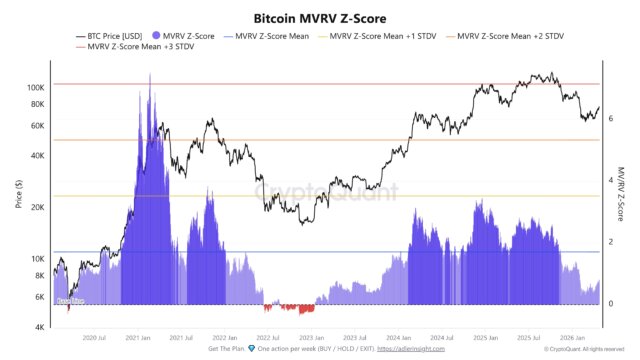
Bitcoin continues to navigate a period of consolidation following its strong rally earlier in the cycle. One of the most closely watched on-chain indicators, the MVRV Z-score, has steadily declined over recent months, reflecting a reduction in unrealized profits across the network. However, despite this pullback, Bitcoin’s valuation remains far from the overheated levels that have historically marked the final stages of bull markets. This shift is important because it highlights a market that is digesting gains rather than collapsing under excessive speculation. Moreover, the current correction appears to be resetting investor expectations while allowing the network to establish stronger foundations. As a result, many analysts view the ongoing consolidation as a normal part of the broader cycle rather than a sign of a long-term trend reversal.
MVRV Z-Score Shows Cooling Valuation Without Extreme Overheating
The MVRV Z-score has retraced significantly from its 2025 highs, signaling that unrealized profits are gradually being absorbed by the market. Historically, readings above +2 and especially above +3 have often coincided with periods of widespread euphoria and excessive speculation. Today, however, the indicator remains comfortably below those levels. This decline suggests that investors who accumulated Bitcoin at lower prices have been taking profits, while newer buyers are establishing positions at higher cost bases. Consequently, the market is undergoing a redistribution process that reduces excessive profit concentration across the network. At the same time, Bitcoin’s price remains relatively strong compared to previous correction phases. This combination of lower valuation readings and elevated prices indicates that the market is not experiencing panic selling. Instead, it reflects a controlled adjustment that allows market participants to rebalance positions while maintaining overall bullish structure.
Profit Absorption and Market Consolidation Support Cycle Continuation
Market corrections often play a vital role in sustaining long-term bull cycles. Without periods of consolidation, unrealized gains can accumulate rapidly and create conditions that become vulnerable to sharp reversals. Therefore, the recent cooling phase may actually strengthen Bitcoin’s broader market structure. During previous cycles, similar periods emerged when investors gradually realized profits while long-term holders continued accumulating. These phases typically reduced leverage, removed weak hands, and prepared the market for future growth. Furthermore, they helped create healthier demand conditions by allowing new capital to enter at more sustainable valuation levels.
Current on-chain metrics appear to support this interpretation. Rather than showing signs of widespread distribution, many indicators suggest that capital rotation is occurring within the market. Existing holders are taking profits, yet new participants continue absorbing available supply. As a result, selling pressure has not developed into the type of large-scale exit activity usually associated with cycle-ending events. Additionally, short-term volatility remains a normal part of Bitcoin’s behavior. While price swings can create uncertainty, they often serve an important purpose by removing speculative excess. Consequently, periodic corrections should not automatically be interpreted as evidence that the broader bull market has ended.
Structural Demand Is Changing Bitcoin’s Market Dynamics
One of the most important differences between the current cycle and previous ones is the emergence of new demand sources. Institutional participation has expanded significantly, creating a more diverse investor base than Bitcoin experienced in earlier market cycles. Spot Bitcoin ETFs have introduced a steady channel for capital inflows, allowing traditional investors to gain exposure through familiar financial products. Meanwhile, corporations, asset managers, and professional investment firms have increasingly incorporated Bitcoin into broader portfolio strategies. Because of this, a larger share of supply is now held by investors with longer investment horizons.
Long-term holder accumulation also continues to influence market dynamics. As more coins move into strong hands, available liquid supply becomes increasingly constrained. Therefore, valuation indicators may require more time to reach historical extremes because fewer market participants are actively trading based on short-term price movements. This evolving structure does not eliminate market cycles. However, it may alter the speed and intensity with which traditional on-chain metrics develop. For that reason, investors should interpret valuation signals within the context of Bitcoin’s changing ecosystem. Although historical patterns remain useful, the growing presence of institutional capital introduces new variables that can affect how cycles unfold.
Conclusion
Bitcoin’s recent correction has led to a notable decline in the MVRV Z-score, yet current readings remain well below the levels historically associated with major market tops. The data suggests that unrealized profits are being reset through a healthy consolidation process rather than through a widespread distribution event. Furthermore, Bitcoin continues to benefit from structural demand drivers such as ETF inflows, institutional adoption, and long-term holder accumulation. While short-term volatility may persist, on-chain indicators currently point toward profit absorption and cost-basis redistribution rather than cycle-ending exuberance. As a result, the market appears to be undergoing a constructive reset that could support future growth if demand conditions remain favorable.
Disclaimer: CryptopianNews shares this for learning and info only. It’s not meant to be financial or investment advice. Crypto markets change a lot and move quickly. Investing in them can be risky. You should always look into things yourself. Talk to a trained financial advisor before making any choices about investing.

- Bitcoin tightest session: Why Traders Are Watching $65K - July 20, 2026
- Can 5x Bitcoin Still Happen This Market Cycle? - July 18, 2026
- Capital Is Chasing AI: Why Bitcoin Is Waiting Its Turn - July 2, 2026