

Crowdlending is moving from an alternative finance option toward a more structural role in how businesses access capital. As traditional lenders tighten risk criteria and credit approval timelines lengthen, small and medium-sized enterprises (SMEs) are increasingly turning to private funding that can provide faster, more flexible working capital. At the same time, investors facing lower yields on deposits and higher volatility across speculative markets are showing renewed interest in investments tied to predictable business cash flows rather than asset price movements.
This convergence is gradually reshaping how private capital interacts with the real economy. Instead of flowing primarily through banks or public markets, capital is increasingly reaching operating companies through digital lending platforms that structure and distribute loans directly to investors. To understand why this shift is accelerating, it is necessary to look at the broader financing environment for European businesses and how crowdlending fits into the evolving lending landscape across the EU.
Crowdlending Moves Into Europe’s Financial Mainstream
Crowdlending in Europe has moved beyond its early high-growth phase and is now operating as a more mature segment of alternative finance. According to Mordor Intelligence, the regional crowd investing and lending market is no longer defined by exponential expansion but by consolidation and institutionalization of platforms and investor participation.
Debt-based crowdlending accounted for almost 20% of the overall market in 2025, underscoring the growing preference for financing models tied to predictable interest income rather than equity-style risk. Demand is largely driven by the real economy: SMEs and real-estate special-purpose vehicles together captured 43% of total market share, showing that platform financing is increasingly serving operating businesses and asset-backed projects rather than purely digital ventures.
In Europe’s evolving crowdlending landscape, a new generation of crowdlending solutions emerges and moves beyond simple investment marketplaces toward structured financing infrastructure. Maclear, a swiss-based platform, is one of the few players enabling efficient connections between private investors and SMEs, while keeping the platform open and accessible to a broad investor base. Maclear manages the full financing cycle, from borrower origination and credit assessment to loan structuring, proprietary scoring, and repayment monitoring. By combining credit analysis, servicing, and liquidity management within one operational framework, it functions as a controlled private debt environment rather than merely a marketplace for loan listings.
This institutionalization of crowdlending reflects broader structural shifts in both lending and investment behavior. As fintech capabilities mature and investor expectations evolve, private capital is redirected toward structured, asset-backed opportunities. Three key forces, in particular, are accelerating this transition and redefining how businesses across Europe access financing.
Force #1. Bank Lending Tightens as SME Financing Needs Grow
SMEs remain structurally underfinanced across Europe, yet their need for external funding continues to rise. Working capital pressures, investment needs, and slower payment cycles are pushing many companies to seek financing even as borrowing conditions become more restrictive.
In Q4 2025, banks reported an unexpected net tightening of credit standards for corporate loans, with a net 7% of banks tightening lending conditions. The shift was primarily driven by weaker economic outlook expectations and declining internal risk tolerance, signalling elevated caution across the banking sector. Banks expect conditions to tighten further in Q1 2026.
What makes the situation more notable is that loan demand continues to grow despite these worsening conditions. Firms’ demand for loans rose slightly in late 2025, with a net increase of 3%, broadly in line with the previous quarter. Moderating interest rate pressure provided limited support, but overall financing needs continue to outweigh deteriorating credit access. Banks expect demand to increase further in early 2026. However, greater demand is not translating into broader access. Banks also reported a rising share of rejected loan applications across large firms and SMEs alike, indicating that more companies are seeking financing but fewer are successfully obtaining it.
For many SMEs, this creates a financing gap where timing becomes critical. Extended approval timelines, higher collateral requirements, and stricter credit scoring make bank financing slower and less predictable. This gap increasingly opens space for alternative financing channels capable of providing capital with greater speed and flexibility, which is primarily offered by crowdlending platforms.
Force #2. Investor Capital Shifts Toward Private Lending
Investor capital is increasingly moving away from traditional financial instruments toward private lending strategies that offer clearer links between returns and underlying economic activity. Persistently low real yields on deposits, volatility across public markets, and tighter bank intermediation have encouraged investors to seek income streams tied to contractual repayments rather than asset price appreciation.
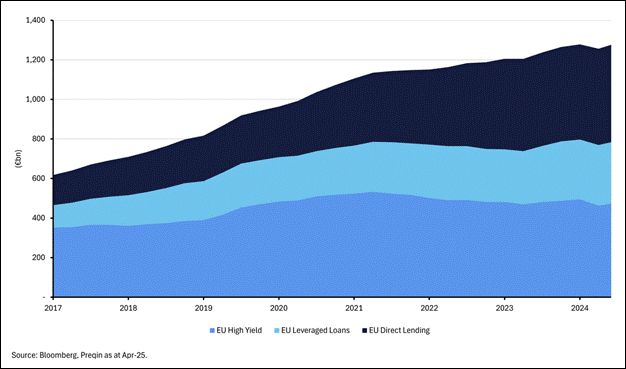
Private credit markets have become a primary beneficiary of this shift. Direct lending now represents roughly half of global private debt assets under management in the EU. Notably, its share has been steadily growing over the previous decades, representing a gradual shift toward private investment.
Source: AIMA
Europe has emerged as a growing centre for this capital reallocation. By 2025, the European private debt market was expected to reach an estimated €400 billion, expanding steadily as SMEs and mid-sized companies seek alternatives to constrained bank lending. At the same time, large pools of unallocated capital remain available: private equity sponsors hold roughly €435 billion in dry powder, while European private debt funds maintain around €90 billion ready for deployment.
This abundance of capital is beginning to reshape credit markets, with private lenders increasingly competing with syndicated bank debt to finance companies. As public and private credit markets converge, financing channels outside the banking system are becoming more structurally embedded. Crowdlending platforms represent the retail and digital extension of this same trend, opening private lending opportunities to a broader investor base and enabling capital to reach operating businesses more directly.
Force #3. Regulatory Clarity Fuels Growth in Private Lending
What was once a fragmented landscape of national rules is increasingly being replaced by harmonised EU-wide standards, reducing uncertainty for platforms, investors, and borrowers alike. For instance, one key step came in May 2025, when the European Securities and Markets Authority (ESMA) updated technical standards under the European Crowdfunding Service Providers Regulation (ECSPR) after more than a year of practical implementation. The revisions strengthened borrower disclosure requirements, improved cross-border supervisory coordination, and simplified authorization procedures for platforms operating across the EU. For investors, the result is clearer risk information and stronger oversight, while for platforms, it reduces regulatory friction when expanding beyond domestic markets.
Regulation is also enabling technological innovation within lending infrastructure. In September 2025, the second phase of the Markets in Crypto-Assets (MiCA) framework entered into force across the EU, providing legal certainty for financial platforms experimenting with blockchain-based settlement mechanisms. Crowdlending operators can now deploy tokenized loan instruments, use regulated stablecoins for cross-border payments, and serve investors under a single European rulebook rather than navigating 27 separate regimes.
Capital Finds New Routes to the Real Economy
Tighter bank lending standards, rising investor demand for predictable income, and clearer EU-wide regulation together accelerate the shift toward private credit and crowdlending. SMEs increasingly struggle to secure timely bank financing, while investors seek returns linked to real business performance rather than market volatility.
Crowdlending platforms sit at the intersection of these trends, enabling private capital to flow directly into operating companies through structured, transparent lending models. As regulation matures and market participants gain experience, private lending is evolving from a niche alternative into a complementary financing channel for the real economy.
Read Also: DeFi’s Shift From Yield to Cash Flow
Disclaimer!! CryptopianNews provides this information for educational and informational purposes only. You should not consider it financial or investment advice. Cryptocurrency markets are highly volatile and speculative, and they carry inherent risks. We advise readers to conduct their own research and to consult with a qualified financial advisor before making any investment decisions.

- As Bank Lending Tightens, Crowdlending Steps In - February 19, 2026
- Mystery IBIT Buyer Revealed: Who Is the Hong Kong Firm That Purchased $436M in BlackRock Bitcoin ETF - February 18, 2026
- Trump-Backed Crypto Forex Platform Targets $9.6 Trillion Market with World Swap - February 12, 2026