
Important Points
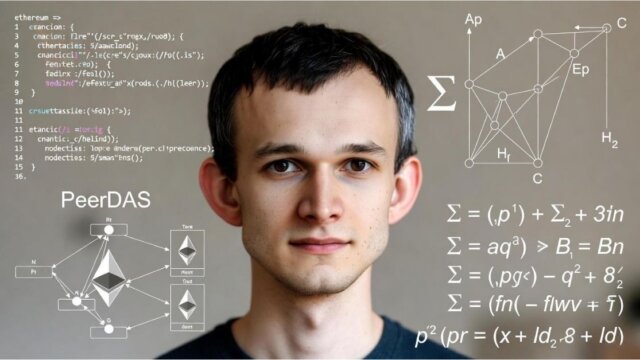
- PeerDAS radically changes data handling by enabling nodes to verify availability without downloading complete blocks.
- Zero-Knowledge Proofs (ZK-EVMs) shift validation from full re-execution to cryptographic verification, reducing computation.
- The Fusaka Upgrade on Ethereum’s mainnet introduced PeerDAS to boost data throughput.
- This roadmap alleviates scaling bottlenecks while preserving decentralization and security.
- ethereum layer 2 vs base layer scaling remains an essential consideration in achieving optimal performance.
What Is PeerDAS and Why It Matters
Understanding the Data-Availability Bottleneck
Ethereum’s scaling limitations historically stem from the requirement that every node must download and verify every block’s data. This model ensures security and decentralization but constrains throughput. PeerDAS—short for Peer Data Availability Sampling—addresses this by letting nodes confirm that data exists without ingesting the entire dataset.
In practice, PeerDAS divides data into multiple “blob” columns and uses statistical sampling to distribute responsibility for pieces of that data among validators. Instead of every node storing all data, nodes sample random subsets. When enough samples confirm that data is distributed across the network, availability is assured.
This sampling approach dramatically reduces bandwidth demands while preserving key decentralized security properties. The Fusaka upgrade, which deployed PeerDAS on Ethereum mainnet in December 2025, marked a turning point in how the network processes large volumes of data.
Technical Mechanisms Behind PeerDAS
PeerDAS uses Reed-Solomon erasure coding, a redundancy technique that splits a data blob into many pieces, ensuring the entire blob can be reconstructed even if some pieces are missing. Validators fetch only a fraction of the columns, and the mathematical properties of erasure codes guarantee that the original data can be recovered if the pieces exist somewhere in the network.
This method ensures that network nodes are not burdened with storing all data, thereby lowering hardware requirements without compromising security. By reducing data redundancy on individual nodes, Ethereum can support higher “blob” capacity and thus more transactions or layer-2 data commitments.
Zero-Knowledge Proofs: Verifying Without Re-Executing
How Zero-Knowledge Proofs Help Scaling
Zero-Knowledge Proofs (ZKPs) are a family of cryptographic techniques that allow one party to prove to another that a statement is true without revealing underlying data. In Ethereum’s context, zero knowledge proofs ethereum scaling comes into play through ZK-EVMs (Zero-Knowledge Ethereum Virtual Machines).
Typically, validators process every transaction and re-execute all smart contract code to verify state transitions. ZK-EVMs change this dynamic. Instead of re-execution, a cryptographic proof is generated off-chain, verifying that the execution was correct. The proof is then posted on chain and checked by validators, vastly reducing computational load.
Recent implementations of zero knowledge proofs ethereum scaling show that proof generation times have dropped dramatically and costs have fallen significantly, making ZK-EVMs viable for production-grade scaling solutions.
Interaction with PeerDAS
While PeerDAS reduces data availability constraints, ZK-EVMs reduce computational validation costs. Together, they address the two major bottlenecks of blockchain throughput: data distribution and transaction verification. This synergy is central to Ethereum’s scaling roadmap, enabling higher throughput without sacrificing decentralization or security.
ethereum layer 2 vs base layer scaling: The Strategic Divide
Layer-2 Scaling Solutions
Layer-2 (L2) networks process transactions off the main Ethereum chain and rely on the base layer for final settlement and data availability. Rollups are the most prominent L2 solution and come in two main forms: Optimistic Rollups and ZK Rollups. Both types compress many transactions and only post summaries to the base layer, reducing congestion and gas costs. PeerDAS directly benefits these systems by increasing available data capacity per block, making rollups more efficient.
Base Layer (Layer-1) Enhancements
Base layer scaling focuses on improving the fundamental protocol rather than off-chain or side-chain solutions. PeerDAS is a base layer innovation that directly influences how mainnet validators handle data. In contrast to approaches that merely push computation and data off the chain, PeerDAS increases the base layer’s efficiency, enabling it to support a higher volume of commitments from layer-2 networks.
The combination of base layer improvements and layer-2 integrations exemplifies an approach where Ethereum does not seek to become a high-throughput transactional system by itself. Instead, it offers a robust base for layer-2 ecosystems while enhancing that base for broader participation.
How the Roadmap Affects Users and Developers
For Validators
Validators benefit from reduced storage and bandwidth requirements enabled by PeerDAS. This allows more individuals to operate validator nodes without needing expensive infrastructure, reinforcing decentralization.
For Developers
Developers building decentralized applications (dApps) and layer-2 solutions can expect lower data fees and increased scalability potential as the underlying protocol supports more commitments per block. ZK-EVMs also allow developers to explore new smart contract designs with efficient verification, boosting performance for complex applications.
For End Users
End users stand to benefit from lower fees and faster settlement times as rollups and other layer-2 solutions leverage the enhanced base layer capabilities. PeerDAS’s data efficiency and ZK-EVM’s cryptographic validation combine to support smoother experiences even during peak usage.
Concluding Observations
Vitalik Buterin’s Ethereum scaling roadmap, anchored by PeerDAS and zero-knowledge proofs, marks a fundamental evolution in how the network approaches throughput, decentralization, and security. By focusing on bandwidth and cryptographic verification rather than purely latency or traditional node replication, Ethereum aims to support an ecosystem capable of growth without centralizing power or sacrificing integrity.
This strategic blend of base layer upgrades and layer-2 integrations positions Ethereum to meet future demands while retaining its core values of open access, decentralization, and robust security.
Read Also: Ethereum Price Prediction 2026: Will Vitalik’s ZK-EVM Upgrade Push ETH to $3,600?
Disclaimer!!The information provided by CryptopianNews is for educational and informational purposes only. It should not be considered financial or investment advice. Cryptocurrency markets are highly volatile and speculative, and investing in them carries inherent risks. Readers are advised to conduct their own research and consult with a qualified financial advisor before making any investment decisions.

- Gate.io Gets Malta PSD2 License: What It Means for EU Crypto Users - February 27, 2026
- Inside the $61M Tether DOJ Investigation Recovery Case - February 26, 2026
- Why Crypto Market Is Falling Today – Short-Term Dip or Long Fall? - February 24, 2026