
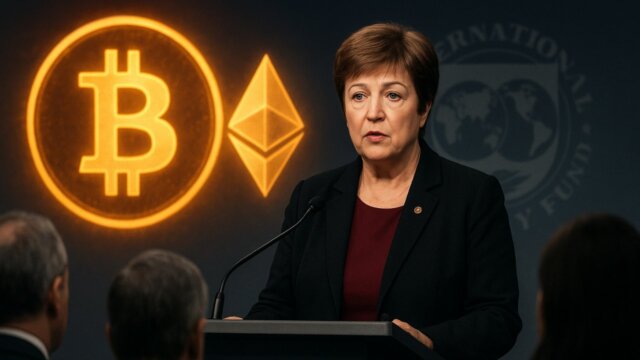
- IMF Chief Georgieva, a traditional multilateral lender, has expressed a more receptive stance towards cryptocurrencies and digital money.
- She urged nations to adapt and manage the risks associated with the transformation, not resist it.
- The IMF report issued sobering advice to monetary authorities worldwide, warning against inflation pressures, duty pressures, and the need for clear regulatory guardrails.
IMF Managing Director Kristalina Georgieva has voiced a more receptive stance toward cryptocurrencies and digital money, urging nations to stop resisting the transformation and instead prepare to manage its risks. Her comments come alongside a sweeping IMF report that not only urges central banks to guard against inflation pressures, but warns of the deepening interconnectedness between regulated banks and unregulated financial firms—including crypto platforms and private credit institutions. This shift in rhetoric signals a more nuanced posture: acknowledging the forces reshaping money and finance, while pressing for vigilance, regulation, and structural reforms. Below is a deep dive into what Georgieva said, what the IMF report reveals, and why this matters for global financial stability.
A New Tone on Crypto: “Don’t Resist What’s Coming”
In recent public remarks, Georgieva expressed optimism about the evolving digital money landscape. She observed that cryptocurrencies are reshaping how people and markets transact, and urged governments to accept that change rather than fighting it. Her key message: resisting this transformation is not viable; instead, financial authorities must adapt and manage the accompanying risks. Georgieva cautioned that central banks and regulators should not bury their heads in the sand. She emphasized the need for clear regulatory guardrails, and stressed that policy should not aim to stifle innovation—but rather to integrate new technologies into a resilient financial architecture. This perspective marks a tempering of earlier caution. In past remarks, Georgieva and other IMF officials had repeatedly flagged the risks of crypto adoption—its volatility, challenges to monetary transmission, and potential for illicit flows. But now, the tone is evolving: the change is already underway, and we must learn to live with it.
Inflation Risks, Duty Pressures & Monetary Policy: The IMF’s Warning to Central Banks
The latest IMF report issues sobering advice to monetary authorities worldwide. Its main cautions include:
- Watch inflation pressures stemming from trade barriers and tariffs. The IMF flags how customs duties may contribute to price pressures globally.
- Avoid over-relaxing monetary policy. The report argues that too much easing—especially in already overheated markets—can inflate risky asset valuations further.
- Respect central bank independence. The Fund underscores that central bank credibility is vital to anchoring expectations and maintaining a stable macroeconomic environment.
Importantly, the report does not single out any specific central bank or country; its warnings are broad and applicable to all economies facing post-pandemic and geopolitically uncertain times. One recent Reuters coverage captures this warning succinctly: the IMF cautions that erosion of trust in central banks—for instance under political interference—can raise inflation expectations and unravel macro stability. In essence, the IMF is reasserting a long-held orthodoxy: credible, independent monetary policy is a bulwark against economic fragility.
Hidden Risks: Nonbank Linkages, Shadow Finance, and Crypto Spillovers
Possibly the most noteworthy element of the IMF’s report is its warning about dangerous, underappreciated links between banks and unregulated financial entities—which include nonbank financial institutions (NBFIs), private credit platforms, hedge funds, and crypto firms. The IMF cautions that these webs of interconnection amplify the risk that a shock in one domain—say, a crypto meltdown or credit squeeze—could cascade into the regulated banking sector. Such contagion could exacerbate stress, especially if it’s sudden and unanticipated.
- Many banks hold or are exposed to counterparty credit, derivatives, or credit lines tied to nonbank entities. Losses or defaults in nonbank sectors can ricochet into traditional banks.
- The growth of private credit funds and alternative lenders—which often escape strict regulatory oversight—risks building hidden vulnerabilities. The IMF notes that exposure to such firms is rising.
- The crypto arena represents a frontier of risk: stablecoins, algorithmic protocols, lending protocols, and cross-platform dependencies may transmit losses across seemingly distant domains.
In its global stability outlook, the IMF emphasizes that regulators must gear up for “risk propagation” across sectors, and not view each domain in isolation. By exposing these hidden connections, the IMF is sounding the alarm: what seems contained may not be, and future crises may emerge in the blind spots.
The recent statements by IMF Managing Director Kristalina Georgieva, alongside the Fund’s latest report, mark a turning point: cryptocurrencies and fintech are no longer fringe topics—they are now central to macroprudential planning. Georgieva’s insistence that countries accept change rather than deny it, paired with the IMF’s robust warnings to central banks and regulators, signals that the global financial community is entering a new regime. The question is no longer “if” digital money matters—it’s how to build a framework that harnesses innovation while guarding stability. For policymakers, the path ahead is demanding: maintain central bank independence, build fiscal buffers, map hidden financial ties, and regulate the edge where banks and nonbanks intersect. The risks are real—but so is the opportunity to shape a more resilient, smarter financial future. Let’s see which nations take heed—and whether the next crisis is prevented or merely postponed.
Disclaimer: CryptopianNews shares this for learning and info only. It’s not meant to be financial or investment advice. Crypto markets change a lot and move quickly. Investing in them can be risky. You should always look into things yourself. Talk to a trained financial advisor before making any choices about investing.

- Fed Balance Sheet Reduction Shakes Global Markets - January 30, 2026
- Inside the White House Crypto Meeting on Digital Assets - January 28, 2026
- Wall Street Warns: US Crypto Policy Clouds the Market - January 26, 2026