
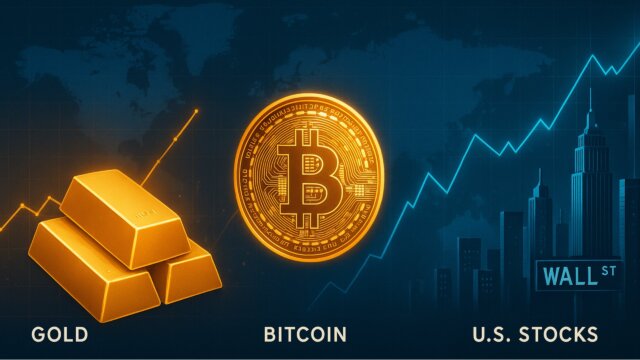
- Gold has seen a significant increase in 2025, jumping over 60%, surpassing almost every major index.
- Bitcoin has held its own with a year-to-date gain of around 15.58%.
- The NASDAQ’s growth is largely due to growth in AI, semiconductors, and software sectors, which attract investment despite macro uncertainty.
- The S&P 500’s gain is largely due to broader economic resilience, with low unemployment rates, decent corporate earnings, and interest-rate cuts supporting valuations.
As we move into the final months of 2025, the markets are offering a clear set of lessons for investors who have been paying attention. Volatility has been the name of the game this year, yet despite the ups and downs, some asset classes have powered ahead — with surprising results. By comparing major assets side by side — gold, cryptocurrency (namely bitcoin), and U.S. stocks — we gain fresh insight into where money has flowed, why, and what that means for your portfolio. The latest performance snapshot shows this:
- Gold (XAU/USD) is up about 62% since January.
- The NASDAQ is up around 18.34%.
- Bitcoin (BTC/USD) is up approximately 15.58%.
- The S&P 500 (SPX) has climbed roughly 13.30%.
Yes — all four major assets have posted gains this year. But the size of those gains tells a deeper story: it’s about macro-risk, monetary policy, and the indispensable role of diversification.
Gold: The Comeback of the Classic Safe Haven
Gold has clearly been the standout performer of 2025. The metal has jumped more than 60% — beating almost every major index. What’s driving this surge? Several factors converge:
- Central banks around the world have cut interest rates (or at least signalled easing) and taken on more risk, reducing the opportunity cost of holding non-yielding assets like gold.
- Global tensions and inflation remain elevated, prompting investors to seek shelter.
- Many large institutional investors (including sovereign funds and central banks) have increased gold allocations, worried about currency stability and long-term debt risk.
On the price charts, gold’s behaviour is noteworthy: its trajectory has been smooth and resilient, barely dipping even when other markets show turbulence. That steadiness underscores gold’s role as a hedge against systemic risk and weak currency environments.
Why gold’s timing is unusual
We often think of gold spiking in times of crisis; 2025 has provided a textbook case. For example, major banks are raising their gold price forecasts given the backdrop. In fact, one analyst described gold’s rally as the strongest since 1979. From an investor’s perspective, this rally underscores an age-old truth: when uncertainty is high and trust in fiat or credit is shaky, gold becomes the go-to asset. And 2025 has been one of those years.
What this means going forward
If inflation stays sticky, interest rates don’t plunge, and geopolitical risk persists, gold could maintain its leadership. But that does not mean it’s free of risks: slower global growth may reduce industrial demand for metals, and if confidence returns to other assets, gold could lose some shine.
Bitcoin: The Digital Hedge That Still Swings
Turning to digital assets, let’s look at bitcoin. With a year-to-date gain of around 15.58%, bitcoin has held its own — but it did not dominate like gold. Here’s what to observe:
- Bitcoin’s price chart more closely resembles that of the NASDAQ than a pure hedge asset. That’s telling: institutions increasingly treat bitcoin as a technology or speculative asset, not purely a safe haven.
- Despite volatility, every market dip this year has prompted renewed accumulation — especially among long-term holders and corporate treasuries.
- From a fundamentals point of view, bitcoin remains compelling: limited supply, increasing scarcity, growing usage and adoption.
- But it remains sensitive to interest rate shifts, liquidity conditions, regulatory news and investor sentiment. For example, a recent article flagged a retracement back toward $100,000 amid trade tension and risk-asset outflows.
Why bitcoin is playing a different role in 2025
The narrative around bitcoin is shifting. It’s no longer just “digital gold” in the purest sense; instead, it’s becoming part of the broader risk-asset universe. The academic research indicates that the correlation between bitcoin and major equity indices has increased substantially. This means: while bitcoin has upside, it also means it can be pulled down with equities when risk appetite fades.
The upside & the risks
If monetary easing picks up, inflation surprises to the upside, or institutional adoption accelerates, bitcoin could out-perform. But if interest rates remain high or the liquidity environment tightens, bitcoin might struggle. Also, regulatory changes (positive or negative) will likely move the needle.
NASDAQ and S&P 500
While gold and bitcoin draw the headlines, don’t overlook the performance of U.S. stocks. The NASDAQ is up ~18.34% this year, and the S&P 500 ~13.30%.
What’s powering the equity gains?
- The NASDAQ’s gain has largely been driven by strong growth in AI, semiconductors, and software. These sectors continue to attract investment even amidst macro uncertainty.
- The S&P 500’s gain reflects broader economic resilience: unemployment rates relatively low, corporate earnings staying decent, and interest-rate cuts (or hints thereof) supporting valuations.
What’s the caveat?
The ride hasn’t been smooth. Mid-year trade tensions, inflation spikes, and fears of recession caused sharp swings. Investors had to navigate turbulence to capture the gains. And while stocks have performed reasonably, they haven’t matched the explosive returns of gold this year.
Why stocks still matter
For many investors, equities remain the growth engine of a portfolio. When the economy is stable and growth expectations are favourable, stocks tend to lead. In 2025, that’s held true — even if they didn’t steal the show.
The 2025 Lesson: Diversify—or Risk Losing
If there’s one clear takeaway from 2025 so far, it’s this: no single asset class wins in every environment.
- Gold wins when fear spreads, inflation sticks, or currency concerns mount.
- Bitcoin wins when liquidity flows, innovation narratives expand, and investor adoption grows.
- Stocks win when the economy is strong, earnings are solid, and interest rates fall.
Putting all your eggs in one basket—say, only stocks or only crypto—means you miss out when the regime shifts. A portfolio balanced across these asset types reduces risk while preserving upside. Consider a hypothetical: 40% stocks, 30% gold, 20% bitcoin, 10% cash or bonds. Such a mix might not produce the absolute highest return (for example, pure gold would have beaten it in 2025) but it offers resilience and diversification—key ingredients in a volatile year.
Looking Ahead
Heading into 2026, investors face both opportunity and danger. The macro environment remains dynamic: interest rates, election cycles, debt loads, geopolitical flashpoints—all will shape returns.
Scenarios to watch
- If inflation remains high or returns again, gold could continue to shine, especially if global debt levels and currency concerns mount.
- If global liquidity improves, central banks ease, and institutions further embrace digital assets, bitcoin might regain strong momentum.
- If credit becomes easier and companies deliver strong earnings, stocks could lead again — especially growth segments like AI, tech and clean energy.
In 2025, the investment race has delivered a standout winner in gold, with solid performances from stocks, and respectable returns from bitcoin — each for different reasons. The broader lesson is clear: diversification matters more than ever. Whether you hold gold as a hedge, bitcoin as a growth-oriented digital asset, or stocks for capital appreciation, balancing across these asset classes is key to navigating uncertain markets. As the year draws close and we gear up for 2026, making thoughtful allocations — not reliant on a single asset class — will empower investors to manage risk while capturing opportunity.
Disclaimer: CryptopianNews shares this for learning and info only. It’s not meant to be financial or investment advice. Crypto markets change a lot and move quickly. Investing in them can be risky. You should always look into things yourself. Talk to a trained financial advisor before making any choices about investing.

- What Is DeSoc Crypto & Why Vitalik Cares - January 28, 2026
- Why Long-Term Bitcoin Holders Are Not Selling Yet - January 26, 2026
- U.S. Cryptocurrency Oversight Faces a Major Senate Shift - January 25, 2026