
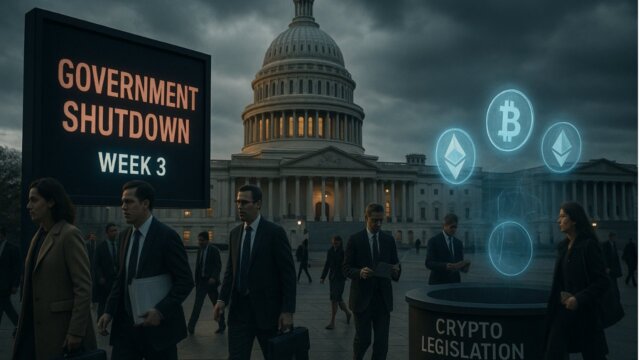
- The U.S. government shutdown has entered its third week, with lawmakers focusing on reopening operations and addressing a long-delayed crypto market-structure bill.
- The shutdown is the third-longest in U.S. history, with federal operations suspended or drastically scaled back since October 1.
- The Senate will hold a crucial vote on Monday to break the impasse, allowing federal employees to return to work if the bill passes and the President signs.
The federal government of the United States has now entered its third week of a shutdown, while lawmakers juggle two urgent priorities: reopening operations and tackling a long-delayed crypto market-structure bill. On Monday evening, the United States Senate will make the eleventh attempt in as many days to pass a funding measure. Meanwhile, on Wednesday, Senate Democrats will convene a roundtable with crypto industry leaders to discuss the stalled digital-assets legislation.
Shutdown stalemate intensifies
Since October 1, federal operations have been suspended—or drastically scaled back—after negotiations between congressional Democrats and Republicans failed to secure sufficient funds for government departments. The current shutdown now qualifies as the third-longest in U.S. history, behind only the episodes in 1995 and 2018-19. The urgency for a resolution is mounting. According to sources, the Senate will hold a crucial vote at 5:30 p.m. ET on Monday in hopes of breaking the impasse. If the bill passes and the President signs, federal employees—including those currently furloughed—could return to work. If not, the shutdown will stretch onward, threatening greater disruption across government services. Despite the shutdown’s severe impact on federal staffing and operations, legislators are still pressing ahead with other business, notably in the realm of cryptocurrency regulation. The latter is drawing attention amid the lull in government funding.
Industry meets lawmakers
In a striking demonstration of how digital-asset policy has become embedded in federal decision-making, Senate Democrats are organizing a high-level meeting this coming Wednesday with major crypto firms. The agenda: the long-stalled U.S. market-structure bill for digital assets. The session will be led by Senator Kirsten Gillibrand and is expected to include chief executives and top representatives from firms such as Coinbase Global, Kraken, Circle, Ripple Labs and others. They will voice concerns, share industry data and attempt to influence the shape of legislation they say could define the U.S. crypto ecosystem for years. Crucially, the meeting comes after several Democratic senators introduced a rival proposal to the bill, one which critics argue could undermine decentralized finance (DeFi) and erode bipartisan support for the earlier passed House version, the CLARITY Act. The Senate’s eventual legislation is meant to serve as the counterpart to the CLARITY Act, aiming to impose clear federal rules for digital assets—an area long flagged for regulatory ambiguity.
The market-structure bill
The crypto industry is watching this development with sharp interest. At stake is clarity around how the U.S. treats digital‐asset platforms, tokens and DeFi protocols—and which regulator has oversight: the U.S. Securities and Exchange Commission (SEC), the Commodity Futures Trading Commission (CFTC), or both. Some of the key points of contention:
- The Democratic‐draft version reportedly treats many DeFi protocols as “brokers,” potentially subjecting them to registration and heavy compliance burdens. The industry says that approach would “kill DeFi.”
- Republicans are pushing for a division of oversight between the SEC and CFTC, and for defining “ancillary assets” that fall outside traditional securities laws.
- Without a compromise, observers say the legislation may slip into 2026, delaying regulatory certainty for many companies.
For the industry, regulatory clarity is no longer optional—it’s critical. Firms are planning product launches, filings and investments that depend on how U.S. law treats digital assets. A misstep—or further delay—may hamper growth, innovation or even result in relocation of business overseas.
Shutdown’s ripple effects on crypto ETF approvals
Beyond regulation, the government shutdown is having a tangible impact on crypto-related financial products: namely, exchange-traded funds (ETFs). What had been expected as a pivotal October for U.S. crypto ETFs has instead been bogged down by limited staff at the SEC and other regulatory delays. Here are some of the specifics:
- One of the earliest missed deadlines was for Canary Capital’s proposed Litecoin ETF (Litecoin being the cryptocurrency “LTC”) on October 2. The shutdown induced staffing shortages at the SEC, delaying the review process.
- On October 7, Bloomberg analyst Eric Balchunas told reporters that both the Litecoin ETF and Canary’s HBAR (Hedera Hashgraph) ETF appeared ready—yet likely postponed due to the shutdown.
- Industry reports estimate up to 16 crypto ETFs were slated for October launches, including funds tied to Solana, XRP, Dogecoin and Litecoin.
- A further 21 ETF applications were reportedly filed in early October, many with staking features in the case of Solana and Ethereum.
- Major issuers such as Bitwise Asset Management, Fidelity Investments, Franklin Templeton, CoinShares, Grayscale Investments, Canary Capital and VanEck have updated their S-1 filings with the SEC—including changes referencing staking mechanics.
In short: the shutdown is not just a political impasse—it is materially delaying product launches in the crypto ecosystem, reducing investor access, and creating uncertainty in an industry that already operates on thin margins of regulatory confidence.
The confluence of a prolonged federal shutdown and stalled crypto-regulation talks has placed Washington at a crossroads. With the Senate’s funding vote looming Monday evening and a high-stakes crypto roundtable scheduled for Wednesday, the coming days could mark a turning point for both federal operations and the future of digital-asset policy. Whether Congress can break its inertia—and whether the industry can get the clarity it needs—remains to be seen. What is clear: the cost of delay is mounting, not just for government, but for innovation, investment and the global competitive position of the U.S. in the digital-assets era.
Disclaimer: CryptopianNews shares this for learning and info only. It’s not meant to be financial or investment advice. Crypto markets change a lot and move quickly. Investing in them can be risky. You should always look into things yourself. Talk to a trained financial advisor before making any choices about investing.

- Fed Balance Sheet Reduction Shakes Global Markets - January 30, 2026
- Inside the White House Crypto Meeting on Digital Assets - January 28, 2026
- Wall Street Warns: US Crypto Policy Clouds the Market - January 26, 2026