
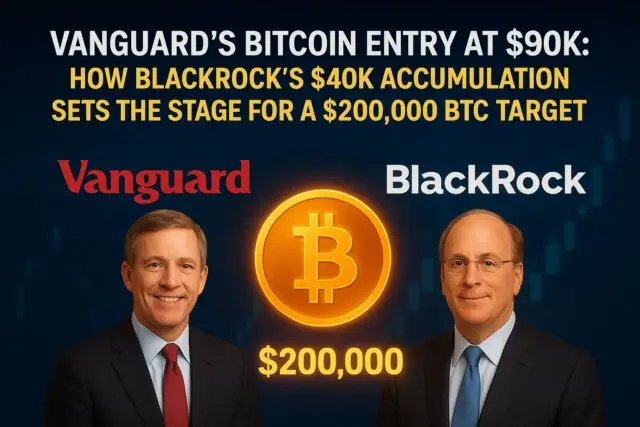
For more than a decade, analysts have argued that Bitcoin’s ultimate growth would come when the biggest institutions on the planet finally entered the market. That moment is happening now — and the timeline explains exactly why Bitcoin’s next realistic long-term target may be above $200,000.
BlackRock — the world’s largest asset manager — began accumulating Bitcoin through its iShares Bitcoin Trust (IBIT) when spot ETFs launched in early 2024. At that time, Bitcoin traded in the $40k–$45k range, marking BlackRock’s effective entry window. This institutional demand helped push Bitcoin into a powerful multi-year rally, eventually reaching an all-time high near $126,000.
Now, Vanguard — historically one of the most conservative investment firms — has allowed its clients to buy and sell Bitcoin ETFs directly on its brokerage platform, with BTC trading around $90,000 at the time. This move has unlocked a new wave of demand from retirement accounts, long-term investors, and conservative capital that previously had no easy access to Bitcoin.
Combined, these two institutional forces are reshaping the market — tightening supply, increasing mechanical demand, and accelerating Bitcoin’s transformation into a mainstream, professionally managed asset class.
Below is the full breakdown of how these developments create a realistic path to a $200K Bitcoin.
BlackRock’s Entry Near $40K: The Foundation of the ETF Era
When spot Bitcoin ETFs launched in January 2024, IBIT, BlackRock’s ETF, immediately became one of the fastest-growing ETFs in history. At that time, Bitcoin’s price sat around $40,000–$45,000, forming the rough entry zone where BlackRock began accumulating its early holdings.
This timing matters for several reasons:
1. BlackRock forced real BTC buying at scale
ETF inflows require the fund to purchase physical Bitcoin. As billions poured into IBIT, BlackRock bought large quantities of BTC regardless of price movement. This created mechanical, emotion-free demand.
2. ETF buying removed supply from circulation
Spot ETFs store actual BTC in cold custody. Once inside ETF reserves, those coins rarely move. This dramatically reduced the liquid supply available on exchanges.
3. Early accumulation contributed to Bitcoin’s rise toward $126K
When supply tightens and institutional demand grows, price naturally compresses upward. By late 2025, Bitcoin surged to an all-time high near $126,000, aided by sustained ETF inflows and new institutional buyers.
BlackRock’s early entry established the base layer of institutional demand. But the story doesn’t end there — another giant stepped in.
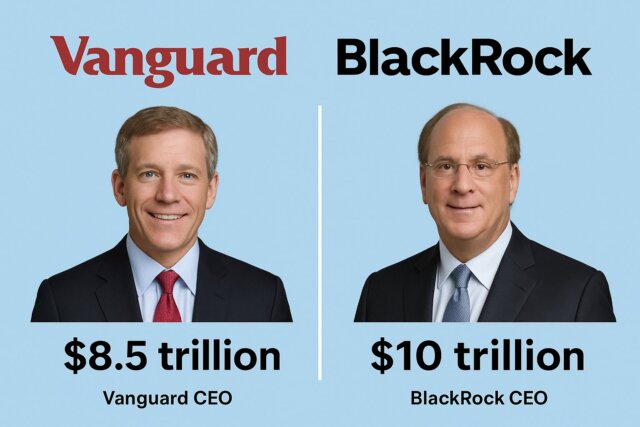
Vanguard’s Entry Near $90K: A Conservative Giant Joins the Cycle
Vanguard has long been known for its cautious, index-driven philosophy. For years, the firm refused to offer Bitcoin ETFs, citing volatility and lack of suitability for long-term investors.
But in late 2025, Vanguard unlocked access to third-party Bitcoin ETFs — including BlackRock’s IBIT — on its platform. This occurred while Bitcoin was trading near $90,000.
This shift is monumental.
1. Tens of millions of Vanguard users now have seamless access
Vanguard manages trillions in retirement savings. These users previously couldn’t buy Bitcoin ETFs without opening accounts elsewhere. That friction prevented billions in potential demand.
2. Conservative investors follow institutional precedents
BlackRock’s early success with IBIT established Bitcoin ETFs as legitimate financial instruments. Vanguard could not ignore competitive pressure — or the product’s vast demand.
3. Long-term capital now has a low-friction pathway into Bitcoin
Retirement investors don’t trade daily. They allocate and hold. This is the most powerful kind of demand in Bitcoin’s market structure.
Vanguard’s entry at a much higher price point (~$90K vs. BlackRock’s ~$40K) shows that the firm is not trying to “buy low.” It is simply responding to market reality — Bitcoin is now an institutional asset, and investors want exposure.
Why Bitcoin Could Realistically Reach Above $200,000
Bitcoin surpassing $200K no longer requires a speculative narrative. It requires understanding the structural forces created by ETF adoption:
1. ETF demand exceeds new Bitcoin supply
After the 2024 halving, miners produce minimal new supply. Yet ETFs often buy more BTC per day than miners create, forcing price upward as liquidity tightens.
2. Institutions set durable price floors
BlackRock, Fidelity, ARK, and now Vanguard clients are long-term allocators. Their buying is not speculative — it is strategic. This stabilizes the market and strengthens the base.
3. Liquidity compression causes rapid upside moves
With coins locked in ETF custody, exchange liquidity thins. When new buyers enter, price jumps quicker and sharper. Low liquidity in bull markets accelerates rallies.
4. Macro tailwinds strengthen Bitcoin’s store-of-value narrative
A declining dollar, easing interest rates, and global demand for hard assets all support BTC’s long-term trajectory.
5. Institutional competition fuels adoption
BlackRock entered first. Vanguard followed. Other major financial institutions are expected to integrate Bitcoin ETF access. Competition translates into more buying, more demand, and more assets locked away.
In a world where trillions in investment capital are being diversified, even 1% allocations from pensions, endowments, and wealth managers could drive Bitcoin well above $200,000.
Risks and Realistic Expectations
Even with strong fundamentals, Bitcoin’s path will not be straight up. Investors must acknowledge risks:
- ETF outflows can trigger temporary price shocks
- Macro uncertainty can cause risk-off selling
- Regulations could slow institutional adoption
- Short-term volatility remains extreme
But none of these risks undermine the long-term structural shift.
Final words — The Road to $200K Is Becoming Clearer
BlackRock began accumulating Bitcoin around $40k–$45k, triggering a new era of institutional demand. That early adoption helped propel Bitcoin to a new all-time high near $126,000. Now Vanguard has entered the market at $90K, opening the gates to millions of conservative and retirement investors.
The combination of:
- mechanical ETF demand
- shrinking supply
- institutional competition
- macro tailwinds
- and long-term adoption
is exactly the formula that pushes Bitcoin toward $200,000 and beyond.
Bitcoin’s next growth phase is no longer a question of hype — it is a question of structural economics.
CZ vs Peter Schiff Gold Debate: What Happened at Binance Blockchain Week
Disclaimer!! The information provided by CryptopianNews is for educational and informational purposes only. It should not be considered financial or investment advice. Cryptocurrency markets are highly volatile and speculative, and investing in them carries inherent risks. Readers are advised to conduct their own research and consult with a qualified financial advisor before making any investment decisions.

- What Is DeSoc Crypto & Why Vitalik Cares - January 28, 2026
- Why Long-Term Bitcoin Holders Are Not Selling Yet - January 26, 2026
- U.S. Cryptocurrency Oversight Faces a Major Senate Shift - January 25, 2026