
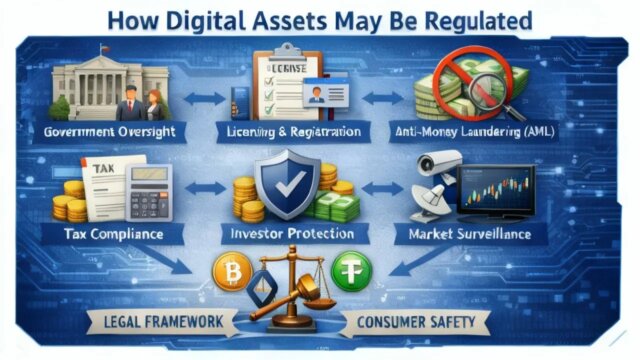
- U.S. Cryptocurrency Oversight is at a turning point as a Senate hearing revisits commodity laws and reshapes how digital assets may be regulated.
- Current regulatory confusion is due to inconsistent interpretations by agencies like the SEC and CFTC, leading to lawsuits and capital flight from U.S. crypto exchanges.
- A discussion draft of the Digital Commodity Exchange Act was released by Republicans on the Senate Agriculture Committee, aiming to clarify rules for the crypto commodity market.
The United States is on the verge of a significant shift in how digital assets are supervised, traded, and legislated. A newly announced Senate hearing, set for next week, aims to revisit decades-old commodity laws to accommodate the rapidly evolving crypto sector. The move follows months of closed-door negotiations, competing draft proposals, and industry lobbying aimed at clarifying what many experts view as one of the most important unresolved questions in American finance: How should cryptocurrency be regulated?
Digital assets currently sit in a confusing regulatory landscape in which different agencies interpret their authority inconsistently. The Securities and Exchange Commission (SEC) has argued that many crypto tokens should be treated as securities, while the Commodity Futures Trading Commission (CFTC) has maintained that Bitcoin and certain other tokens fall squarely within its jurisdiction as commodities. This split has contributed to lawsuits, compliance disputes, and capital flight from U.S. crypto exchanges, all of which have prompted lawmakers to revisit the issue with renewed urgency.
On January 25, Galaxy Research Director Alex Thorn revealed on X (formerly Twitter) that Republicans on the Senate Agriculture Committee had released a discussion draft of the Digital Commodity Exchange Act, marking one of the most detailed legislative attempts to outline workable rules for the crypto commodity market. The draft is expected to merge with ongoing work from the Senate Banking Committee to form a combined legislative package informally referred to as the Cryptocurrency Market Structure Act.
Political Stakes and Committee Dynamics
The Agriculture Committee plans to review the bill during a January 27 hearing, during which lawmakers are expected to propose revisions. Insiders expect additional amendments related to cybersecurity, disclosure standards, and custody practices — areas that have proven critical in past exchange failures. The proposed bill is widely seen as a narrower and less ideological counterpart to work underway in the Senate Banking Committee, which has hosted more contentious debates over securities classification and systemic risk. By contrast, Agriculture Committee members have framed their draft as a pragmatic approach intended to foster regulatory clarity for a sector that is growing internationally.
Committee Chair John Boozman has emerged as one of the most vocal advocates for giving the CFTC jurisdiction over crypto spot markets. His bill explicitly authorizes the agency to build a licensing framework for platforms facilitating spot trading, disclosures around token listings, and risk controls to limit market manipulation. Supporters say the agency already has experience policing derivatives markets and could adapt quickly with additional funding. During a recent interview, one committee staffer described the proposal as “a serious legislative pathway that could break years of stalemate,” adding that the crypto sector has “reached a point where clarity is not optional.”
Regulatory Turf Wars Aren’t Over Yet
Despite optimism, the Agriculture Committee draft does not resolve the long-running jurisdictional dispute over which tokens are securities and which are commodities. The SEC has repeatedly asserted that most token offerings qualify as securities, while the crypto industry argues that only certain subsets do — particularly those involving startups raising capital via token sales. Until classification is settled, Congress faces a structural challenge: cryptocurrency market regulation must account for both securities and commodities frameworks simultaneously. Some experts have proposed a dual-registration model while others advocate for a new digital asset regulator altogether. For now, Congress appears more inclined to strengthen existing agencies rather than create new ones.
A Legislative Opening After Years of Gridlock
For years, U.S. crypto regulation has been defined more by conflict than consensus. Competing agencies, contradictory interpretations, and political gridlock have shaped an industry that now spans payments, trading, infrastructure, and distributed computing. With global competitors moving fast, the stakes have never been higher. The Agriculture Committee’s draft bill does not solve every problem, and it does not resolve the securities question. But it does mark a meaningful legislative opening — a shift from regulatory improvisation to structured policymaking. If merged successfully with Banking Committee efforts, Congress could deliver the first comprehensive framework for digital commodity spot markets in U.S. history. Whether lawmakers can translate this momentum into durable law remains uncertain, but the political, economic, and strategic incentives are stronger than ever. The coming months will reveal whether the U.S. chooses to lead, follow, or fall further behind in shaping the next era of digital financial infrastructure.
Disclaimer: CryptopianNews shares this for learning and info only. It’s not meant to be financial or investment advice. Crypto markets change a lot and move quickly. Investing in them can be risky. You should always look into things yourself. Talk to a trained financial advisor before making any choices about investing.

- What Is DeSoc Crypto & Why Vitalik Cares - January 28, 2026
- Why Long-Term Bitcoin Holders Are Not Selling Yet - January 26, 2026
- U.S. Cryptocurrency Oversight Faces a Major Senate Shift - January 25, 2026