
Grasping the nuances of an ethereum vs stablecoin yield comparison is vital for modern crypto investors. In 2025, with DeFi protocols maturing and staking mechanisms evolving, the competition for crypto yield is heating up. In this analysis, we’ll contrast ETH staking with yield-bearing stablecoins to determine which offers superior returns.
ETH Staking Yields in 2025
Since Ethereum’s Merge in late 2022, its staking dynamics have changed significantly. At one point, ETH staking offered around 5.3% APY. However, recent data shows that it has dropped to under 3% in many cases.
Yield Components of Ethereum Staking
- Consensus rewards have diminished as staking participation has increased. The protocol’s yield curve scales inversely with the number of validators.
- Execution-layer rewards, such as MEV and priority fees, continue to fluctuate based on transaction volume and block demand.
- Solo stakers benefit from keeping all rewards. Nonetheless, most retail investors use liquid staking platforms, like Lido, Coinbase, or Rocket Pool, where platform fees range between 10% and 25%. As a result, net returns often drop below 2.5%.
Importantly, the total ETH staked now exceeds 35 million, which is approximately 28% of Ethereum’s circulating supply.
Yield-Bearing Stablecoins: A New Contender
The rise of yield-bearing stablecoins vs ETH presents investors with more passive income opportunities. These stablecoins, which earn yield via U.S. Treasuries, staking derivatives, or other structured finance mechanisms, have rapidly gained traction.
How Stablecoin Yields Work
First, some yield-bearing stablecoins—like USDY or USDM—earn interest by holding short-term government bonds. This method is relatively low-risk and reflects traditional financial strategies.
Second, others like Ethena’s USDe generate returns using delta-neutral strategies involving perpetual swaps and collateralized positions. These systems distribute the resulting revenue to holders in the form of yield.
Finally, some stablecoins are backed by DeFi yield sources such as staked ETH or LP fees. Examples include protocols like Lybra, Prisma, and eUSD.
According to sources, these innovations pushed the total value locked (TVL) in yield-bearing stablecoins from $1.5 billion to $11 billion in just a few months—now representing 4.5% of the entire stablecoin market.
Real-Time Yield Comparison
Let’s examine the numbers.
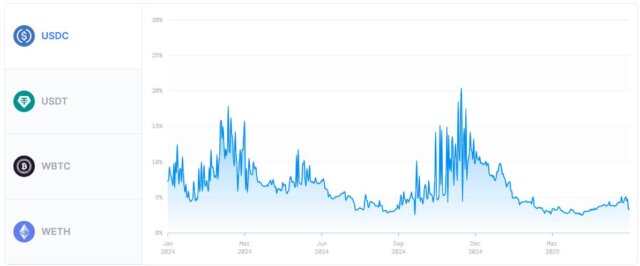
- ETH staking APY (2025): Now averaging between 2.5% and 3.0%, with net yields lower after validator fees.
- Stablecoin APY (2025): Ranges from 4.5% to 5.5% depending on the protocol and strategy.
Notably, assets like Ondo’s USDY and Mountain Protocol’s USDM maintain stable yield generation thanks to their bond-backed frameworks. They also remain fully liquid, unlike staked ETH which may require unbonding periods.
Which One Delivers Better Returns?
Yield Performance
On yield alone, stablecoins currently outpace ETH staking. For example, Ondo Finance’s USDY offers around 5% APY, while Lido’s stETH sits closer to 3%.
Risk Assessment
Ethereum staking has protocol-level security and a proven track record. Still, it carries ETH price volatility and potential validator penalties. In contrast, yield-bearing stablecoins appear more stable but expose users to smart contract risk, custodial risk, and potentially unregulated financial structures.
Additionally, these stablecoins are susceptible to U.S. regulatory scrutiny. For instance, their exposure to Treasuries could draw SEC or Treasury oversight in the near future.
Liquidity and Accessibility
Another advantage of stablecoins is flexibility. Unlike ETH staking, which often includes withdrawal waiting periods, stablecoins allow immediate redemption and easy transfer between platforms.
Strategy for 2025 Yield Maximization
When considering the best crypto yield 2025, diversification appears essential. Ethereum offers long-term capital appreciation and utility within DeFi ecosystems. Meanwhile, stablecoins deliver short-term, predictable yield with lower volatility.
Balanced Portfolio Strategy
- Allocate 30%–40% to Ethereum staking for exposure to ETH price growth and protocol rewards.
- Dedicate 60%–70% to yield-bearing stablecoins to ensure consistent returns and higher liquidity.
This hybrid model blends upside potential with income stability—two components increasingly important in today’s volatile market.
Moreover, upcoming developments like Ethereum ETFs could reduce staking rates temporarily, thereby improving future yields. Investors should monitor these changes closely.
Conclusion
The ethereum vs stablecoin yield comparison favors stablecoins for short-term returns in 2025. However, Ethereum’s value proposition extends beyond APY—it plays a foundational role in DeFi.
To summarize:
- Yield-bearing stablecoins offer ~5% APY with lower volatility.
- ETH staking offers ~2.5% APY, but benefits from ETH price appreciation.
- Diversification allows investors to capitalize on both income and long-term growth.
By blending these strategies, crypto investors can create a resilient, yield-focused portfolio suitable for both bull and bear markets.
Read Also: Ethereum Market Trends and Outlook: What the Future Holds
Disclaimer!! The information provided by CryptopianNews is for educational and informational purposes only. It should not be considered financial or investment advice. Cryptocurrency markets are highly volatile and speculative, and investing in them carries inherent risks. Readers are advised to conduct their own research and consult with a qualified financial advisor before making any investment decisions.

- Why Stablecoins Are a Growing Threat to Traditional Bank Deposits - January 28, 2026
- Rich Dad Poor Dad Author’s Bitcoin Loss: Capital Rotation Strategy Gone Wrong - January 25, 2026
- What is Corposlop in Crypto: Vitalik Buterin’s Warning About Centralized Crypto Platforms - January 21, 2026