
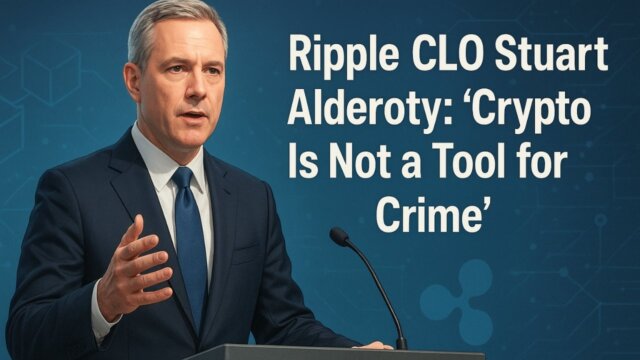
- Alderoty rejects the recurring claim that cryptocurrencies are tools for crime and corruption, arguing that the narrative is “convenient but lazy and inaccurate.”
- He argues that public blockchains are open, traceable, and permanent, reducing the ability of bad actors to hide illicit flows.
- Alderoty emphasizes that “tens of millions of Americans” now use digital assets for day-to-day purposes, such as lending money, proving ownership, and building new businesses.
Ripple Labs’ Chief Legal Officer Stuart Alderoty has forcefully rejected the widespread claim that cryptocurrencies are primarily tools for crime and corruption. Posted on social-media platform X on October 17, Alderoty labelled the recurring allegation a “convenient but lazy and inaccurate story.” He urged observers to shift focus away from sensationalist headlines and toward the real users, real use-cases and real value embedded in public blockchains.
The Challenge to the “Crypto = Crime” Narrative
Alderoty’s statement arrives at a moment of heightened scrutiny for the crypto industry. Regulators, mainstream media, and public watchdogs have repeatedly asserted that digital assets represent a major conduit for money-laundering, terrorist financing and other financial crimes. But according to Alderoty, such framing misses the bigger picture—and overlooks the transparency built into many blockchain systems. In his X post, he emphasised that because public blockchains are open, traceable and permanent, they actually reduce the ability of bad actors to hide illicit flows. In his words: “Crime doesn’t thrive in plain sight.” By contrast, he argued, much of the media’s focus remains on dramatic but isolated incidents, rather than the far larger number of legitimate transactions by everyday users. According to recent media summaries, Alderoty noted that “tens of millions of Americans” now use digital assets for day-to-day purposes — such as lending money, proving ownership & building new kinds of businesses. He explicitly called out narratives that portray crypto as a wild frontier of illicit activity: those stories, he said, ignore the fact that the ledgers are public, and the activity of bad actors is much more exposed—not less—than in many traditional financial settings.
The Real Story Behind Crypto
Alderoty’s message strongly emphasises that utility, not scandal, is the true driver of digital-asset adoption. According to him:
- Blockchain-based systems help speed up payments.
- They remove unnecessary middlemen.
- They provide detailed, auditable records for users ranging from individuals to small businesses.
- They enable new business models, such as peer-to-peer lending and tokenised ownership.
By framing crypto as a tool for ordinary Americans, Alderoty hopes to redirect regulatory and public attention toward the positive side of the ledger. He pointed out that millions of U.S. citizens are already using digital-asset infrastructures for real tasks — not just speculative trades, but everyday transactions and business operations. This shift in vantage is important, he said, because regulation and policy often follow narrative. If the narrative stays stuck on crime, the policy response tends to be heavy-handed or hostile. In his capacity at the National Cryptocurrency Association (NCA) — a nonprofit born out of an initiative led by Ripple — Alderoty is actively working to collect and share real-world user stories so that the public can better see how digital assets are being used beyond headlines.
The Transparency Advantage of Public Blockchains
One of the central claims in Alderoty’s argument is the transparency of many public blockchains. He emphasises that because transactions are publicly recorded, traceable, and permanent, they offer law enforcement, regulators and analytics firms visibility that far surpasses many conventional financial systems. In his view, portraying crypto as primarily enabling wrongdoing is misguided because it overlooks this inherent feature. Alderoty asserted that when the ledger is open, it becomes easier — not harder — to track suspicious movement. Well-known cases of illicit flows in traditional finance often benefit from closed networks, complex intermediaries, and opaque ownership structures. By contrast, public blockchains demand accountability. This argument challenges the long-standing assertion that digital assets are perfect for laundering or hiding illicit funds — a narrative that many regulators and media outlets echo. By stressing the public-ledger model, Alderoty positions crypto as an “auditable” ecosystem rather than a hidden back-channel.
Regulatory Clarity
Beyond narrative, Alderoty is focused on policy reform. He often argues that the absence of clear, consistent rules leaves the U.S. crypto industry exposed — both to enforcement risk and to losing talent and innovation abroad. For instance:
- He has criticised what he calls “regulation by enforcement,” where regulators act without clear statutory guidance.
- He has called on U.S. lawmakers to “finish the job on crypto clarity,” enabling responsible companies to grow and consumers to be protected.
- His role at the NCA includes encouraging transparent frameworks, collecting user stories, and promoting safe adoption.
The bigger picture: if the public continues to view crypto through the lens of crime and corruption, lawmakers may adopt overly strict or counter-productive regulations. Conversely, if the narrative shifts to real-world uses and value creation, the industry may find a more constructive regulatory path.
Final Thoughts
In sum, the remarks from Stuart Alderoty mark a significant moment in crypto-industry messaging. He is not simply defending his company — he is challenging a narrative he sees as outdated and unhelpful. By placing emphasis on utility, transparency, and everyday users, Alderoty argues that crypto deserves to be viewed through a more balanced lens. For regulators, the message is clear: consider the full spectrum of crypto-use, not just the most sensational extremes. For users and innovators, the takeaway is that storytelling matters — the broader adoption of blockchain systems depends not only on technology, but on the public’s understanding of what those systems actually do. The ongoing legal, regulatory and social battle around digital assets is far from over. But with voices like Alderoty’s pushing the discourse toward everyday utility and auditability, the industry may be positioning itself for the next phase of maturity.
Disclaimer: CryptopianNews shares this for learning and info only. It’s not meant to be financial or investment advice. Crypto markets change a lot and move quickly. Investing in them can be risky. You should always look into things yourself. Talk to a trained financial advisor before making any choices about investing.

- What Is DeSoc Crypto & Why Vitalik Cares - January 28, 2026
- Why Long-Term Bitcoin Holders Are Not Selling Yet - January 26, 2026
- U.S. Cryptocurrency Oversight Faces a Major Senate Shift - January 25, 2026