

- The surge was driven by the U.S. Federal Reserve’s first interest rate cut of 2025, sparking optimism across both traditional and digital financial markets.
- CEO Jack Mallers of Twenty One Capital predicted that Bitcoin could rise by 200 times its current value, positioning it as the next global store of wealth.
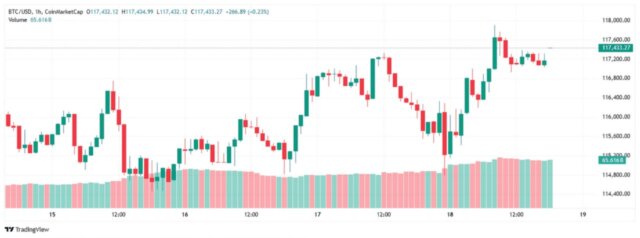
- Bitcoin has surpassed the $117,000 mark, marking a significant milestone in the global financial market.
Bitcoin has once again captured global attention after surpassing the $117,000 mark this week. The sharp rally followed the U.S. Federal Reserve’s decision to implement its first interest rate cut of 2025, sparking optimism across both traditional and digital financial markets. Adding fuel to the bullish sentiment, Jack Mallers, CEO of Twenty One Capital, boldly predicted that Bitcoin could eventually rise by 200 times its current value, positioning it as the next global store of wealth. This forecast has stirred debate across Wall Street, Silicon Valley, and the crypto community, as investors weigh Bitcoin’s growing role in the global economy against its historical volatility.
Jack Mallers’ Bold Vision
During a recent interview on NYSE TV, Mallers outlined his ambitious outlook for Bitcoin. He argued that the cryptocurrency is no longer a fringe experiment but is increasingly competing with traditional stores of value like stocks, real estate, gold, and fine art. “Today Bitcoin’s market value stands at around $2.5 trillion,” Mallers explained. “If Bitcoin absorbs even a fraction of the wealth stored in other asset classes, it could expand 100 to 200 times from where it is now.”
Mallers described Bitcoin as a hedge against currency debasement, pointing out that government-issued currencies often lose purchasing power over time due to inflation. Bitcoin, with its capped supply of 21 million coins, offers what he calls an incorruptible alternative. “Just as gold has historically protected wealth from inflation and economic uncertainty, Bitcoin is emerging as the digital equivalent — but with greater accessibility, portability, and transparency,” Mallers added.
The Rise of Twenty One Capital
Founded in April 2025, Twenty One Capital is a Bitcoin-only investment firm designed to serve as a regulated entry point for institutional investors. Instead of asking clients to handle private keys or navigate crypto exchanges, the firm operates much like a treasury fund, where every share of the company represents a claim on its underlying Bitcoin reserves. Backed by major players such as Tether, Bitfinex, and SoftBank, the firm has quickly established itself as one of the largest corporate holders of Bitcoin. Its current stash of 43,500 BTC already surpasses Tesla’s Bitcoin holdings, placing it among the top institutional treasuries worldwide.
Public Listing Plans
To broaden its reach, Twenty One Capital is preparing to go public through a SPAC merger with Cantor Fitzgerald’s Cantor Equity Partners. Pending approval by the U.S. Securities and Exchange Commission (SEC), the company is expected to trade on Nasdaq under the ticker “XXI”. The ticker itself is symbolic — a nod to Bitcoin’s finite supply of 21 million coins. Mallers emphasized that Twenty One Capital is designed to provide institutional-grade exposure to Bitcoin without the complexities of custody management. “We are building a bridge between traditional finance and Bitcoin. This way, pensions, endowments, and large funds can allocate into Bitcoin in a regulated, transparent manner,” he said.
The Federal Reserve’s Rate Cut
While Mallers’ prediction grabbed headlines, Bitcoin’s immediate rally was driven by macroeconomic policy shifts in the U.S.. On Thursday, the Federal Reserve reduced interest rates by 25 basis points, setting the target range between 4% and 4.25%. This marked the Fed’s first rate cut in 2025, signaling its willingness to stimulate growth amid concerns of slowing economic activity. However, Fed Chair Jerome Powell cautioned that further cuts may not be forthcoming unless there is clear improvement in both inflation and employment data. Despite Powell’s cautious tone, Bitcoin surged past $117,000, a level unseen in previous market cycles. Other cryptocurrencies followed suit:
- Ethereum (ETH) climbed 2% to $4,633.
- XRP advanced nearly 3% to $3.11.
- Several smaller altcoins also posted gains as investor confidence returned to the crypto sector.
Why Lower Interest Rates Favor Bitcoin
Financial analysts note that lower interest rates generally benefit alternative assets, particularly those that act as hedges against inflation or currency debasement. With yields on government bonds declining, institutional investors are more inclined to explore alternative vehicles that promise better long-term returns. Bitcoin, often referred to as “digital gold,” becomes especially attractive in such an environment. Unlike fiat money, which can be printed indefinitely, Bitcoin’s supply is hard-capped, making it resistant to monetary dilution.
“The Fed’s decision has effectively reignited the narrative that Bitcoin is a hedge against central bank policy,” said one analyst at a New York-based hedge fund. “As traditional assets face yield compression, Bitcoin’s scarcity-driven value proposition becomes harder to ignore.”
Can Bitcoin Truly Rise 200x?
Mallers’ 200x growth prediction naturally raises skepticism. If realized, Bitcoin’s market cap would exceed $500 trillion, dwarfing the current global store-of-value markets combined. Critics argue that such an outcome is highly unlikely, pointing to Bitcoin’s volatility, regulatory uncertainties, and competition from emerging digital assets and central bank digital currencies (CBDCs). However, supporters of Mallers’ thesis believe that the digitization of finance is inevitable, and Bitcoin, as the pioneer, stands to capture an outsized share of global capital. “If the world continues moving toward decentralized money and away from government-issued currencies, Bitcoin could very well achieve valuations we once thought impossible,” said a venture capitalist specializing in digital assets.
The combination of the Federal Reserve’s rate cut and Jack Mallers’ bold vision has placed Bitcoin back at the center of financial discussions. While a 200x surge may sound unrealistic in the near term, Bitcoin’s resilience, growing institutional adoption, and role as a hedge against monetary policy continue to attract serious attention. Whether or not Bitcoin achieves Mallers’ astronomical prediction, one thing is clear: Bitcoin has firmly cemented itself as a legitimate contender in the global financial system. Its journey from a niche internet experiment to a multi-trillion-dollar asset class is proof that the world is rethinking the very foundations of money and value storage. As the Fed navigates uncertain economic waters and institutions like Twenty One Capital expand access, the stage is set for Bitcoin to play an even larger role in shaping the future of finance.
Disclaimer: CryptopianNews shares this for learning and info only. It’s not meant to be financial or investment advice. Crypto markets change a lot and move quickly. Investing in them can be risky. You should always look into things yourself. Talk to a trained financial advisor before making any choices about investing.

- Why Tokenized Gold Trading Volume Surpasses BNB Now - January 31, 2026
- CZ Explains Bitcoin Safe Haven Amid Global Uncertainty - January 30, 2026
- Timothy Peterson Reveals a New Bitcoin Rally Window - January 28, 2026