
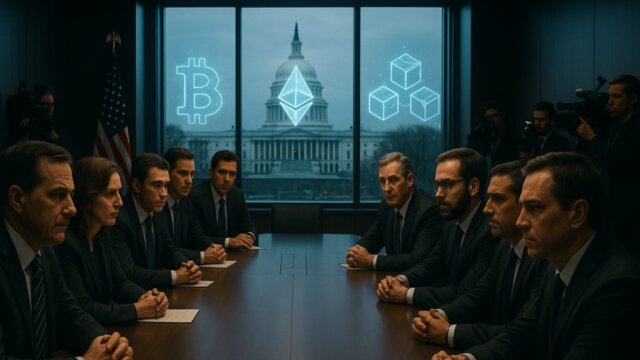
- Crypto industry leaders met with lawmakers to advocate for a significant crypto market-structure bill.
- The meetings revealed deep divisions between the parties, indicating the path ahead for a meaningful crypto market-structure bill may still be treacherous.
- Major crypto firms, including Coinbase CEO Brian Armstrong, Galaxy Digital CEO Mike Novogratz, Andreessen Horowitz’s head of crypto policy Miles Jennings, and Chainlink Labs CEO Sergey Nazarov, met separately with Senate Democrats and Republicans.
In a series of high-profile sit-downs on Capitol Hill this week, top figures from the cryptocurrency industry met with key lawmakers to advocate for a landmark legislative push. Yet amid the polished optics, the meetings revealed deep divisions between parties, signalling that the path ahead for a meaningful crypto market-structure bill may still be treacherous.
Industry leaders engage both parties, but fault-lines show
Senior executives from major crypto firms — including Coinbase CEO Brian Armstrong, Galaxy Digital CEO Mike Novogratz, Andreessen Horowitz’s head of crypto policy Miles Jennings, and Chainlink Labs CEO Sergey Nazarov — separately met with Senate Democrats and Republicans on Wednesday. These sit-downs were held to discuss the proposed market structure legislation for digital assets. While the gatherings were intended to demonstrate unified support for regulation, they instead laid bare how far apart lawmakers remain — particularly on issues of timing, agency jurisdiction, and the interplay of the crypto industry’s alignment with political parties.
Republicans emphasise urgency
A person familiar with both sets of meetings told Decrypt that the mood was tense:
“Democrats don’t like being rushed with deadlines. But Republicans are saying if we don’t act by November, we’ll miss our chance to finish it this year, and everything will fall apart.”
This tension frames a broader divide. On the Republican side, the narrative is one of ** urgency** — the belief that a meaningful bill must pass this year, or momentum will fade. On the Democratic side, there is frustration at perceived smokescreens or rushed timelines, and at the mechanics by which draft language was leaked. For example, during the Democrats’ meeting, senators such as Catherine Cortez Masto (D-Nevada), Mark Warner (D-Virginia), and Ruben Gallego (D-Arizona) expressed displeasure at the leak of a draft “DeFi section” earlier this month that later drew sharp online criticism. One Democratic senator, Cory Booker (D-New Jersey), pressed the crypto executives to back efforts to keep both the Securities and Exchange Commission (SEC) and the Commodity Futures Trading Commission (CFTC) balanced with membership from both parties — a key sticking point in the regulatory debate.
Jurisdictional tug-of-war and agency independence
At the heart of the discussion is the question of who regulates what in the digital-asset world. Prior moves made under the previous administration weakened the independence of agencies like the CFTC and SEC, and lawmakers are keen not to repeat those missteps. Under the proposed market-structure bill, both agencies would be given wide control over how crypto rules are made and enforced. But Democrats are calling for assurances that neither agency is completely captured by one party or faction — hence the push for bipartisan membership and shared oversight. The regulatory framework remains one of the thorniest aspects of the legislation, because digital assets straddle the lines between securities, commodities, and payments.
Crypto industry voices cautiously optimistic
Despite the tension, executives walked away from the meetings with a measured sense of hope. Sergey Nazarov of Chainlink told Decrypt that he was “encouraged by the presence of pro-crypto voices in both political parties.” However, he was also clear that time is running short. One major external pressure: the ongoing federal government shutdown, which has produced a 22-day freeze on federal funding and slowed Congressional business to a crawl. Nazarov called it “the biggest problem” facing the bill right now. Another issue: the perception among Democrats that the crypto industry leans Republican. As Nazarov paraphrased, the concern was:
“The Democrats had a concern that the crypto industry is basically part of the Republican Party.”
He responded: “But I don’t believe that’s true. If Democrats support our industry, then many people in crypto will be very pro-Democrat.”
The shift in mindset from industry players may help bridge trust gaps.
The meetings between crypto executives and U.S. senators this week were a show of intent: the industry and lawmakers appear committed to moving forward with meaningful regulation of digital assets. Yet beneath the surface, substantial gaps remain. From the timeline quarrel to agency jurisdiction, from leaks that erode trust to the broader geopolitical and budgetary headwinds — the road to a market structure bill is still rocky. For the crypto sector, the stakes are high: regulatory clarity in the U.S. could unlock new waves of growth, innovation and mainstream adoption. For policymakers, the challenge is balancing innovation with protection, growth with oversight, and urgency with deliberation. The coming weeks should reveal whether these two sides can bridge the divides and deliver a durable framework — or whether the moment slips away, leaving behind uncertainty and missed opportunity.
Disclaimer: CryptopianNews shares this for learning and info only. It’s not meant to be financial or investment advice. Crypto markets change a lot and move quickly. Investing in them can be risky. You should always look into things yourself. Talk to a trained financial advisor before making any choices about investing.

- Fed Balance Sheet Reduction Shakes Global Markets - January 30, 2026
- Inside the White House Crypto Meeting on Digital Assets - January 28, 2026
- Wall Street Warns: US Crypto Policy Clouds the Market - January 26, 2026