
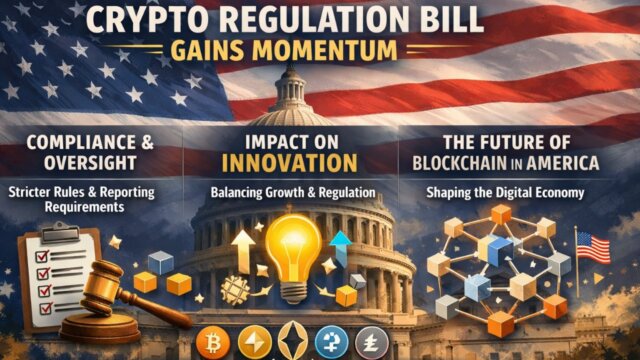
- The crypto regulation bill US is gaining momentum, how it affects compliance, innovation, and the future of blockchain in America.
- A new legislative proposal, referred to as the crypto regulation bill US, aims to clarify how cryptocurrencies, stablecoins, and other blockchain assets should be regulated.
- Recent bipartisan interest and pressure from financial institutions have reinvigorated discussions, with upcoming hearings marking a significant procedural milestone.
For years, the United States has been playing catch-up in the global race to regulate digital assets. After numerous aborted attempts, stalled hearings, political battles, and intense lobbying pressure from the financial and crypto industries, lawmakers in Washington are once again making a serious push to establish a national framework that defines how cryptocurrencies should be treated and regulated. This renewed effort revolves around a major proposal widely referenced as the crypto regulation bill US, a legislative package that seeks to resolve one of the most contentious policy gaps of the last decade.
The new bill, which had previously stalled but is now back on the move, aims to finally give companies, investors, and regulators clarity on how digital tokens, stablecoins, decentralized finance infrastructure, and emerging blockchain-based assets should operate in the country. With hearings scheduled and two powerful Senate committees preparing revisions, digital asset policy may be closer than ever to passing a legitimate federal framework — though not without political brawls on the way.
A Bill That Refuses to Die
Last year, momentum surrounding crypto legislation seemed to vanish. Scandals, bankruptcies, multibillion-dollar fraud cases, and a general collapse in public trust weighed heavily on lawmakers. Bills were drafted but never left committee. Lobbyists redoubled efforts, while regulators like the Securities and Exchange Commission (SEC) used enforcement actions to fill the policy vacuum. Many analysts expected Congress to give up.
Yet Washington rarely abandons a fight permanently. This year, the crypto regulation push is back, driven by bipartisan interest, pressure from financial institutions, and the growing acknowledgment that crypto is not going away. Legislators are set to revisit what they now describe as the most comprehensive attempt to define a national digital asset rulebook.
Scheduled hearings on Thursday mark the first major procedural milestone. The Senate Agriculture Committee and the Senate Banking Committee will review their respective portions of the bill, work through amendments, and reconcile language that splits authority between federal regulators. Supporters describe the legislation as the first serious attempt to deliver clarity instead of confrontation.
If Congress succeeds, the United States could finally adopt a real market structure for digital assets — something rival jurisdictions like the European Union, Singapore, and the United Arab Emirates already implemented through proactive regulatory packages.
Inside the Bill
The backbone of the revived proposal focuses on taming ambiguity. Crypto has lived for over a decade in regulatory gray space, triggering turf wars between federal agencies and leaving companies uncertain whether they are operating legally. The crypto regulation bill US seeks to end this confusion by clarifying the roles of key regulatory bodies, particularly the SEC and the Commodities Futures Trading Commission (CFTC).
Under current law, both agencies claim pieces of crypto oversight. The SEC argues most tokens are securities, while the CFTC treats others as commodities. Without statutory clarity, companies risk enforcement actions, fines, and lawsuits simply for issuing tokens, offering yield products, or operating exchanges. The revived bill outlines:
- How tokens should be classified
- Which companies must register
- How exchanges and brokerages must operate
- Which agency oversees which asset class
- What disclosures companies must provide investors
- What compliance requirements apply to stablecoins and DeFi platforms
The bill, now commonly referenced as the “Clarity Act,” intends to allow law-abiding digital asset firms to operate in the U.S. without being strangled by regulatory guesswork or endless legal battles. To many technologists, this is urgently needed. Crypto entrepreneurs have increasingly relocated to countries with more predictable legal environments. Analysts warn the U.S. risks losing talent, capital, and financial innovation to overseas markets unless it catches up.
The Flashpoints: Stablecoins, DeFi, and Trump-Linked Tokens Ignite Controversy
Despite newfound momentum, not everything is smooth sailing. Three issues have emerged as politically explosive flashpoints: These controversies will dominate Capitol Hill debates as hearings begin.
1. Stablecoins Under Fire: The Reward Debate
The stablecoin segment has grown into one of the most mainstream components of crypto, with dollar-pegged tokens facilitating payments, remittances, and market liquidity across exchanges and decentralized protocols. But the rise of stablecoin “rewards,” yield products, and interest-bearing structures has triggered fears that crypto companies are recreating shadow banking without regulatory guardrails.
Cody Carbone, policy chief of the Digital Chamber, described the stablecoin debate as the “biggest outstanding issue” lawmakers need to resolve. He emphasized that both Democrats and Republicans agree that yields tied to stablecoins require clear guardrails. The question is how strict those rules should be.
Earlier this year, the American Bankers Association raised alarms through its Community Bankers Council, warning that stablecoin issuers have begun rolling out incentive programs that skirt the restrictions passed in last year’s GENIUS Act — a law that attempted to ban dollar-linked tokens from paying interest or yield. Because certain structures technically avoid the legal definition of “yield,” they are now competing with traditional savings accounts without facing the same regulatory scrutiny as banks.
Banking groups argue this creates unfair competition and systemic risk. Crypto firms contend the innovation should not be crushed just to protect legacy financial incumbents. The hearings this week will likely feature intense debate over whether stablecoin issuers should be treated as banks, money transmitters, or something entirely new.
2. DeFi Developers Fear Punishment for Other People’s Crimes
The second controversy revolves around decentralized finance (DeFi) — platforms that allow users to borrow, trade, or earn yield directly through smart contracts without intermediaries.
The federal government has expressed concern that criminals and sanctions evaders could use DeFi tools for money laundering. While regulators agree illegal finance must be stopped, open questions remain about who is legally liable when a person misuses decentralized software.
Amanda Tuminelli, chief legal officer at the DeFi Education Fund, says developers are anxious about being treated as accomplices simply for writing code. Their position is straightforward: developers cannot control what individuals do with decentralized software after deployment. Punishing developers for the behavior of strangers would be equivalent to prosecuting hammer manufacturers for robberies.
Tuminelli stressed that DeFi organizations are watching the bill closely to ensure illegal finance provisions target bad actors — not coders. She also urged lawmakers to adopt language from the Blockchain Regulatory Certainty Act, which would shield software developers and service providers who do not manage customer funds.
Another priority for DeFi advocates is preserving the right of individuals to hold their own private crypto wallets without relying on custodial intermediaries. Self-custody has become a philosophical and political principle within the crypto world, and DeFi supporters want it explicitly protected under federal law.
3. Trump-Linked Crypto Profits Stir Ethics Battles in Washington
The third controversy is unique to the intersection of crypto and politics. Lawmakers are increasingly concerned that elected officials and public appointees are profiting from crypto assets while shaping policy that could influence their value.
President Donald Trump has already been linked to multiple blockchain ventures, including a memecoin and a non-fungible token (NFT) collection that generated significant revenue. Critics argue that allowing public officials to continue participating in such ventures creates conflicts of interest and opens the door to indirect bribery through token airdrops, NFT purchases, and political speculation.
Senator Elizabeth Warren and several allies are pushing for the revived crypto regulation bill US to include an ethics clause banning public officials from earning cryptocurrency profits while in office. While the House version of the bill discarded this provision, Senate negotiators are determined to keep it alive.
Industry lobbyists warn that the ethics battles could delay the entire legislative package. But they also acknowledge that public trust in digital assets remains fragile, and ethics measures may be necessary for a bipartisan agreement.
Consolidation, Merging, and the Race Against Time
If Thursday’s committee hearings succeed, the Senate Agriculture and Banking Committees will finalize their revisions and release updated text later in the week. The goal is to merge both segments into a single comprehensive market structure bill that will then move to a floor vote.
The process could take weeks or months — and time is not on Congress’s side. With the 2026 midterm elections approaching, legislative calendars will soon be consumed by budget battles, campaign politics, and other national priorities. Summer Mersinger of the Blockchain Association warned that the political window to pass crypto regulation is shrinking rapidly.
Lawmakers understand that if the bill does not receive a floor vote before November, the entire legislative effort could collapse. If control of either chamber shifts after the election, committee leadership could change, hesitant lawmakers could retire, and political coalitions necessary to pass the bill could evaporate. In Washington, timing can matter as much as content.
Will This Be the Year Crypto Finally Gets Its Rulebook?
After more than a decade of uncertainty, lawsuits, and political infighting, the United States appears closer than ever to establishing a real regulatory foundation for digital assets. The revived crypto regulation bill US represents not just a legislative document but a defining moment for the future of financial innovation in America. Lawmakers are acutely aware that time is running out, both politically and competitively, as other nations advance their own digital asset frameworks.
If the bill succeeds, the U.S. could cement itself as a hub for crypto entrepreneurship, trading, payments, and blockchain technologies. If it fails, the country risks watching leadership in the next generation of financial infrastructure migrate overseas. With stablecoins, DeFi, ethics battles, and institutional pressure all colliding in Washington, the coming weeks will determine whether crypto’s long-awaited moment of clarity finally arrives — or slips away once again.
Disclaimer: CryptopianNews shares this for learning and info only. It’s not meant to be financial or investment advice. Crypto markets change a lot and move quickly. Investing in them can be risky. You should always look into things yourself. Talk to a trained financial advisor before making any choices about investing.

- CZ Explains Bitcoin Safe Haven Amid Global Uncertainty - January 30, 2026
- Timothy Peterson Reveals a New Bitcoin Rally Window - January 28, 2026
- Yi Lihua Market Outlook Warns Short-Term, Bets Long-Term - January 26, 2026