
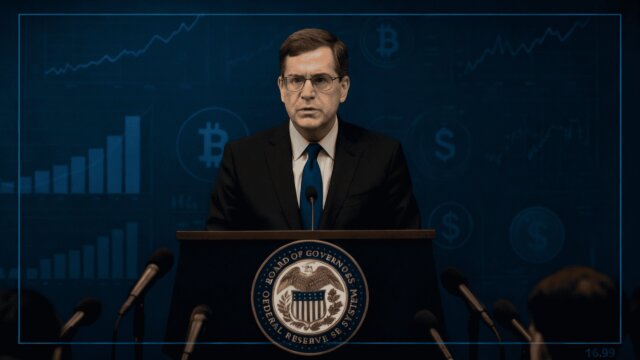
- U.S. Federal Reserve Governor Michael Barr warns about potential risks in the GENIUS Act, particularly regarding the inclusion of volatile assets like Bitcoin in stablecoins’ legal reserve assets.
- Barr argues that this could threaten the stability of payment-linked digital assets, investor confidence, and the broader financial system.
- The GENIUS Act allows for “any medium of exchange authorized or adopted by a foreign government” as a permissible reserve asset for payment stablecoins, which could potentially lead to Bitcoin’s value plunge.
In a significant warning to the financial-technology world, Michael Barr, Governor of the Federal Reserve, today sounded the alarm about potential risks embedded in the recently passed GENIUS Act, particularly around the possibility that issuers of stablecoins could count volatile assets such as Bitcoin among their legal reserve assets. According to Barr, this scenario could pose a threat to the stability of payment-linked digital assets and, by extension, to investor confidence and the broader financial system. In remarks delivered at a fintech industry event, Barr pointed out that under the GENIUS Act’s language, stablecoin issuers might claim that Bitcoin qualifies as a “medium of exchange authorized or adopted by a foreign government”—a status that could render it eligible as a backing asset. He referenced the fact that El Salvador recognises Bitcoin as legal tender as a concrete example of how this argument might be made.
Why Barr is Raising Red Flags
Barr’s criticism centres on the realism of stablecoins maintaining a truly stable backing when their reserve assets include instruments subject to substantial volatility. Here are the key concerns he raised:
- The GENIUS Act allows for “any medium of exchange authorized or adopted by a foreign government” as a permissible reserve asset for payment stablecoins. Under this clause, Bitcoin—given El Salvador’s recognition—could theoretically qualify, posing a risk if its value plunges.
- Stablecoins are meant to maintain a one-to-one backing with their reference value (typically the U.S. dollar). If reserve assets drop in value, the backing becomes compromised—undermining the very design of stablecoins.
- Barr emphasised the historical precedent of “private money” or quasi-money instruments that lacked robust safeguards and then faced runs or instability—a scenario stablecoins might replicate if regulatory safeguards are weak.
- Moreover, the Act grants both federal and state regulators oversight, but leaves room for regulatory arbitrage—issuers might shop for the lightest oversight regime, thus weakening the scheme’s coherence.
Barr’s message: the GENIUS Act constitutes a major step forward, but only if the implementation fills key regulatory gaps.
What the GENIUS Act Sets Out—and What It Misses
The GENIUS Act (short for Guiding and Establishing National Innovation for U.S. Stablecoins) was passed to create a formal regulatory framework for payment-stablecoins in the U.S. Among its principal provisions:
- It declares that stablecoins should be backed by high-quality liquid assets and that issuers must provide timely redemption rights and public disclosures of reserves.
- It assigns supervisory responsibilities to both federal and state agencies, with the intent of nationally harmonised regulation.
- It addresses redemption rights, reserve composition, capital and liquidity requirements and risk-management framework for issuers.
However, Barr identified several significant gaps:
- The permitted reserve assets include uninsured deposits and overnight repurchase agreements. These instruments may be vulnerable to stress.
- The clause allowing “medium of exchange authorised or adopted by a foreign government” as reserve assets opens the door to assets like Bitcoin, which by nature are highly volatile.
- The Act does not sufficiently restrict stablecoin issuers engaged in broader digital-asset business activities (e.g., exchanges, broker-dealers) even though risk spill-over could affect the broader banking system.
- Consumer-protection standards are weaker than for traditional payment instruments; the law doesn’t cover all tokenized products and may lead to confusion about which instruments are truly regulated stablecoins.
In Barr’s view, these loopholes could allow stablecoins to operate with ambition but lacking the robustness required to guard against systemic risk.
Bitcoin, Legal Tender Status
One of the more striking elements in Barr’s remarks relates to Bitcoin’s status in El Salvador. By virtue of being legal tender in that country, Bitcoin could theoretically be counted as a “medium of exchange authorised or adopted by a foreign government.” Under the statutory language of the GENIUS Act, that opens the door for it to be included as an eligible reserve asset for a payment stablecoin issuer. Why does this matter? Because Bitcoin is famous—or infamous—for its price swings. If a stablecoin issuer held Bitcoin as part of its backing, and Bitcoin’s price collapsed or plunged significantly, the stablecoin might lose its 1-to-1 peg, risking loss of confidence, large redemptions, and potentially ripple effects across the payment system. Barr warned of exactly that scenario: “A stablecoin issuer could be stuck holding the Bitcoin that had declined in value, potentially compromising the one-to-one backing of the stablecoin liabilities.” This insight encapsulates a core tension of the stablecoin ecosystem: the trade-off between innovation (leveraging new assets or ecosystems) and the need for stability and trusted backing.
Regulators’ Dual Imperative: Innovation + Stability
In his address, Barr did not reject stablecoins outright. On the contrary, he acknowledged their promise: improved efficiency in payments, especially cross-border; the possibility of new entrants; faster settlement; and potential ways to boost the global competitiveness of the U.S. dollar. The challenge, he emphasised, is to fashion a regulatory regime that both enables innovation and guards the financial system. That means:
- Making sure that reserve assets are genuinely liquid and low-risk, not simply the highest-return investments an issuer can reach for.
- Ensuring issuers have adequate capital, liquidity, risk-management frameworks and resolution regimes in the event they fail or hit stress. � especially important given a history of “private money” breakdowns.
- Preventing regulatory arbitrage between states and the federal government, so all issuers operate under substantially similar rules and can’t find the weakest overseer.
- Extending consumer protections and clarity so that stablecoin users understand exactly what protections exist and which instruments they are engaging with.
If done right, Barr suggested stablecoins could be part of the payments evolution. If done poorly, they could be a source of instability.
Disclaimer: CryptopianNews shares this for learning and info only. It’s not meant to be financial or investment advice. Crypto markets change a lot and move quickly. Investing in them can be risky. You should always look into things yourself. Talk to a trained financial advisor before making any choices about investing.

- Save Trading Fees with STONFI on TON Network - March 31, 2026
- XRP transaction cost Explained: Why Higher Prices Save Fees - March 30, 2026
- Ethereum Layer 2 Faces Criticism From Vitalik - March 29, 2026