
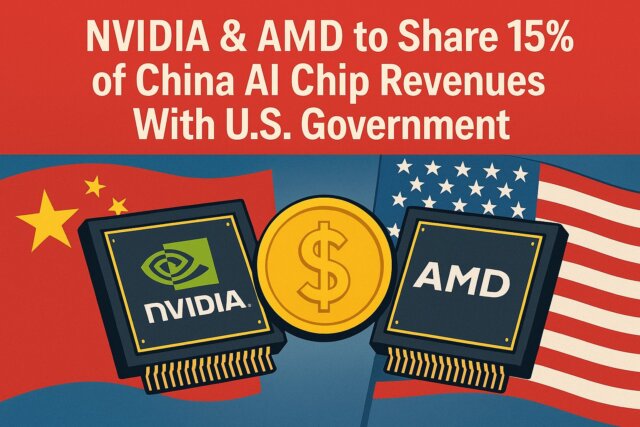
- Nvidia and AMD will pay the U.S. government 15% of AI chip sales revenue from China.
- Deal negotiated under the Trump administration as part of export policy changes.
- Covers Nvidia H20 and AMD MI308 AI chips, previously restricted for export.
- Original U.S. proposal demanded 20% revenue share, reduced to 15% after talks.
- Revenue share applies only to China-bound sales with strict reporting rules.
- Opens access to China’s lucrative AI hardware market, worth billions annually.
- U.S. officials claim it balances national security concerns with trade interests.
- Analysts warn it may set a dangerous precedent for other industries.
- Legal experts say it could violate the U.S. Constitution’s ban on export taxes.
- Stock prices for Nvidia and AMD rose slightly after the announcement.
- Some view it as a short-term win, but long-term export policy remains uncertain.
- Highlights the ongoing U.S.–China semiconductor rivalry.
Tech Giants Strike Historic Revenue-Sharing Deal
In a landmark move, Nvidia and AMD have agreed to hand over 15% of their AI chip sales revenue from China to the U.S. government in exchange for export licenses, officials confirmed this week. The agreement, unprecedented in the technology sector, was brokered under the Trump administration as part of a broader push to control advanced AI chip exports to China.
The deal allows Nvidia’s H20 and AMD’s MI308 processors—both high-performance AI chips—to be sold in China after months of restrictions.
From 20% to 15%: Behind the Negotiations
According to industry insiders, the initial U.S. proposal called for a 20% revenue share, but intense negotiations with company executives brought the figure down to 15%. The agreement applies only to chips destined for Chinese buyers and comes with stringent reporting requirements.
Why It Matters
- Economic Impact – China remains a major market for high-performance computing, and both Nvidia and AMD stand to reclaim billions in lost sales.
- National Security – U.S. officials argue the deal balances security concerns with economic realities, ensuring sensitive AI hardware is monitored without entirely cutting off exports.
- Precedent Setting – Analysts warn this could open the door for similar revenue-sharing arrangements in other strategic industries.
Legal & Constitutional Concerns
Critics, including several legal scholars, have raised alarms that the arrangement may violate the U.S. Constitution’s ban on export taxes. “This is effectively an export tax under another name,” one policy analyst told reporters, suggesting the deal could face court challenges.
Global Semiconductor Rivalry
The move underscores the ongoing U.S.–China tech rivalry, where advanced semiconductors have become the centerpiece of geopolitical competition. While the deal temporarily resolves Nvidia’s and AMD’s access to China, long-term export policy remains uncertain.
Industry Reaction
- Stock Market Response – Shares of Nvidia and AMD saw modest gains following the announcement.
- Investor Outlook – Some analysts view the deal as a short-term win but caution about future restrictions.
- Tech Community Divide – While some welcome the economic boost, others fear national security compromises.
Conclusion
This 15% revenue-sharing deal marks a turning point in U.S. export policy—merging economic strategy with national security concerns. Whether it stands the test of legal scrutiny remains to be seen, but for now, Nvidia and AMD are back in China’s AI chip game
Executive Order Opens Crypto for 401(k) Investors
Disclaimer: CryptopianNews shares this for learning and info only. It’s not meant to be financial or investment advice. Crypto markets change a lot and move quickly. Investing in them can be risky. You should always look into things yourself. Talk to a trained financial advisor before making any choices about investing.

- What Is DeSoc Crypto & Why Vitalik Cares - January 28, 2026
- Why Long-Term Bitcoin Holders Are Not Selling Yet - January 26, 2026
- U.S. Cryptocurrency Oversight Faces a Major Senate Shift - January 25, 2026