
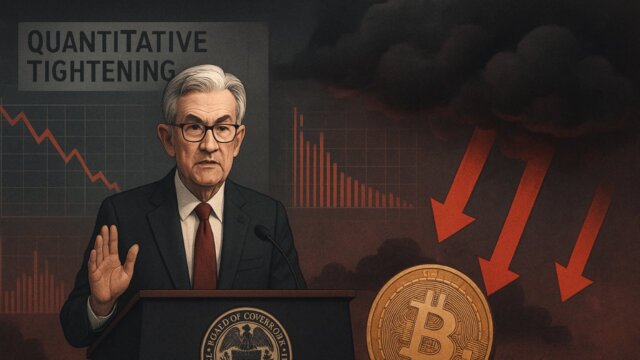
- Federal Reserve Chairman Jerome Powell announcement that quantitative tightening (QT) may be nearing its end has stirred both Wall Street and the crypto community.
- Despite this potentially bullish signal, Bitcoin (BTC) remains subdued, unable to shake off the persistent bearish sentiment that has dominated crypto trading desks in recent weeks.
- Powell’s remarks hinted at a more cautious monetary stance, but the leading cryptocurrency’s lackluster response suggests traders and investors may be pricing in a deeper sense of uncertainty about the economic outlook and the real impact of the Fed’s balance sheet policy.
In a development that stirred both Wall Street and the crypto community, Federal Reserve Chairman Jerome Powell indicated that the era of quantitative tightening (QT)—the gradual shrinking of the Fed’s massive balance sheet—could soon be drawing to a close. Yet, despite this potentially bullish signal for liquidity markets, Bitcoin (BTC) remains subdued, unable to shake off the persistent bearish sentiment that has dominated crypto trading desks in recent weeks. While Powell’s remarks hinted at a more cautious monetary stance, the leading cryptocurrency’s lackluster response suggests that traders and investors may be pricing in a deeper sense of uncertainty about the economic outlook and the real impact of the Fed’s balance sheet policy.
Powell’s Message
Speaking at the National Association for Business Economics Conference in Philadelphia, Powell outlined the Federal Reserve’s evolving approach to its balance sheet reduction program. In his own words:
“Our long-stated plan is to stop balance sheet runoff when reserves are somewhat above the level we judge consistent with ample reserve conditions,”
Powell emphasized that this inflection point could arrive “in the coming months”, signaling that the central bank may soon take a step back from its aggressive liquidity tightening campaign. For context, quantitative tightening (QT) began in 2022, as the Fed sought to unwind the massive stimulus it had injected during the pandemic years. At its peak, the Fed’s balance sheet ballooned to around $9 trillion, driven by emergency asset purchases to stabilize markets during the COVID crisis. As of today, that figure stands at approximately $6.6 trillion—a substantial reduction, but still historically large by any measure. Powell’s comments reinforce the idea that the central bank is keen to avoid over-tightening, wary of a scenario where banking reserves fall too low. If reserves become scarce, it could trigger stress in short-term funding markets, potentially causing ripple effects across global financial systems.
The Fed’s Balancing Act
The Federal Reserve’s challenge lies in walking a delicate line between fighting inflation and maintaining financial stability. With inflation gradually cooling from its post-pandemic highs, policymakers are now more comfortable discussing the pace and timing of balance sheet normalization. However, Powell’s message was measured. He noted that the Fed is “closely monitoring a wide range of indicators” before deciding when to officially end QT. Among those indicators are overnight funding rates, a key gauge of liquidity stress within the banking system. Recent data has shown that overnight repo rates have been edging higher, hinting that reserves may already be nearing the lower threshold of what the Fed considers “ample.” Such signals are likely driving the central bank’s caution.
Rate Cuts Are Back on the Table
While Powell avoided making any firm commitments regarding interest rate cuts, markets have already begun pricing in two additional rate reductions—each of 25 basis points—by the end of the year. These would follow a similar cut made in September, which marked the Fed’s first rate trim since 2020. The prospect of a softer monetary stance has injected a dose of optimism into some corners of the crypto market, with commentators on X (formerly Twitter) expressing hope that easier liquidity conditions could spark renewed demand for risk assets like Bitcoin. However, those hopes have yet to materialize in price action.
Bitcoin’s Tepid Response
Despite the potential for a dovish policy pivot, Bitcoin’s reaction has been notably muted. As of this writing, BTC trades around $112,600, holding relatively flat over the past 24 hours. Market sentiment, as reflected in options data from Deribit, reveals a clear bearish bias. Short-term puts—contracts that protect investors from price declines—are commanding higher premiums than calls, which benefit from price gains. Even longer-dated options, extending out to March 2026, display a similar pattern of caution. This skew in the options market underscores the perception that the end of QT doesn’t automatically translate into easy money. Traders seem to recognize that the Fed’s balance sheet policy is only one piece of a much larger macroeconomic puzzle.
Why Bitcoin Isn’t Rallying
During the pandemic years, the rapid expansion of the Fed’s balance sheet acted as a powerful catalyst for Bitcoin and other digital assets. With trillions of dollars flooding into the system, investors were eager to chase returns in alternative stores of value and high-risk speculative assets. But this time, the setup looks different. Even though QT is slowing, the pace of liquidity injection remains tepid compared to the explosive money supply growth of 2020 and 2021. The Fed has already slowed its runoff pace since mid-2024, capping monthly Treasury redemptions at $5 billion and mortgage-backed securities (MBS) redemptions at $35 billion. That means that even if QT officially ends, it won’t necessarily usher in a wave of new liquidity. In other words, the Fed may stop tightening—but it isn’t easing yet.
Analysts’ Take: “A Slow End, Not a Reversal”
Market analysts have echoed this cautious tone. An independent analyst who goes by Markets and Mayhem on X summarized the sentiment succinctly:
“The big takeaway from Powell’s talk today was that the QT program is likely to end soon. That means the Fed will probably stop shrinking its balance sheet in the next few months. But since the current reduction pace is already slow, it’s not a major shift.”
This perspective aligns with broader market thinking: while the Fed might soon halt QT, the macro backdrop remains far from stimulative. The central bank is focused on ensuring a smooth transition rather than kickstarting another liquidity boom.
While Jerome Powell’s latest remarks signal that the Federal Reserve’s tightening phase may soon conclude, Bitcoin’s muted response underscores the market’s skepticism. Traders are reading between the lines, recognizing that an end to QT is not the same as a return to stimulus. The crypto market’s cautious mood reflects a broader reality: liquidity remains tight, risk appetite is subdued, and macro uncertainty persists. Until these dynamics shift decisively, Bitcoin’s recovery may remain limited—trapped between fading bearishness and hesitant optimism. Still, for long-term investors, this could represent a period of accumulation and positioning, as history has shown that macro tightening cycles often give way to renewed growth phases once the policy tide turns.
Disclaimer: CryptopianNews shares this for learning and info only. It’s not meant to be financial or investment advice. Crypto markets change a lot and move quickly. Investing in them can be risky. You should always look into things yourself. Talk to a trained financial advisor before making any choices about investing.

- What Is DeSoc Crypto & Why Vitalik Cares - January 28, 2026
- Why Long-Term Bitcoin Holders Are Not Selling Yet - January 26, 2026
- U.S. Cryptocurrency Oversight Faces a Major Senate Shift - January 25, 2026