
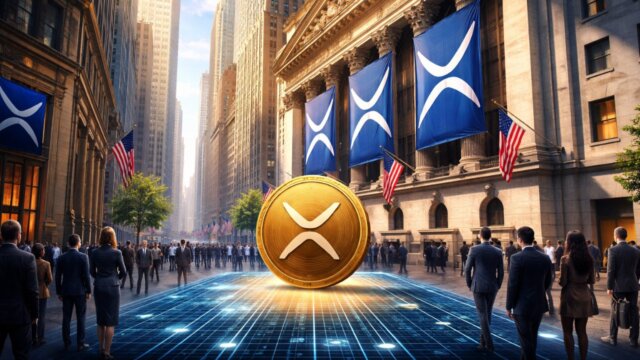
- Companies like Mastercard, BlackRock, and Franklin Templeton are evaluating the XRP Ledger for integration into financial operations, signaling a serious interest in digital asset infrastructure.
- The XRP Ledger’s design makes it appealing for financial services, providing enterprise-ready solutions without complicated technical barriers.
- Increased transaction activity on the XRP Ledger signals real-world adoption, with approximately 1.88 million transactions noted.
Growing Institutional Interest Signals a Shift in Digital Finance
Major financial institutions are increasingly exploring blockchain technology as they search for faster, more transparent, and cost-effective systems. In recent developments, some of the world’s largest financial firms have begun examining how the XRP Ledger could function inside their internal processes, marking another step toward mainstream institutional adoption of digital asset infrastructure. According to statements shared by representatives of XRPL Commons, companies such as Mastercard, BlackRock, and Franklin Templeton have been studying how the XRP Ledger might support real-world financial operations. The information was discussed publicly during a Digital Assets Forum interview by Odelia Torteman, who works closely on corporate adoption initiatives. While these companies have not announced commercial deployments, their technical evaluations highlight how seriously traditional finance is beginning to view blockchain infrastructure.
Three Practical Use Cases Under Review
The institutions examining this technology are not simply experimenting for curiosity’s sake. Their focus revolves around three practical use cases that directly connect to everyday financial operations.
First, cross-border payments remain a top priority. International money transfers still depend heavily on legacy systems that often require multiple intermediaries, leading to delays and higher fees. By testing the XRP Ledger, financial firms are studying whether they can move funds between countries more quickly and at lower cost.
Second, transaction settlement is another key area of interest. Settlement processes—especially in securities and large financial transactions—can take days to complete. Distributed ledger technology offers the possibility of near-instant settlement while providing transparent records accessible to all parties involved.
Third, institutions are looking at digital asset issuance and tokenization. Financial firms are increasingly exploring how real-world assets such as bonds, funds, or commodities can be represented digitally. The XRP Ledger provides built-in mechanisms for issuing and transferring tokens, which could simplify these processes significantly. Each of these use cases addresses long-standing inefficiencies in global finance. Faster transfers, lower operational costs, and improved transparency are not just technical improvements—they could reshape how banks and asset managers operate globally.
A Possible Entry Point for Banks
One of the factors making this technology more appealing to institutions is the removal of certain technical barriers that once complicated adoption. Recent updates from Ripple have simplified integration, making it easier for financial institutions to test the network without requiring complex access layers or specialized infrastructure. This shift has opened the door for banks and payment providers to conduct pilot programs and internal testing. Although these efforts remain in early stages, industry observers see them as an important step toward broader institutional participation. The XRP Ledger was originally designed with financial services in mind, and that heritage continues to shape its capabilities. Unlike some blockchain systems that evolved from experimental or consumer-focused origins, this network was built to handle payments, asset transfers, and settlement workflows from the start. That design philosophy has helped attract attention from organizations seeking enterprise-ready solutions.
Rising Transaction Activity Shows Real-World Usage
Beyond institutional trials, network activity is also increasing. Payment volume has climbed to roughly 1.88 million transactions, a figure that analysts interpret as evidence of real-world adoption rather than purely speculative use. In many cases, digital assets are being used as bridge instruments between fiat currencies and tokenized assets. This process reduces the need for banks to maintain prefunded accounts in multiple jurisdictions—an expensive requirement in traditional cross-border banking. By using the XRP Ledger, financial institutions may be able to streamline liquidity management and move capital more efficiently across borders. These operational efficiencies are particularly important for global institutions managing billions of dollars in daily transactions. Even small percentage savings in settlement costs or liquidity requirements can translate into substantial financial benefits.
Tokenization Could Accelerate Demand
Another factor driving institutional interest is the rapid growth of tokenization. A digital assets advisor connected to the White House recently suggested that tokenization of financial instruments could become widespread within one to three years. If that timeline proves accurate, the financial sector will require infrastructure capable of handling both digital tokens and traditional currencies within the same ecosystem. Many analysts believe that networks like the XRP Ledger are positioning themselves to meet that need by offering integrated settlement, asset issuance, and payment capabilities. For large financial firms, the appeal lies not only in speed but also in transparency. Blockchain-based records provide auditable transaction histories that regulators and auditors can verify more easily than some legacy systems.
The growing interest of major financial institutions in blockchain infrastructure marks an important turning point in the evolution of digital finance. Companies such as Mastercard, BlackRock, and Franklin Templeton are not merely observing from the sidelines—they are actively testing how distributed ledger systems could improve payments, settlement, and asset issuance. While full-scale deployment may still be some distance away, the direction of travel is clear: the financial industry is steadily moving toward faster, more transparent, and more efficient systems. As tokenization gains momentum and regulatory clarity improves, the experiments taking place today could shape the global financial architecture of tomorrow.
Disclaimer: CryptopianNews shares this for learning and info only. It’s not meant to be financial or investment advice. Crypto markets change a lot and move quickly. Investing in them can be risky. You should always look into things yourself. Talk to a trained financial advisor before making any choices about investing.

- Wall Street Eyes XRP Ledger for Institutional Finance - February 16, 2026
- BOJ rate hike Could Shake Bitcoin and Global Crypto Markets - February 14, 2026
- Bitcoin Performance in August: Stability or Surprise? - February 12, 2026