

Key Highlights:
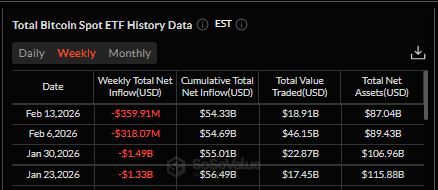
- U.S. spot Bitcoin ETFs recorded nearly $360 million in weekly outflows, marking four consecutive weeks of redemptions.
- A bearish forecast revision from Standard Chartered triggered renewed institutional caution.
- Major products such as BlackRock’s IBIT led recent withdrawals.
- Bitcoin price weakness amplified pressure across ETF products.
- Institutional investors appear to be reallocating rather than exiting completely.
ETF Outflows Extend as Sentiment Weakens
U.S. spot Bitcoin exchange-traded funds have posted another week of net redemptions. According to reports, total outflows recently surpassed $410 million in a single stretch. Weekly data now points to roughly $360 million leaving funds, extending the current streak to four weeks.
As a result, bitcoin etf weekly losses continue to dominate market discussion. Investors appear cautious, and fund managers are adjusting allocations accordingly. While ETF inflows surged in late 2025, February has produced a different trend.
Importantly, ETF flows often reflect institutional positioning rather than retail panic. Large allocators tend to rebalance when macro signals shift. Therefore, sustained outflows suggest broader portfolio adjustments rather than emotional selling.
Moreover, assets under management have declined from recent highs. Although total holdings remain substantial, the contraction signals cooling demand. This shift also affects bitcoin etf performance tracking metrics across fund issuers.
At the same time, daily trading volumes remain active. Liquidity has not disappeared from the market. Instead, capital rotation appears to be the dominant theme.
Forecast Cuts Trigger Institutional Rebalancing
One of the strongest catalysts behind recent weakness came from Standard Chartered. The bank lowered its 2026 Bitcoin price target from $150,000 to $100,000. That revision changed forward return expectations for many institutional models.
Consequently, portfolio managers reassessed risk exposure. Many funds reduced Bitcoin allocations after the downgrade. Because ETFs offer simple exposure, they often absorb the first wave of selling.
Furthermore, the forecast included warnings of potential downside toward lower support levels. That outlook added to short-term uncertainty. When major banks revise projections, institutional desks tend to respond quickly.
In addition, macroeconomic conditions remain mixed. Interest rate expectations continue to shift. Equity markets have also shown volatility. Since Bitcoin increasingly trades like a risk asset, those macro signals influence ETF demand.
For example, the New York Post recently highlighted sharp Bitcoin price swings during February. Price weakness toward the mid-$60,000 range intensified defensive positioning. As prices softened, ETF holders trimmed exposure.
Therefore, macro caution and forecast revisions combined to pressure flows. Neither factor alone explains the trend. However, together they created a clear risk-off environment.
Major Funds Lead the Redemptions
Large issuers experienced the most visible withdrawals. BlackRock’s iShares Bitcoin Trust recorded notable outflows during recent sessions. Similarly, Fidelity Investments’ FBTC also saw redemptions.
These two products represent a substantial share of total ETF assets. When they experience withdrawals, aggregate numbers shift quickly. Smaller funds contribute less to overall volatility.
However, it is important to note that outflows do not necessarily imply structural weakness. Institutions frequently rotate between asset classes. Some capital may move into fixed income or defensive equities.
Additionally, certain alternative crypto ETFs have shown minor inflows. This divergence suggests selective allocation rather than blanket crypto avoidance. Investors may be adjusting exposure based on relative opportunity.
Meanwhile, bitcoin etf performance tracking remains closely tied to spot price movements. Because ETFs mirror underlying Bitcoin value, price weakness amplifies redemption activity. When prices stabilize, flows often normalize.
Historical data supports that pattern. Previous correction phases also produced temporary ETF outflows. Yet inflows returned once sentiment improved.
Bitcoin Market Update February 2026: What Investors Watch
The current bitcoin market update February 2026 centers on three factors: price stability, macro signals, and ETF flows. These elements interact continuously.
First, price support levels remain critical. If Bitcoin holds above key technical zones, confidence may recover. Conversely, a break lower could extend selling pressure.
Second, macro data continues to influence capital flows. Inflation reports and central bank commentary shape risk appetite. Because Bitcoin correlates with growth assets, those signals matter.
Third, ETF flow data provides near-real-time insight into institutional positioning. Analysts monitor daily net flows to gauge sentiment shifts. A return to positive weekly numbers would mark an important inflection point.
Nevertheless, long-term institutional interest remains intact. Total ETF assets still represent billions in capital. Therefore, the present streak reflects caution rather than capitulation.
In summary, bitcoin etf weekly losses highlight short-term defensive positioning. However, the broader market structure remains functional. Liquidity persists, and institutions continue to participate actively.
Read Also: Bitcoin ETF Demand Analysis: How ETFs Reshape Cycles
Disclaimer!! CryptopianNews provides this information for educational and informational purposes only. You should not consider it financial or investment advice. Cryptocurrency markets are highly volatile and speculative, and they carry inherent risks. We advise readers to conduct their own research and to consult with a qualified financial advisor before making any investment decisions.

- Tensor Coin (TNSR) Update: 216M Burn, Supply and 2026 Developments - October 3, 2026
- BTC stuck in a range: Large Buyers Signal Strength - July 20, 2026
- CLARITY Act Odds Drop to 35% After DOJ Warning - July 18, 2026