
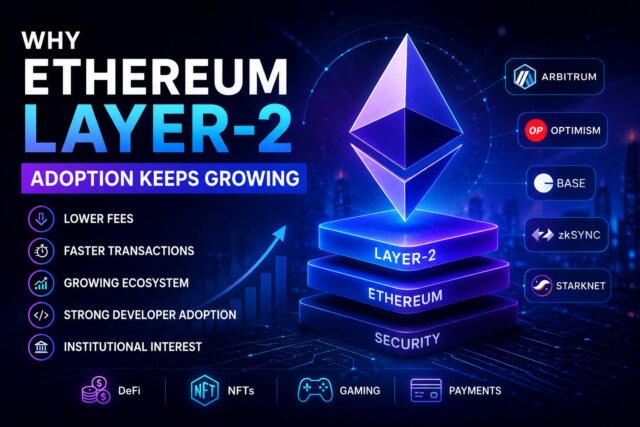
- Lower transaction fees
- Faster blockchain transactions
- Growing DeFi and gaming activity
- Strong developer adoption
- Increasing institutional interest
Ethereum continues to dominate the blockchain industry as the leading network for decentralized applications, decentralized finance, NFTs, and smart contracts. However, as Ethereum became more popular, the network also faced one major issue: scalability. Millions of users entering the ecosystem created congestion, slower transaction speeds, and extremely high gas fees.
This challenge led to the rise of Ethereum Layer-2 solutions. These networks are designed to help Ethereum process transactions more efficiently while maintaining the security of the Ethereum blockchain itself. Over the last few years, Layer-2 adoption has grown rapidly, and many experts now believe these scaling networks represent the future of Ethereum.
Today, Layer-2 ecosystems are becoming essential for crypto users, developers, and institutions. From decentralized exchanges to blockchain gaming platforms, more applications are moving toward Layer-2 infrastructure because it offers faster and cheaper transactions.
Understanding Ethereum Layer-2 Networks
Ethereum Layer-2 solutions are secondary networks built on top of Ethereum. Instead of handling every transaction directly on Ethereum’s main blockchain, Layer-2 platforms process activity separately before sending final transaction data back to Ethereum.
This approach significantly reduces congestion on the main network while improving efficiency for users.
Popular Ethereum Layer-2 networks include Arbitrum, Optimism, Base, zkSync, Starknet, and Polygon. These ecosystems are attracting millions of users because they solve one of Ethereum’s biggest long-term problems.
Rather than replacing Ethereum, Layer-2 networks strengthen the ecosystem by helping it scale globally.
Ethereum’s Scalability Problem Created Demand
Ethereum’s popularity has always been both its strength and weakness. As decentralized finance exploded during previous crypto bull markets, Ethereum usage surged dramatically. The network became crowded, and gas fees increased to levels that many users could not afford.
At times, users paid more than $50 simply to swap tokens or interact with decentralized applications. Small investors and new crypto users were pushed away because blockchain activity became too expensive.
This created demand for scaling solutions that could maintain Ethereum’s security while improving affordability.
Layer-2 networks quickly emerged as the best solution because they allowed transactions to happen faster and cheaper without abandoning the Ethereum ecosystem.
Lower Fees Continue Attracting Users
One of the main reasons Ethereum Layer-2 adoption keeps growing is the dramatic reduction in transaction costs.
Ethereum mainnet transactions can still become expensive during periods of heavy activity. In contrast, Layer-2 transactions often cost only a fraction of a dollar.
For regular users, this creates a significantly better experience. Traders can execute more transactions efficiently, NFT users can mint and transfer assets affordably, and blockchain games can operate smoothly without high fees interrupting gameplay.
Lower fees also make blockchain technology accessible to users in developing regions where transaction costs matter even more.
As the crypto industry grows globally, affordability is becoming essential for mainstream adoption, and Layer-2 solutions are helping Ethereum remain competitive.
Faster Transactions Improve the Entire Ecosystem
Transaction speed is another major reason why Layer-2 adoption is accelerating.
Ethereum mainnet transactions may slow down during busy periods, especially when demand spikes. Layer-2 networks process transactions much faster, often within seconds.
This faster experience is extremely important for decentralized finance applications. Traders expect quick execution when swapping tokens or managing positions. Delays can lead to losses during volatile market conditions.
Gaming applications also require near-instant interactions because users expect performance similar to traditional online games.
The improved speed of Layer-2 ecosystems helps blockchain applications feel more user-friendly and practical for everyday use.
Rollup Technology Is Powering Growth
Most Ethereum Layer-2 solutions rely on rollup technology.
Rollups combine multiple transactions together before submitting them to Ethereum. This reduces the amount of data Ethereum needs to process directly while maintaining security and decentralization.
There are two primary forms of rollups currently dominating the industry.
Optimistic rollups assume transactions are valid unless challenged later. Networks like Arbitrum and Optimism use this model.
Zero-knowledge rollups, often called ZK rollups, use advanced cryptographic proofs to verify transactions more efficiently. zkSync and Starknet are leading examples of this technology.
Many developers believe rollups represent Ethereum’s long-term scaling future because they offer a strong balance between speed, security, and decentralization.
Ethereum itself is increasingly evolving to support rollup infrastructure more effectively.
Ethereum Upgrades Are Supporting Layer-2 Expansion
Ethereum developers continue improving the blockchain specifically to help Layer-2 ecosystems scale further.
Recent upgrades have focused heavily on reducing operational costs for rollup networks and improving transaction efficiency.
The Dencun upgrade became an important milestone because it introduced blob transactions designed to lower Layer-2 costs significantly.
After the upgrade, transaction fees across several Layer-2 networks dropped even further, making them more attractive for users and developers.
This shows how closely Ethereum’s future is connected to Layer-2 adoption.
Instead of processing every transaction directly on the main blockchain, Ethereum is becoming the foundation layer that secures an entire ecosystem of scaling solutions.
Developers Prefer Building on Layer-2 Networks
Developer activity is another major factor driving adoption growth.
Building decentralized applications on Ethereum mainnet can become expensive for users, which limits growth potential. Layer-2 ecosystems allow developers to create applications with lower costs and smoother experiences.
As a result, many new crypto projects are launching directly on Layer-2 networks.
Decentralized exchanges, lending protocols, NFT marketplaces, social applications, blockchain games, and payment systems are all expanding rapidly across Layer-2 ecosystems.
As more applications launch, more users enter these networks, creating a powerful cycle of growth.
Several major Ethereum-native projects are also integrating Layer-2 support to remain competitive in the evolving blockchain market.
Institutional Interest Keeps Increasing
Large institutions are also paying closer attention to Ethereum scaling infrastructure.
Many companies recognize that blockchain adoption cannot expand globally without solving scalability challenges. Layer-2 ecosystems provide a practical path toward mass adoption while still using Ethereum’s trusted security framework.
Coinbase launching the Base Layer-2 network showed how major companies are now directly investing in Ethereum scaling ecosystems.
Institutions are exploring Layer-2 technology for stablecoins, tokenized assets, financial settlements, and enterprise blockchain applications.
As institutional adoption grows, Layer-2 networks may attract even larger amounts of liquidity and development activity.
Gaming and NFTs Are Fueling Adoption
Blockchain gaming and NFTs are playing an important role in Layer-2 expansion.
Games require constant transactions between players, marketplaces, and digital assets. High fees on Ethereum mainnet make this difficult.
Layer-2 networks solve this problem by allowing low-cost and high-speed interactions.
NFT ecosystems also benefit because users can mint, buy, and transfer digital assets more affordably.
This creates a more practical environment for creators, collectors, and gaming communities.
As Web3 gaming continues developing, Layer-2 networks are expected to become increasingly important infrastructure providers.
Security Gives Ethereum an Advantage
Despite competition from alternative blockchains, Ethereum continues maintaining a strong position because of security and decentralization.
Most Layer-2 networks inherit Ethereum’s security model by settling transactions back to Ethereum itself.
This gives users and developers greater confidence compared to some standalone blockchains with weaker decentralization.
For institutions especially, Ethereum’s security reputation remains extremely valuable.
Many developers prefer building within the Ethereum ecosystem because it combines strong security with growing scalability solutions.
Challenges Still Remain
Although adoption is growing quickly, Layer-2 ecosystems still face challenges.
Liquidity remains fragmented across multiple networks, which can create inefficiencies for users and traders.
Bridging assets between networks can also introduce risks and complexity.
New users sometimes struggle understanding how different Layer-2 systems work.
Competition between ecosystems is also increasing rapidly as projects fight for users and developers.
However, infrastructure continues improving every year. Wallets, exchanges, and decentralized applications are making Layer-2 interactions easier and more seamless.
Over time, many users may interact with Layer-2 networks without even realizing it.
The Future of Ethereum Layer-2 Adoption
Ethereum Layer-2 adoption continues growing because these networks solve some of the biggest limitations facing blockchain technology.
Lower fees, faster transactions, improved user experiences, growing developer ecosystems, and increasing institutional interest are all driving expansion.
Layer-2 networks are no longer experimental projects. They are becoming critical infrastructure for decentralized finance, blockchain gaming, NFTs, payments, and future Web3 applications.
As crypto adoption expands globally, scalable blockchain infrastructure will become increasingly important.
Ethereum’s future is now deeply connected to Layer-2 ecosystems, and many experts believe these scaling solutions will play a central role in bringing blockchain technology to mainstream users worldwide.
Why DePIN Is Growing Fast and Why the Crypto Industry Is Paying Attention
Disclaimer: CryptopianNews shares this for learning and info only. It’s not meant to be financial or investment advice. Crypto markets change a lot and move quickly. Investing in them can be risky. You should always look into things yourself. Talk to a trained financial advisor before making any choices about investing.
