

- Bitcoin ETF Demand Analysis reveals how institutional inflows and spot ETFs are reshaping Bitcoin’s market cycle and pushing prices toward $100,000.
- Recent movements toward six figures are primarily fueled by steady inflows into U.S. spot Bitcoin exchange-traded funds (ETFs), rather than retail speculation.
- The rise of Bitcoin above $97,000 has rekindled market discussions about potential resistance levels, with analysts noting a shift from retail-driven dynamics to institutional engagement.
- Significant net inflows of nearly $1.5 billion into U.S. ETFs suggest a sustainable accumulation of Bitcoin by institutional investors, including corporate treasury desks and family offices.
- Analysts indicate that consistent inflow patterns highlight a mature market where demand is being absorbed without excessive leverage or speculative behavior.
Bitcoin’s relentless journey toward the symbolic $100,000 milestone is entering a new era — one heavily influenced by institutional capital, structural demand, and a different market psychology compared to earlier bull runs. In recent months, the world’s largest cryptocurrency has edged closer to six-figure territory, but unlike prior explosive rallies characterized by retail euphoria and speculative leverage, this movement is being shaped by sober, steady inflows into U.S. spot Bitcoin exchange-traded funds (ETFs). This trend has prompted analysts, market makers, and seasoned crypto observers to re-evaluate how the next leg of Bitcoin’s cycle may develop. The key question hovering over the market is whether the arrival of ETFs and deeper Wall Street participation marks a historic shift in how Bitcoin rallies, corrects, and ultimately matures. A detailed look at Bitcoin ETF demand analysis helps illuminate how these forces are converging at a time when indicators suggest a new market structure may be forming.
A Dramatic Move Back Above $97,000 Rekindles Market Debate
Bitcoin’s climb back above $97,000 this week has reignited speculation about where the next significant resistance might lie. Just months earlier, Bitcoin spent a long period oscillating near the $88,000 range—a level that analysts described as a consolidation floor rather than a breakdown pivot. What makes this rebound notable is not merely the price level itself, but the source of capital driving it. Previous cycle tops were often achieved through massive retail participation, meme-driven narratives, speculative leverage, and altcoin correlations. This time, however, the story is shifting. Spot Bitcoin ETFs in the U.S. have become a major conduit for inflows, drawing the kind of buyers that operate on long time horizons, rather than chasing quick-fire momentum. These entities include:
- ETF managers pooling institutional funds
- Corporate treasury desks hedging macro risk
- Long-only asset allocators and family offices
- Registered investment advisors (RIAs) rebalancing portfolios
This dynamic is crucial because it changes how Bitcoin moves. Instead of flash rallies followed by violent liquidations, the market now appears to be digesting new demand in a more measured fashion. Traders describe this as a sign that Bitcoin’s maturation is catching up to its narrative.
ETF Inflows Signal a Stable Bid Rather Than Speculative Frenzy
Fresh data from U.S. spot Bitcoin ETFs shows nearly $1.5 billion in net inflows since the start of the year, according to Bloomberg ETF analyst Eric Balchunas. Notably, one single trading day saw $843.6 million in net inflows, while weekly totals reached approximately $1.07 billion. These are not casual numbers—they reveal the presence of real capital and growing institutional commitment.
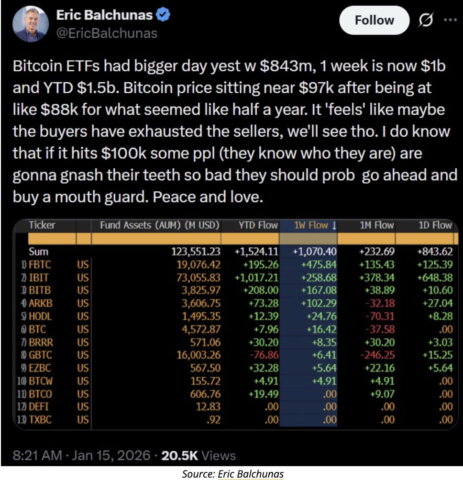
But analysts emphasize that it’s not the size of the spikes that matters most—it’s the consistency. While crypto is known for headline-grabbing volatility, sustained inflow patterns tell a different story about how the asset is being accumulated. Balchunas even remarked on social media that the trend suggests buyers may have “exhausted the sellers,” implying that the supply overhang that kept Bitcoin trapped for months may finally be clearing. In practical terms, this aligns with the observable data: as ETF demand absorbs available sell pressure, price begins to move upward without requiring excessive leverage. At press time, Bitcoin trades near the $97,000 level. The fundamentals also show an intriguing development: this rally is occurring without the heavy participation of perpetual futures leverage, margin longs, or retail speculation. For proponents of structural Bitcoin adoption, this is the most bullish aspect of the current environment.
Is Institutional Demand Rewriting Bitcoin’s Four-Year Market Cycle?
For over a decade, Bitcoin has been shaped by the rhythm of its four-year halving cycles, which reduce block rewards and decrease new supply issuance. Historically, these events precede explosive bull runs that peak roughly 12 to 18 months after the halving. The pattern held through the 2013, 2017, 2021, and early 2025 cycles.
But what happens when Wall Street begins buying with decades-long horizons instead of month-long speculation? This is the question reshaping today’s Bitcoin ETF demand analysis, because ETF inflows are not behaving like traditional crypto cycles. Instead of sharp blow-off tops triggered by retail mania, Bitcoin’s recent peaks appear more methodical and demand-driven. Curiously, when Bitcoin set new all-time highs in 2025, this did not ignite the classic “altcoin season” that many crypto traders anticipated. Altcoins lagged significantly, retail enthusiasm dwindled, and crypto social sentiment failed to match the frenzy of 2021. This decoupling shocked many market participants. The absence of altcoin participation during Bitcoin’s rise indicates that Bitcoin now has enough institutional gravity to rally without dragging the rest of the crypto market with it. That’s not merely unusual — it may signal a broader shift in how capital allocates within the digital asset ecosystem.
Wintermute: The Recovery Will Depend on ETF Issuers and Treasury Buyers
Crypto market maker Wintermute offered pointed commentary on the evolving dynamics. According to the firm, 2026 could be shaped by whether ETF managers and corporate digital asset treasury desks continue accumulating Bitcoin — or broaden their strategies to include other crypto assets. This insight highlights the new gatekeeping role that ETFs and corporate buyers now play. If ETFs and corporate treasuries merely hoard Bitcoin while ignoring the broader crypto landscape, altcoins may continue to languish. But if ETF issuers pursue diversification, or new crypto ETFs extend beyond Bitcoin dominance, capital could start to trickle into other sectors, potentially reviving the long-neglected “wealth effect” that historically boosts retail participation. The firm also observed that Bitcoin’s institutional rally has gone largely unmatched by crypto-native retail demand. Without widespread retail euphoria, speculative dynamics such as meme-coin pumps, NFT bubbles, and social trading cycles fail to ignite.
Retail Investors Sit Out the Rally — and Institutions Take the Wheel
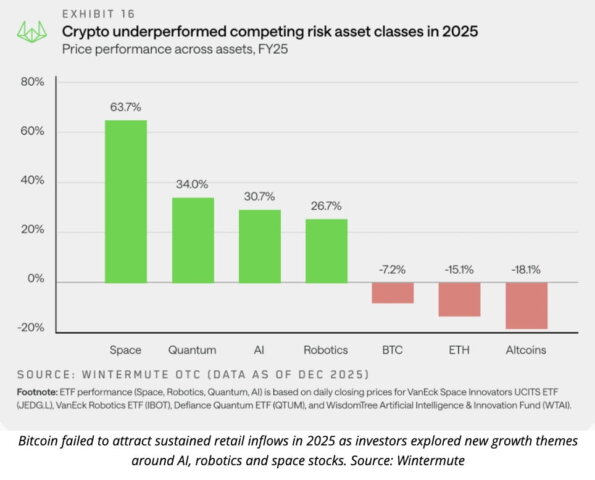
The retail crowd that once defined crypto’s cultural identity has, at least temporarily, moved on. According to Wintermute’s analysis, retail investors largely remained on the sidelines throughout 2025, pursuing different growth themes such as:
- Artificial Intelligence (AI)
- Advanced robotics
- Space and aerospace
- Defense technology
- Semiconductor stocks
In prior cycles, crypto competed primarily with equities and commodities. Today, it competes with thematic investment narratives fueled by major breakthroughs in science and technology. With retail capital migrating to sectors promising revolutionary real-world applications, Bitcoin’s rebound has been led by the types of investors who typically accumulate through index products and long-term strategies, not hype cycles. The absence of retail speculation gives institutions unprecedented control over Bitcoin’s market trajectory. Instead of price action dictated by leveraged longs or meme sentiment, the bid is now coming from:
- Corporate balance sheet allocations
- Fund managers hedging macro uncertainty
- ETF issuers aggregating diversified capital
- Family offices executing long-duration plays
- Endowments and pensions experimenting with digital reserves
These buyer categories rarely enter and exit positions rapidly. Their strategies may offer the kind of slow-burn stability that Bitcoin has never experienced at meaningful scale until now.
How Structural Demand Could Reshape Bitcoin
Bitcoin is currently hovering just below the psychologically significant $100,000 resistance — a level that carries symbolic power far beyond a typical price milestone. Traders now debate whether ETF inflows alone are robust enough to propel Bitcoin into the next pricing zone, potentially between $100,000 and $120,000, or whether fresh catalysts will be required.
A New Type of Bitcoin Bull Market Is Emerging
Bitcoin is now entering a phase where institutional demand, ETF inflows, and corporate participation may permanently rewrite the dynamics of market cycles. The asset’s current trajectory — hovering near $100,000 — is driven more by structural inflows than by speculative euphoria. The most important story unfolding today is that Bitcoin ETF demand analysis reveals a new class of long-duration buyers who do not behave like crypto-native traders.
This institutionalization may delay or dampen traditional cycle patterns, but it could also extend Bitcoin’s maturity into a new paradigm where supply scarcity and sustained accumulation ultimately outweigh speculative retail waves. If ETF inflows maintain strength, 2026 could showcase a very different type of bull market — one defined not by hype, but by steady balance sheet adoption and financial integration. Either way, the world is watching closely as Bitcoin edges nearer to its six-figure frontier. The next time retail returns to the market, they may find Bitcoin already transformed by the silent, disciplined capital of Wall Street.
Disclaimer: CryptopianNews shares this for learning and info only. It’s not meant to be financial or investment advice. Crypto markets change a lot and move quickly. Investing in them can be risky. You should always look into things yourself. Talk to a trained financial advisor before making any choices about investing.

- Bitcoin tightest session: Why Traders Are Watching $65K - July 20, 2026
- Can 5x Bitcoin Still Happen This Market Cycle? - July 18, 2026
- Capital Is Chasing AI: Why Bitcoin Is Waiting Its Turn - July 2, 2026