
- A higher XRP price can further reduce XRP transaction cost in fiat terms, since fees are denominated in XRP, not dollars.
- Fewer tokens per transaction may improve efficiency and liquidity handling
- The idea challenges the belief that XRP must stay cheap to work for payments
Ripple’s long-time technology leader, David Schwartz, recently clarified a key concept that many people misunderstood for years. His explanation focuses on how pricing affects efficiency, not speculation. In simple terms, as the value of XRP rises, the mechanics of sending money can become more streamlined. This directly impacts XRP transaction cost, especially in high-value transfers. Many crypto users assume that a lower price makes a digital asset more useful for payments. However, Schwartz argues the opposite in certain cases. His logic is practical and rooted in how value moves across networks.
How Higher XRP Price Impacts XRP Transaction Cost
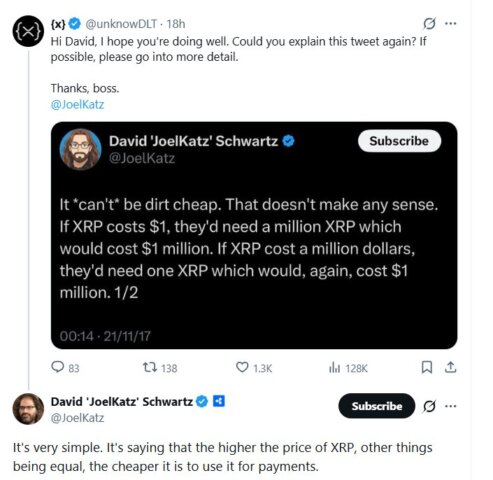
When XRP’s price increases, each token carries more value. As a result, users need fewer tokens to send the same amount of money. For example, if XRP is worth $1, you need 1 million XRP to send $1 million. However, if XRP rises to $10, you only need 100,000 XRP. This reduction in token volume can make transactions more efficient. Fewer tokens mean less data to process and potentially faster execution. Moreover, liquidity providers don’t need to handle massive token quantities, which simplifies operations. In addition, this shift can lower the XRP transaction cost indirectly. Even though XRP fees are already tiny, using fewer tokens reduces friction in the system. Therefore, institutions may find it easier to adopt XRP for cross-border payments.
Debunking the “Low Price Is Better” Myth
For years, a common belief has circulated in the crypto space. Many people think XRP must stay cheap to remain useful for payments. However, this idea does not fully reflect how financial systems work. David Schwartz clarified that price and utility are not opposites. Instead, they can complement each other. A higher price does not make XRP harder to use. On the contrary, it can enhance efficiency in large-scale transactions. Furthermore, analysts explained that Schwartz’s earlier example from 2017 was misunderstood. He was not predicting extreme prices like $1 million per XRP. Instead, he was showing how payment mechanics improve when fewer units are required. Consequently, the focus should remain on functionality, not speculation.
Why Efficiency Matters for Global Payments
Global payments require speed, reliability, and low costs. XRP was designed to meet these needs from the start. However, efficiency becomes even more important when dealing with large institutions and cross-border transfers. When fewer XRP tokens are needed, transactions become easier to manage. This is especially important for banks and payment providers. They prefer systems that reduce complexity and risk. Therefore, a higher XRP price can support better liquidity management. Additionally, streamlined transactions can improve network performance. With less congestion and simpler processing, XRP can scale more effectively. As a result, the overall XRP transaction cost becomes more competitive compared to traditional systems. In the long run, this efficiency could drive wider adoption. Financial institutions care more about performance than price levels. So, if XRP delivers faster and cheaper transfers, its value proposition strengthens significantly.
Conclusion
David Schwartz’s clarification helps clear up a major misunderstanding about XRP. A higher price does not limit its usefulness. Instead, it can make transactions more efficient by reducing the number of tokens needed. This directly influences XRP transaction cost, especially in large transfers where efficiency matters most. While price speculation often dominates crypto discussions, real-world utility tells a different story. Ultimately, XRP’s strength lies in its ability to move value quickly and cheaply. As adoption grows, efficiency improvements could play a key role in shaping its future in global payments.
Disclaimer: CryptopianNews shares this for learning and info only. It’s not meant to be financial or investment advice. Crypto markets change a lot and move quickly. Investing in them can be risky. You should always look into things yourself. Talk to a trained financial advisor before making any choices about investing.

- Save Trading Fees with STONFI on TON Network - March 31, 2026
- XRP transaction cost Explained: Why Higher Prices Save Fees - March 30, 2026
- Ethereum Layer 2 Faces Criticism From Vitalik - March 29, 2026