

Key Takeaways
- Bitcoin and Ethereum are recording sustained capital withdrawals across ETF and on-chain metrics.
- Realized cap data reflects weakening net inflows and rising realized losses in early 2026.
- Institutional redemptions are accelerating, reinforcing bearish liquidity signals.
- These developments are central to current crypto market capital flows analysis.
Capital Flow Breakdown and Market Structure Shifts
The bitcoin eth capital outflows 2026 narrative has intensified as institutional and on-chain data converge toward a consistent trend. Capital flows represent the net movement of funds into or out of crypto assets. When inflows dominate, realized capitalization expands and price momentum stabilizes. However, when outflows persist, liquidity contracts and volatility often rises.
According to recent report, Bitcoin entered early 2026 under visible structural strain Bitcoin ETFs See Fourth Week of Losses $360M. ETF redemptions increased while realized losses mounted across several trading sessions. As a result, market depth thinned, and downside pressure accelerated.
Ethereum mirrored portions of this trend, although earlier realized cap growth had briefly outpaced competing networks. Nevertheless, once broader risk appetite faded, both BTC and ETH began experiencing synchronized capital withdrawals. Consequently, liquidity dynamics shifted from accumulation toward defensive positioning.
Importantly, capital flow deterioration tends to appear in data before sharp price collapses. Therefore, analysts closely monitor realized cap expansion rates and ETF subscription metrics for confirmation. In 2026, those signals have leaned negative.
Glassnode Realized Cap Outflows Trends and On-Chain Signals
The concept of realized capitalization plays a crucial role in crypto market capital flows analysis. Unlike market cap, realized cap values coins at their last moved price, which reveals aggregate investor cost basis. When new capital enters at higher prices, realized cap rises. Conversely, stagnation suggests demand exhaustion.
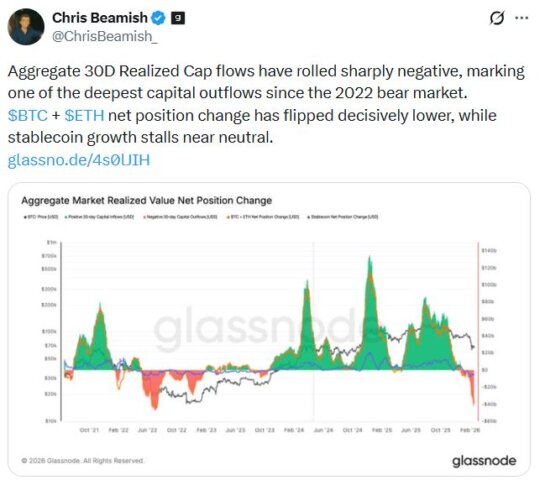
Recent insights from Glassnode indicate that Bitcoin’s realized cap growth slowed materially in early 2026. Daily realized losses reportedly exceeded $1 billion during peak stress intervals. Such data points highlight active distribution rather than passive holding.
Ethereum’s realized cap trajectory also moderated after previous expansion phases. Although ETH once led net on-chain inflows relative to several alternative networks, that strength diminished as macro uncertainty intensified. Consequently, glassnode realized cap outflows trends now reflect broader capital caution.
Moreover, the MVRV ratio for Bitcoin declined toward levels historically associated with compressed profitability. While these zones sometimes precede recovery, they also confirm investor stress. Therefore, on-chain metrics collectively signal weakening structural support.
In addition, exchange flow balances show elevated coin transfers toward trading venues during volatile sessions. That pattern typically aligns with heightened sell-side liquidity. As these movements accumulate, they reinforce net outflow dynamics.
ETF Redemptions and Institutional Liquidity Withdrawal
Spot ETF activity provides transparent evidence of institutional positioning. When ETFs attract subscriptions, underlying spot demand strengthens. However, when redemptions dominate, authorized participants withdraw liquidity from the ecosystem.
Throughout early 2026, Bitcoin ETFs recorded several weeks of net redemptions. Reports summarized documented multi-hundred-million-dollar weekly outflows. In some instances, cumulative withdrawals surpassed one billion dollars within short time frames.
Ethereum investment products experienced similar, though smaller-scale, redemptions. While ETH inflows briefly outpaced peers in prior quarters, recent capital rotation reversed that momentum. Consequently, institutional exposure appears to be contracting rather than expanding.
Because ETF flows represent regulated capital pools, their behavior carries signaling weight. When institutions scale back allocations, retail sentiment often follows. Therefore, ETF outflows amplify broader bearish narratives.
Additionally, macroeconomic tightening and higher real yields likely influence allocation decisions. When alternative safe-yield instruments become attractive, speculative capital can retreat from digital assets. As a result, ETF redemption waves may persist until macro conditions stabilize.
Broader Implications for 2026 Liquidity Cycles
The persistence of bitcoin eth capital outflows 2026 extends beyond isolated volatility events. Instead, it reflects a broader liquidity cycle transition. Historically, sustained outflows from major assets precede sector-wide consolidation phases.
Within crypto market capital flows analysis frameworks, analysts observe three key developments. First, liquidity concentration shifts away from risk assets during uncertainty spikes. Second, realized cap growth slows as fewer new participants enter. Third, volatility increases due to thinner order books.
Furthermore, smaller market-cap tokens tend to experience amplified swings when flagship assets weaken. Because Bitcoin and Ethereum anchor overall liquidity, their capital stability supports the broader ecosystem. When both undergo net withdrawals, secondary markets often struggle.
However, structural resets sometimes establish long-term accumulation zones. When realized losses peak and outflows moderate, equilibrium conditions can gradually form. Until that stabilization emerges, liquidity contraction remains the dominant theme.
2026 data underscores a decisive shift in institutional and on-chain capital allocation patterns. Realized cap compression, ETF redemptions, and exchange flow signals collectively illustrate tightening liquidity. For analysts tracking glassnode realized cap outflows trends, these metrics define the current cycle stage without ambiguity.
Read Also: Bitcoin ETF Demand Analysis: How ETFs Reshape Cycles
Disclaimer!! CryptopianNews provides this information for educational and informational purposes only. You should not consider it financial or investment advice. Cryptocurrency markets are highly volatile and speculative, and they carry inherent risks. We advise readers to conduct their own research and to consult with a qualified financial advisor before making any investment decisions.

- DeFi’s Shift From Yield to Cash Flow - February 18, 2026
- Bitcoin and ETH Capital Outflows Surge in 2026: Glassnode - February 18, 2026
- Stablecoin Yield Debate Heats Up Inside US Policy Circles - February 14, 2026