
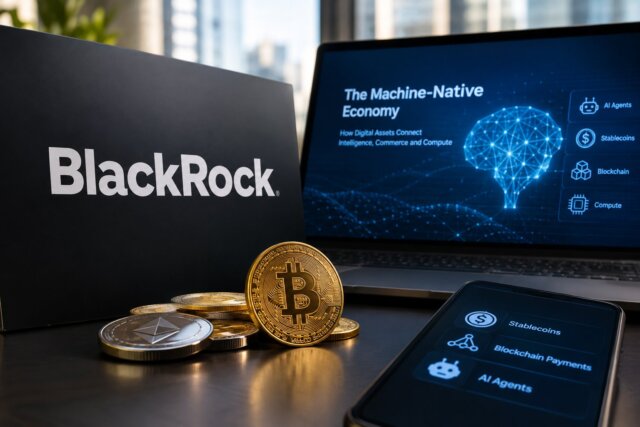
Artificial intelligence may end up creating a new group of crypto users: machines.
That is one of the ideas behind a new BlackRock research paper looking at the growing connection between AI and digital assets. The paper argues that as AI agents become capable of carrying out tasks on their own, they will need ways to pay for data, software, computing power and other services.
BlackRock believes stablecoins could be particularly useful for those transactions.
The firm’s Digital Assets Research team published “The Machine-Native Economy: How Digital Assets Connect Intelligence, Commerce, and Compute” this week. The report examines what could happen as AI systems move from answering questions to taking actions on behalf of people and businesses.
AI Agents Need More Than Intelligence
An AI agent can already do more than generate text or answer a question. Developers are building systems that can search for information, call software tools and complete tasks with limited human intervention.
If that trend continues, money becomes part of the equation.
An agent booking a service, buying access to a database or renting computing power needs a way to pay. It may also need to make many small payments without asking a person to approve every transaction.
That is where BlackRock sees an opening for blockchain networks.
Traditional payment systems were largely designed around people and businesses. Automated machine-to-machine commerce creates a different set of requirements. Transactions may need to happen at any time, in very small amounts and without someone manually entering payment details.
BlackRock says digital assets and programmable payment networks could fit that model.
Why Stablecoins Stand Out
Bitcoin is not the obvious choice for every machine payment because its price can move significantly over short periods.
Stablecoins are different. They are generally designed to track the value of a currency such as the U.S. dollar.
That makes them easier to use when an AI agent needs to pay a known amount for a service.
BlackRock expects stablecoins to have an important role in what it calls agentic commerce. An AI system could potentially use a stablecoin to pay for an API request, obtain data or purchase computing resources.
The technology for this kind of transaction already exists in limited forms. BlackRock points to emerging payment protocols, including Coinbase’s x402, as examples of infrastructure being developed for automated payments.
But the market is still small. AI agents are not yet conducting machine-to-machine payments on anything close to the scale of ordinary consumer or business payments.
That distinction matters.
BlackRock is describing a potential source of future demand rather than reporting that AI agents have already become a major driver of crypto usage.
Computing Power Could Become a Digital Asset
Payments are only part of the argument.
AI requires enormous amounts of computing power. Training and running advanced models depends on GPUs, data centers and cloud infrastructure, and demand for that capacity continues to grow.
BlackRock sees a possible market developing around the computing resources themselves.
The firm’s research suggests that claims on computing capacity could eventually be standardized and represented as digital assets. If that happens, those claims could potentially be traded or used as collateral.
It is a much earlier idea than stablecoin payments.
For a liquid market to develop, buyers and sellers would need standardized contracts and a reliable way to value the underlying computing capacity. BlackRock acknowledges that those markets do not yet exist at scale.
Still, the proposal is notable because it extends the discussion around tokenization beyond familiar assets such as bonds, funds and real estate.
BlackRock Has Already Linked AI and Digital Assets
The new research follows an earlier BlackRock discussion of the relationship between AI and crypto.
In its 2026 thematic research, BlackRock said AI and digital assets could reinforce each other’s adoption in everyday applications. One example involved an AI agent helping a person arrange travel.
The agent could search for flights and hotels, compare information and handle parts of the booking process. Blockchain payments could potentially be used when the agent obtains third-party information or services.
It is an example rather than a prediction of how consumers will book their next holiday.
The underlying point is more practical: an AI system that can make decisions may eventually need its own way to interact with financial infrastructure.
The Payment System Is Only One Piece
There are several problems to solve before that becomes normal.
An autonomous agent handling money raises questions about security and authorization. A user needs to know exactly what an agent is allowed to spend and where it can send funds.
There is also the question of identity. Financial institutions have established procedures for identifying customers and monitoring transactions. Automated software introduces a different participant into that system.
Fees matter too. A machine that makes hundreds or thousands of tiny payments needs an economical payment rail. A transaction that costs more than the service being purchased is not useful.
Regulation could shape the market as well.
Stablecoins are becoming an increasingly important part of digital-asset infrastructure, but the rules governing them and automated financial activity continue to develop across different jurisdictions.
None of these issues makes the idea impossible. They do mean adoption will probably depend on more than simply building the technology.
A Different Route to Crypto Adoption
For years, crypto adoption has largely been discussed in terms of people.
Someone buys Bitcoin. A company accepts stablecoins. An institution adds digital assets to its financial products.
AI introduces another possibility.
Software could become an active participant in the digital economy.
An agent could need data in one transaction, computing power in another and access to a digital service in a third. If those transactions happen automatically and at large scale, the financial infrastructure supporting them could become important.
That is the part of BlackRock’s thesis worth watching.
The firm is not saying that AI agents will suddenly replace conventional payment systems. It is arguing that the growth of autonomous software could create a new reason to use programmable payment networks and digital assets.
Stablecoins may be the first area to benefit because their value is designed to remain relatively stable.
Tokenized computing capacity is a longer-term possibility.
What Happens Next?
The next stage will depend on whether AI agents actually begin conducting economic activity at scale.
For now, the technology is moving faster than the surrounding financial infrastructure. Developers are experimenting with automated payments, while financial firms are exploring tokenization and stablecoins.
If those pieces eventually connect, crypto could gain a new use case that has little to do with people buying tokens for investment.
Machines could become regular participants in digital commerce.
That is still a developing story, not a finished one. But BlackRock’s latest research shows that large financial institutions are beginning to look at AI and crypto as parts of the same economic system rather than two separate technology trends.
CryptopianNews provides this information for educational and informational purposes only. You should not consider it financial or investment advice. Cryptocurrency markets are highly volatile and speculative, and they carry inherent risks. We advise readers to conduct their own research and to consult with a qualified financial advisor before making any investment decisions.

- BlackRock Says AI Agents Could Bring New Demand to Crypto - September 25, 2026
- Bitcoin Highest Weekly Close Signals Bullish Momentum - July 20, 2026
- Biggest Crypto Catalysts to Watch Before the Next Rally - July 18, 2026