

- Crypto during war attracts global capital flows – As uncertainty rises, investors diversify into crypto alongside or instead of gold and stocks for liquidity and resilience.
- Investor behavior is shifting toward digital assets as alternative hedges.
- Bitcoin and Ethereum are attracting both retail and institutional capital.
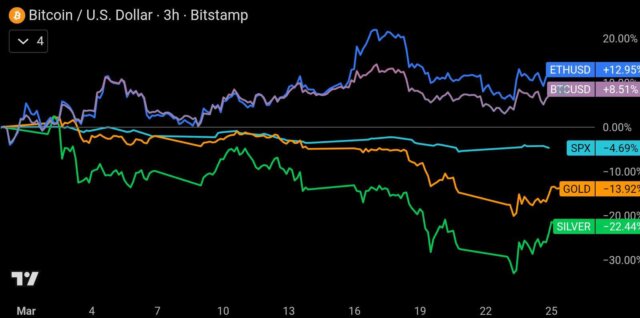
The recent rise in geopolitical tensions between the United States and Iran has shaken global financial markets. However, one surprising trend stands out—crypto during war has shown strong resilience. While traditional assets like gold and oil reacted with mixed signals, digital currencies surged ahead, drawing attention from investors worldwide. This shift highlights a changing mindset. Investors are no longer relying only on conventional safe havens. Instead, they are exploring decentralized assets that operate outside government control. As a result, Bitcoin and Ethereum are gaining traction as modern hedging tools in uncertain times.
Market Resilience and Crypto During War
The performance of cryptocurrencies during geopolitical crises has been impressive. While stocks often decline due to uncertainty, Bitcoin and Ethereum tend to recover quickly. In fact, recent data shows increased inflows into crypto markets as tensions rise. This suggests that investors are actively seeking alternatives to protect their wealth. Moreover, digital assets are not tied to any single economy. Because of this, they remain less affected by localized conflicts. For example, when traditional markets react negatively to war news, crypto markets often experience increased trading activity instead. This behavior highlights their growing appeal as non-correlated assets. In addition, liquidity in crypto markets has improved over time. Large institutions are now participating, which adds stability and confidence. As a result, crypto during war is no longer seen as purely speculative. Instead, it is becoming a strategic part of diversified portfolios.
Shifting Safe-Haven Narrative
Traditionally, investors turned to gold, silver, or currencies like the Japanese yen during crises. However, recent market behavior shows a shift. Gold prices have been inconsistent, while fiat currencies face inflation and policy risks. Consequently, confidence in these assets is no longer absolute. On the other hand, cryptocurrencies offer transparency and accessibility. Blockchain technology allows investors to track transactions in real time. This builds trust, especially during uncertain global events. Furthermore, crypto markets operate 24/7, giving investors flexibility that traditional markets cannot provide. Another important factor is generational change. Younger investors are more comfortable with digital assets. Therefore, they are more likely to choose crypto over gold during crises. This evolving preference is gradually reshaping the definition of a safe haven in modern finance.
Institutional Flows and Future Outlook
Institutional interest in cryptocurrencies has grown significantly. Hedge funds, asset managers, and even corporations are allocating capital to Bitcoin and Ethereum. This trend becomes even stronger during times of geopolitical stress. As uncertainty rises, institutions look for assets that can deliver both growth and protection. On-chain data also supports this trend. Accumulation patterns indicate that large investors are holding rather than selling. This suggests confidence in long-term value. Additionally, reduced supply on exchanges often leads to upward price pressure, which benefits the market overall. Looking ahead, macroeconomic factors will continue to influence crypto markets. Interest rates, inflation, and global conflicts will all play a role. However, the increasing adoption of digital assets points to a strong future. As more investors recognize their benefits, crypto during war could become a standard strategy rather than an exception.
In conclusion, the recent US-Iran tensions have revealed an important shift in financial markets. Cryptocurrencies have outperformed many traditional assets, proving their resilience and growing importance. As investor behavior evolves, digital assets are emerging as reliable hedging tools in uncertain times. Therefore, crypto during war is not just a trend—it represents a new phase in global finance where decentralization meets real-world challenges.
Disclaimer: CryptopianNews shares this for learning and info only. It’s not meant to be financial or investment advice. Crypto markets change a lot and move quickly. Investing in them can be risky. You should always look into things yourself. Talk to a trained financial advisor before making any choices about investing.

- BTC stuck in a range: Large Buyers Signal Strength - July 20, 2026
- CLARITY Act Odds Drop to 35% After DOJ Warning - July 18, 2026
- Strategy Updates Financial Policy for Bitcoin Holdings - July 2, 2026