

Key Takeaways
- 2026 marks the final realistic deadline to pass the CLARITY Act before political priorities shift.
- Lawmakers aim to clarify crypto regulation between SEC and CFTC, ending years of confusion.
- Delays could push regulation to 2030 or beyond, slowing innovation in the U.S.
- The bill includes strong protections for DeFi developers and crypto startups.
- Investors expect greater market stability and institutional adoption if the bill passes.
Why the US Senate crypto legislation deadline 2026 is critical
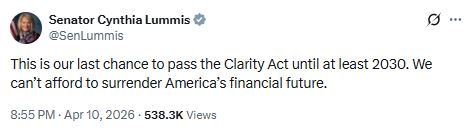
Senator Cynthia Lummis has made it clear that 2026 represents a decisive year for crypto regulation in the United States. She believes lawmakers must act before election cycles shift attention away from complex financial reforms.
Moreover, legislative momentum often slows dramatically during campaign seasons, which makes policy approvals significantly harder to achieve. Therefore, missing this window could delay meaningful action for several years.
If Congress fails to pass the bill in time, policymakers may not revisit comprehensive crypto legislation until after 2030. As a result, businesses would continue operating in regulatory uncertainty for an extended period.
At the same time, global competitors continue advancing their frameworks, which puts additional pressure on U.S. lawmakers to act quickly.
What the Cynthia Lummis CLARITY Act 2026 crypto bill aims to solve
The core purpose of the CLARITY Act focuses on defining which regulator oversees different types of digital assets. Currently, the lack of clarity forces companies to navigate overlapping and sometimes conflicting rules.
Therefore, the bill proposes a clear division where securities fall under the SEC, while commodities remain under the CFTC. This structure would simplify compliance for exchanges and token issuers.
In addition, the bill introduces protections for decentralized finance developers and blockchain innovators. Lawmakers want to encourage growth while maintaining necessary safeguards for investors.
Furthermore, updated provisions address stablecoins and yield-generating products, which previously caused disagreements among regulators. These revisions now reflect a more balanced approach.
Lummis crypto regulation last chance before 2030 explained
Senator Lummis has repeatedly warned that failing to pass the bill could result in a multi-year legislative freeze. Consequently, crypto companies may continue facing uncertainty without clear regulatory guidance.
This delay would not only affect compliance but also discourage long-term investment in U.S.-based blockchain projects.
Meanwhile, countries like the UAE and Singapore continue attracting crypto firms with clearer policies and faster approvals. As a result, U.S. companies may relocate operations to remain competitive.
Additionally, ongoing uncertainty could weaken America’s position as a leader in financial innovation. Therefore, lawmakers face increasing pressure to act before talent and capital move elsewhere.
Why this bill matters for investors, markets, and future growth
Investors consistently demand clear rules before committing significant capital to emerging markets like crypto. If the CLARITY Act passes, institutions may increase participation due to reduced legal risks.
As a result, the market could experience improved liquidity, stronger price stability, and broader adoption across traditional finance sectors.
The bill also sets expectations for exchanges, custody solutions, and token issuance frameworks. Therefore, companies would operate with greater confidence and fewer legal uncertainties.
Moreover, startups could focus on innovation instead of regulatory survival, which would accelerate blockchain development in the United States.
At the same time, clearer guidelines would help prevent sudden enforcement actions, creating a more predictable environment for growth.
Read Also: Charles Hoskinson Warns on CLARITY Act Risks
Disclaimer!! CryptopianNews provides this information for educational and informational purposes only. You should not consider it financial or investment advice. Cryptocurrency markets are highly volatile and speculative, and they carry inherent risks. We advise readers to conduct their own research and to consult with a qualified financial advisor before making any investment decisions.

- The potential of AI Agents as the next big user base for cryptocurrencies. - October 3, 2026
- Bitcoin ETFs Bring $2.65B in September as Institutional Demand Returns - October 2, 2026
- With $388M hacked, Bitget resumes Bitcoin Withdrawals After Stolen Crypto Moves. - September 28, 2026