
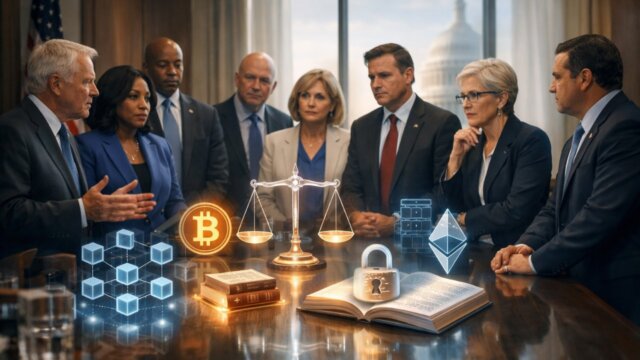
- As pressure mounts in Washington, Democratic Senators Crypto Ethics Showdown Ahead of Key Senate Vote highlights conflicts of interest shaping crypto regulation.
- Democratic senators advocate for ethical guardrails to ensure lawmakers cannot profit from crypto investments while in power, promoting the Digital Asset Ethics Act.
- Senator Michael Bennet’s proposed amendment is crucial for establishing formal boundaries for federal officials’ personal benefits from digital assets.
A Pivotal Moment for US Crypto Governance
The United States Senate is once again poised to take a significant step toward shaping how the nation—and by extension, the world—regulates digital assets. As the crypto sector matures into a mainstream economic engine, Washington’s efforts to modernize federal rules carry major consequences for investors, banks, developers, and policymakers. But this time, a new twist has emerged: Democratic senators are demanding ethics guardrails to stop public officials from privately profiting from crypto interests while they hold power. The emerging battle offers more than a policy debate—it reflects a broader political shift. Crypto has grown from a niche technology to a multi-trillion-dollar financial ecosystem, and with it comes growing scrutiny over conflicts of interest, transparency, financial stability, and global competitiveness.
This ongoing clash gives rise to a central narrative that is increasingly defining the conversation: Democratic senators crypto ethics. As the Senate Agriculture Committee prepares for a markup vote that could shape federal crypto rules for decades, the new amendments illustrate how deeply concerns about ethics, conflicts of interest, and political accountability have penetrated the debate.
The New Amendments
The latest amendments landed on Friday, just days before the Agriculture Committee’s scheduled markup session. This timing was no accident. With Congress under pressure to respond to the accelerating growth of crypto markets, senators recognized that the ethical integrity of any regulatory framework could determine whether Americans trust the system being built.
One of the most consequential provisions is championed by Senator Michael Bennet, who attached the Digital Asset Ethics Act to the larger crypto market structure bill. The amendment would erect formal boundaries that block U.S. federal officials from personally benefiting from digital asset investments or crypto platforms while they hold public office. This represents a significant escalation in the debate over crypto policy integrity. Support for crypto continues to grow across party lines, but so have concerns that a sector defined by rapid wealth creation could create new avenues for insider influence. In order for any crypto legislation to carry legitimacy, Bennet argues, Congress must ensure that lawmakers cannot shape markets for personal gain.
The political context matters here, too. The push comes amid heightened scrutiny over former President Donald Trump’s alleged association with the World Liberty Financial crypto project, which critics argue inflated Trump’s personal wealth and raised concerns over transparency. While the controversy revolves not around legality but optics and influence, it has sharpened the focus on public-sector financial entanglements. Senator Elizabeth Warren, who has long advocated for strict digital asset oversight, echoed these concerns and urged Congress not to pass a bill that enables policymakers to “profit from the rules they write.” Other Democrats joined this chorus, formalizing what is now one of the most prominent themes in the debate: Democratic senators crypto ethics concerns are not merely symbolic—they aim to structurally reshape how Washington interacts with crypto markets.
Delay Mechanisms and Market Readiness: The Klobuchar Amendment
A second amendment spearheaded by Senator Amy Klobuchar has stirred debate for a very different reason. Rather than target conflicts of interest, Klobuchar’s change would delay the crypto market structure bill until the Commodity Futures Trading Commission (CFTC) has its full commissioner seats filled. Currently, the CFTC is operating with only its newly installed chair, Michael Selig, who assumed office on December 22. Four commissioner seats remain vacant, with no clear appointment timeline. For an agency that could receive sweeping crypto oversight authority if the bill passes, the absence of a full commission raises concerns about uneven enforcement and weakened regulatory capacity.
Supporters say it’s simple governance: No major regulatory expansion should proceed without a fully staffed commission, especially not one that may soon oversee billions of dollars in trading activity. Critics counter that delay mechanisms slow down urgently needed clarity for businesses and investors. Regardless of perspective, the amendment highlights how divided Washington is on whether the crypto industry is ready for regulation—or whether regulation is ready for the crypto industry.
Market Structure Bill Expands Into a Broader Financial Reform Battle
The crypto debate no longer exists in a vacuum. This became evident as Democrats Roger Marshall, Dick Durbin, and Peter Welch introduced a separate amendment attaching the Credit Card Competition Act to the bill. Their proposal addresses exclusive credit card network rules used by major payment networks and banks—expanding what began as a crypto conversation into a sweeping debate over financial competition and consumer protection. This intersection matters strategically. Digital assets are integrated into a much wider ecosystem of payments, lending, remittances, and credit infrastructure. As crypto matures, regulation naturally blends with broader questions about:
- Transaction rails
- Banking access
- Consumer safeguards
- Financial competition
- Anti-monopoly enforcement
This illustrates why Democratic senators crypto ethics concerns are not only about conflicts of interest—they also reflect a broader movement to establish holistic financial governance standards for the 21st century.
Political Timing and External Disruptions Threaten the Markup
The Agriculture Committee markup, originally slated to proceed next week, already faced turbulence even before ethics amendments arrived. Lobbying groups clashed over the role of stablecoin reward systems and decentralized finance (DeFi), leading Coinbase to withdraw support for the bill earlier in the month. Now, lawmakers brace for additional uncertainty as a major snowstorm is forecast for Washington, DC, threatening logistical disruptions and further delays. Even with snow, negotiations, and partisan disagreement, few doubt the significance of the vote ahead. The bill is seen by many industry analysts as one of the most viable paths toward long-sought regulatory clarity in the United States, especially as other jurisdictions—such as the European Union through its MiCA framework—move decisively ahead. With major global financial centers fast-tracking crypto rules, the U.S. risks ceding leadership if domestic legislation remains stalled.
A Turning Point for Crypto Integrity, Governance, and Trust
As the Senate moves forward, one lesson stands out: regulation is not just about markets, it is about ethics, power, and accountability. With Democratic senators crypto ethics concerns now influencing legislative strategy, the U.S. crypto conversation is evolving beyond narrow regulatory questions to encompass broader democratic values. If Congress succeeds in establishing rules that prevent public officials from profiting from the markets they govern, it could help restore trust at a moment when confidence in institutions is fragile. Conversely, failure could deepen skepticism and slow momentum for responsible innovation. The stakes are high not only for crypto firms and regulators, but for the future of America’s position in digital finance. Whether this bill passes, stalls, or transforms further, it is already clear that crypto has entered an era where ethics are not an afterthought—they are the opening chapter.
Disclaimer: CryptopianNews shares this for learning and info only. It’s not meant to be financial or investment advice. Crypto markets change a lot and move quickly. Investing in them can be risky. You should always look into things yourself. Talk to a trained financial advisor before making any choices about investing.

- Fed Balance Sheet Reduction Shakes Global Markets - January 30, 2026
- Inside the White House Crypto Meeting on Digital Assets - January 28, 2026
- Wall Street Warns: US Crypto Policy Clouds the Market - January 26, 2026