

- The FOMC crypto market reaction often triggers sharp Bitcoin moves and macro signals drive sudden volatility after Fed meetings.
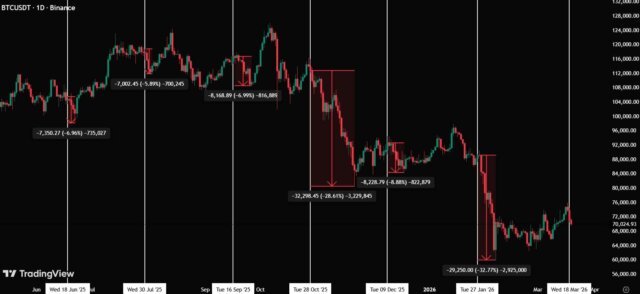
- Historical data reveals drops between 6% and 30% in recent cycles.
- Key liquidity zones to watch are $67K for mild moves and $50K for deeper corrections.
Bitcoin traders closely watch macro events, and one of the biggest drivers is the FOMC crypto market reaction. These events don’t just move traditional markets—they directly impact liquidity, risk appetite, and investor sentiment. As a result, Bitcoin tends to react quickly and often aggressively. In recent history, the last six FOMC meetings triggered notable declines. These moves weren’t random. Instead, they followed clear patterns tied to interest rate expectations and tightening liquidity conditions. Therefore, understanding this behavior can help traders prepare instead of react emotionally.
Understanding the FOMC Crypto Market Reaction Pattern
The FOMC crypto market reaction is rooted in macroeconomics. When the Federal Reserve signals higher interest rates, liquidity tightens. As a result, investors pull money out of riskier assets like Bitcoin and move toward safer options. Historically, Bitcoin has dropped anywhere from 6% to 30% after FOMC meetings. These moves reflect a reset in market positioning. Moreover, leveraged traders often get liquidated during these periods, which accelerates price declines. However, this pattern also creates opportunity. Smart money tends to reposition during these dips. Therefore, instead of fearing volatility, experienced traders prepare for it and use it to their advantage.
Key Price Targets: $67K vs $50K Scenarios
Bitcoin’s reaction to FOMC events often aligns with key liquidity zones. A mild correction of around 6% points toward the $67K level. This zone acts as a short-term liquidity target where buyers may step in. On the other hand, a deeper correction—closer to 30%—brings the $50K level into focus. This area holds strong structural support and has historically attracted long-term investors. Therefore, it becomes a critical zone during heavy sell-offs. Additionally, these levels are not random. They represent areas where large orders are clustered. As a result, price tends to move toward them during high-volatility events.
Volatility Compression Before Expansion
Before major FOMC announcements, Bitcoin often enters a phase of low volatility. This is known as compression. During this period, price moves sideways, and trading activity slows down. However, this calm phase rarely lasts. Once the macro trigger hits, volatility expands. This expansion is usually aggressive and directional, catching many traders off guard. Therefore, recognizing compression phases is key. They often signal that a big move is coming. Traders who prepare early can position themselves better and avoid emotional decisions.
Conclusion
The FOMC crypto market reaction is a powerful force that shapes Bitcoin’s short-term price action. Historical patterns show consistent volatility, with drops ranging from 6% to 30%. Moreover, key levels like $67K and $50K remain important liquidity targets in 2026. As macro pressure continues, these reactions are likely to repeat. Therefore, traders should focus on preparation, not prediction. Understanding liquidity zones and volatility cycles can make a big difference in navigating the market successfully.
Disclaimer: CryptopianNews shares this for learning and info only. It’s not meant to be financial or investment advice. Crypto markets change a lot and move quickly. Investing in them can be risky. You should always look into things yourself. Talk to a trained financial advisor before making any choices about investing.

- BTC stuck in a range: Large Buyers Signal Strength - July 20, 2026
- CLARITY Act Odds Drop to 35% After DOJ Warning - July 18, 2026
- Strategy Updates Financial Policy for Bitcoin Holdings - July 2, 2026