

- Global liquidity continues to grow as central banks and financial systems expand available capital.
- Most investment flows remain concentrated in U.S. equities, pushing stock market valuations to elevated levels.
- Bitcoin is currently in a consolidation phase, and future liquidity rotation could influence its next major move.
The financial landscape is entering an interesting period as the Global M2 money supply continues to expand across major economies. Historically, increasing liquidity has supported risk assets by providing investors with more capital to deploy. However, current market conditions reveal a unique situation where much of this liquidity is flowing into traditional equity markets rather than alternative assets. At the same time, Bitcoin remains in a sideways trading range despite broader liquidity growth. Investors are closely monitoring whether capital will continue favoring stocks or gradually rotate into digital assets. Therefore, understanding the relationship between liquidity, equity valuations, and Bitcoin’s market structure has become increasingly important.
Global M2 money supply and Equity Market Concentration
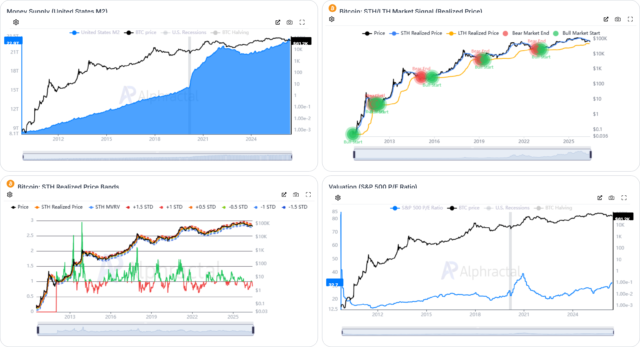
The continued rise in global liquidity has helped fuel strong performance in U.S. equities. As a result, the S&P 500 has reached historically elevated valuation levels, with its price-to-earnings ratio trading around 32.7. This suggests that investors remain highly confident in the earnings potential of large public companies. Moreover, many institutional investors still view equities as the preferred destination for capital allocation. Consequently, a significant portion of newly available liquidity continues flowing into stocks rather than alternative investments. This concentration creates an environment where traditional markets absorb most of the benefits from expanding monetary conditions. However, high valuations often encourage investors to search for new opportunities. Therefore, market participants are watching closely for signs that capital could begin moving into undervalued or emerging asset classes.
Bitcoin’s Current Accumulation and Market Structure
Bitcoin’s on-chain indicators provide valuable insight into investor behavior. The Short-Term Holder (STH) and Long-Term Holder (LTH) Realized Price metrics show that Bitcoin remains above the average cost basis of both investor groups. This generally reflects a healthy market structure and sustained investor confidence. Nevertheless, Bitcoin recently touched the upper range of its realized price bands before entering a period of sideways movement. Since then, the asset has experienced modest corrections while trading near important short-term cost basis levels. As a result, many analysts interpret the current phase as accumulation rather than distribution. Furthermore, accumulation periods often occur before major market trends develop. Investors frequently use these phases to build positions gradually while waiting for stronger catalysts to emerge.
Liquidity Rotation and Future Market Opportunities
One of the most important themes for investors is the potential rotation of capital between asset classes. Although liquidity is expanding, most funds currently remain allocated to equities. If stock valuations continue climbing, some investors may begin seeking alternative assets with greater upside potential. Bitcoin could become a beneficiary of such a shift. Historically, digital assets have responded positively when excess liquidity finds its way beyond traditional markets. Additionally, growing institutional acceptance and improved market infrastructure may support broader participation. The Global M2 money supply remains a critical indicator because it reflects the overall availability of capital within the financial system. Therefore, monitoring liquidity trends alongside equity valuations and Bitcoin accumulation metrics may help investors identify future market opportunities before they become obvious.
In conclusion, expanding liquidity continues to support financial markets, but the majority of capital remains concentrated in U.S. equities. Meanwhile, Bitcoin is moving through a consolidation and accumulation phase while maintaining strength above key investor cost bases. As capital allocation patterns evolve, the Global M2 money supply will remain an important factor in determining whether liquidity eventually rotates toward Bitcoin and other alternative assets.
Disclaimer: CryptopianNews shares this for learning and info only. It’s not meant to be financial or investment advice. Crypto markets change a lot and move quickly. Investing in them can be risky. You should always look into things yourself. Talk to a trained financial advisor before making any choices about investing.

- BTC stuck in a range: Large Buyers Signal Strength - July 20, 2026
- CLARITY Act Odds Drop to 35% After DOJ Warning - July 18, 2026
- Strategy Updates Financial Policy for Bitcoin Holdings - July 2, 2026