
- Hashflow is a decentralized exchange (DEX) offering slippage-free, MEV-resistant trades through its Request-for-Quote (RFQ) model.
- It fetches off-chain quotes from professional market makers and locks in the price for the trade duration.
- The live price of Hashflow (HFT) recently hit $0.130912, representing an 85.50% surge in just 24 hours.
What is Hashflow?
So, what exactly is Hashflow? At its core, Hashflow is a decentralized exchange (DEX) that stands out by offering slippage-free, MEV-resistant trades through its Request-for-Quote (RFQ) model. Unlike traditional DEXs that use automated market makers (AMMs), Hashflow fetches off-chain quotes from professional market makers and locks in the price for the trade duration. That means what you see is what you get—no surprises, no slippage.
And here’s where it gets even more interesting: Hashflow’s Exchange OS (xOS). This is the tech backbone that turns any exchange into what the team calls a “provable exchange.” Think of it as the blockchain version of a verified checkmark—an exchange you can trust. Let’s not forget Aggregator+, Hashflow’s DEX aggregator. With its Smart Order Routing (SOR) tech, it hunts down the best prices across multiple liquidity sources—whether PMMs or AMMs—and fills trades efficiently, regardless of size. In short, Hashflow isn’t just another DeFi player—it’s a next-gen trading solution that’s built to scale. And now, its token ($HFT) is catching serious attention.
Hashflow’s Price Spike
The live price of Hashflow (HFT) recently hit $0.130912, representing a jaw-dropping 85.50% surge in just 24 hours. With a trading volume of over $580 million USD and a market cap topping $76 million USD, Let’s break down the major reasons behind this epic price movement.
1. Hashflow’s Rapid Growth in the Solana Ecosystem
Hashflow is planting deep roots in the Solana blockchain, one of the fastest and most scalable Layer 1 networks out there. Why does this matter?
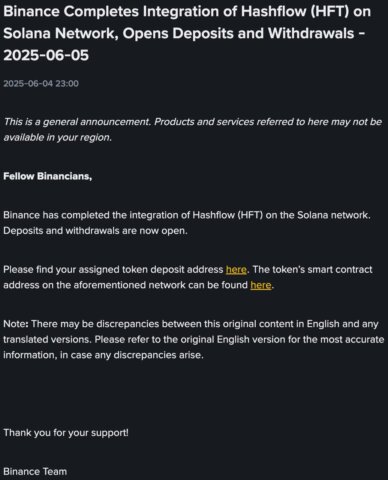
- Binance now supports $HFT on Solana.
- Integrations with top Solana protocols like Jupiter, Kamino, and Titan are already live.
- More integrations are on the way, expanding Hashflow’s reach across DeFi.
Why is this important for the price? Solana’s reputation for lightning-fast transactions and low fees makes it an attractive home for Hashflow. The more integrations, the higher the user adoption—and more demand usually equals price increase. Simple math, right?
2. $HFT Is Now Fully Live on Solana
In another bullish development, $HFT is officially live on Solana, with deposits and withdrawals supported directly through Binance. This is a big deal for several reasons:
- Cross-chain accessibility opens the floodgates for a wider user base.
- Faster execution = better trading experiences = happy traders.
- More exposure from a top-tier exchange like Binance adds instant credibility.
The message is loud and clear: Solana users, welcome to the Hashflow party.
3. Hashflow x Kamino: Lending Liquidity Skyrockets
Hashflow recently teamed up with Kamino Finance, the largest lending and borrowing platform on Solana.
- Kamino now supports RFQ-based liquidity from Hashflow.
- This bridges DEX functionality with DeFi yield farming and lending.
- It brings in more capital and more users, reinforcing the Hashflow ecosystem.
As RFQ liquidity expands deeper into DeFi protocols, it increases the real utility of $HFT. More use cases mean more traction—again, great for price momentum.
4. Sky-High Yields from Centralized Exchanges (CeFi)
Let’s be honest—crypto traders love passive income. And right now, staking $HFT on CeFi platforms is looking insanely attractive:
- Gate.io: Earn up to 499.32% APY
- Bybit: Offers a generous 124.56% APY
- Binance: Provides 45.65% APY through Earn (Flexi)
- KuCoin: Slightly lower at 0.50% APY
With yields like that, who wouldn’t want to grab some HFT tokens and stake them? High returns = increased demand, which adds buying pressure and supports the ongoing price spike.
Hashflow Is Just Getting Started
Hashflow isn’t just another altcoin pumping out of nowhere. The price spike we’re witnessing is backed by real utility, major partnerships, and solid tech innovation. From seamless integration with Solana to high-yield opportunities on major CeFi platforms, Hashflow is proving it has both the muscle and momentum to rise through the ranks. And with its RFQ model challenging traditional AMM-based DEXs, it might just be the DEX that finally bridges the gap between centralization and decentralization—with zero slippage and full transparency. So, whether you’re a DeFi degen, a Solana believer, or just chasing the next moonshot—Hashflow deserves a closer look.
Read Also: Crypto Tax Overhaul Backed by Lummis
Disclaimer: CryptopianNews shares this for learning and info only. It’s not meant to be financial or investment advice. Crypto markets change a lot and move quickly. Investing in them can be risky. You should always look into things yourself. Talk to a trained financial advisor before making any choices about investing.

- Bitcoin tightest session: Why Traders Are Watching $65K - July 20, 2026
- Can 5x Bitcoin Still Happen This Market Cycle? - July 18, 2026
- Capital Is Chasing AI: Why Bitcoin Is Waiting Its Turn - July 2, 2026