
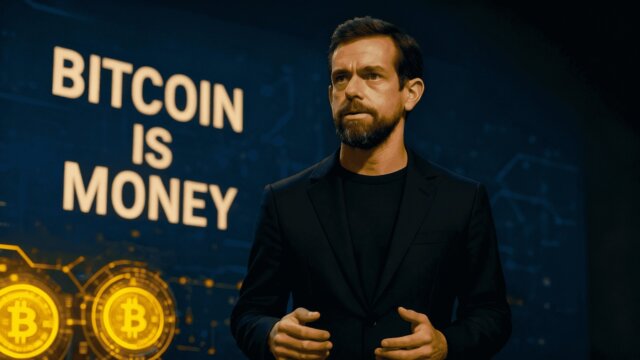
- Jack Dorsey declares Bitcoin Is Money, Not Crypto, redefining finance by 2026.
- He believes Bitcoin’s value lies in its utility as a borderless, censorship-resistant, and decentralized medium of exchange.
- Dorsey’s vision challenges how governments, regulators, and crypto investors currently view Bitcoin.
Jack Dorsey, the tech visionary who co-founded Twitter and now leads Block, Inc., has once again taken center stage in the global financial conversation. His message is both simple and revolutionary: “Bitcoin Is Money.” In a time when digital assets are often lumped together under the “crypto” label, Dorsey is adamant about drawing a sharp line between Bitcoin and the rest of the cryptocurrency market. In his words, “Bitcoin is not crypto.” This statement has reignited debates across the financial world, sparking renewed discussions about Bitcoin’s original purpose and where it’s headed next. With his extensive network—spanning Square, Cash App, and the Lightning Network—Dorsey isn’t just talking; he’s building the foundation for a Bitcoin-based financial future that could change how we think about money itself.
The Vision Behind Dorsey’s Declaration: “Bitcoin Is Money”
Dorsey’s philosophy on Bitcoin has been remarkably consistent over the years. While other tech entrepreneurs jumped between blockchain projects and speculative crypto tokens, Dorsey stayed laser-focused on Bitcoin. To him, Bitcoin isn’t just another form of investment—it’s the purest expression of money in the digital era. He believes that Bitcoin’s value lies not in its volatility or potential profit, but in its utility as a borderless, censorship-resistant, and decentralized medium of exchange. The key phrase he keeps returning to is simple yet profound: Bitcoin Is Money.
“Bitcoin is not an investment. It’s not a stock. It’s not even ‘crypto’—Bitcoin is money,” Dorsey said in a recent interview.
This clear stance challenges how governments, regulators, and even crypto investors currently view Bitcoin. For Dorsey, Bitcoin should function as everyday money—usable for small purchases, accessible to all, and free from the heavy regulations and taxes that make microtransactions impractical.
From Square to Lightning
Through Block’s ecosystem, Dorsey is quietly reshaping the global payment infrastructure. Square (now part of Block) and Cash App already allow users to buy, sell, and send Bitcoin. But Dorsey’s next big move is to eliminate transaction fees entirely by 2026. That’s where the Lightning Network comes in. This layer-2 scaling solution makes Bitcoin transactions nearly instant and almost free. By connecting Square terminals and Cash App wallets through Lightning, Dorsey aims to make Bitcoin payments as fast as swiping a credit card—but without the fees.
“The goal,” Dorsey said, “is a world where every business—from coffee shops to farmers markets—can accept Bitcoin without losing a percentage to intermediaries.”
Currently, Mastercard and Visa take between 1.5% and 3.5% per transaction. If Dorsey succeeds in making Bitcoin peer-to-peer at zero cost, it could mark the beginning of the end for traditional payment networks.
The Farmers Market Revolution
In small communities across the United States, Dorsey’s vision is already taking shape. Local vendors at farmers markets are testing Bitcoin payments via Square terminals. Instead of paying processing fees, they’re able to keep every cent of their earnings. For independent shop owners and farmers, this model is a financial liberation. Bitcoin payments—especially on the Lightning Network—allow them to receive funds instantly, with no middlemen, no banks, and no waiting periods. One vendor in Texas reportedly described it this way:
“It’s like cash, but faster and safer. When I get paid in Bitcoin, it’s mine instantly. No waiting for the bank, no fees eating into my profits.”
These real-world tests are exactly what Dorsey envisions for Bitcoin’s future: a practical, everyday currency that anyone can use anywhere, not a speculative asset locked away in digital wallets.
Bitcoin Is Money, Not Crypto
Dorsey’s separation of Bitcoin from “crypto” is both ideological and technical. He argues that while many cryptocurrencies were created for profit, Bitcoin was created for freedom. Where most crypto projects are built around centralized leadership or venture capital funding, Bitcoin stands apart as a decentralized, open, and permissionless network that no single entity controls. In Dorsey’s words, the crypto industry has “twisted Satoshi’s vision” by focusing on trading and speculation instead of the peer-to-peer electronic cash described in the 2008 white paper. His declaration—“Bitcoin is money”—isn’t just a marketing slogan. It’s a philosophical stance. It’s about returning Bitcoin to its roots and restoring it as the world’s native currency.
Could Jack Dorsey Be Satoshi Nakamoto?
No conversation about Dorsey’s deep connection to Bitcoin would be complete without addressing one of the internet’s most intriguing conspiracy theories: Could Jack Dorsey actually be Satoshi Nakamoto? This question has resurfaced online after Dorsey’s recent statements. Enthusiasts point to several mysterious coincidences:
- Dorsey’s early interest in cryptography dates back to the early 2000s. Some of his 2003 notes discuss concepts eerily similar to what would later appear in the Bitcoin white paper.
- Certain timestamps from his early coding projects align closely with the timeline of Satoshi’s early Bitcoin activity.
- His old Twitter bio once read “sailor”—a curious link to the nautical proverb used in Bitcoin’s source code.
- Some digital forensics fans claim that Satoshi’s IRC login traces back to California, where Dorsey was living at the time.
Still, Dorsey has never entertained or confirmed these rumors. In interviews, he typically laughs them off, redirecting the focus back to the mission: building Bitcoin as money, not mythology. As Dorsey himself once said,
“Who Satoshi is doesn’t matter. What matters is what Satoshi built—and how we keep that vision alive.”
The Final Message: Bitcoin Is Money
Jack Dorsey’s message cuts through the noise: “Bitcoin Is Money.” Not “crypto,” not an investment tool, but real, global, digital cash. His efforts—through Block, Cash App, and the Lightning Network—aren’t just about technology. They’re about restoring financial freedom in a world increasingly dominated by corporations and governments. If his 2026 vision unfolds as planned, millions could soon live in a world where Bitcoin transactions are instant, free, and universal. And in that world, Dorsey’s simple yet powerful phrase—Bitcoin Is Money—won’t just be a slogan. It will be a reality.
Disclaimer: CryptopianNews shares this for learning and info only. It’s not meant to be financial or investment advice. Crypto markets change a lot and move quickly. Investing in them can be risky. You should always look into things yourself. Talk to a trained financial advisor before making any choices about investing.

- David Solomon Bitcoin Shift Signals Institutional Change - March 31, 2026
- WLD Token All-Time Low 2026: Is Worldcoin Still Worth Buying? - March 29, 2026
- Tokenized Assets: The Future of Crypto in 2026 - March 27, 2026