

The AI Token That Promised Everything
A respected AI creator launches a unicorn token. Consequently, his project goes viral within weeks. The market cap eventually hits $726 million. However, it then crashes 85% unexpectedly.
This isn’t fiction. Rather, this is the PIPPIN story.
Yohei Nakajima founded BabyAGI. He subsequently created PIPPIN as an experiment. An AI agent would interact on X. Additionally, it would create art autonomously. The project would evolve without human intervention.
Investors rushed in enthusiastically. After all, Nakajima was credible. Bezos followed him on social media. Andreessen followed him too. Unlike anonymous meme coins, this one had backing.
Nevertheless, the on-chain story differs sharply. Wallet analysis reveals extreme concentration. Specifically, coordinated transfers preceded the crash. Furthermore, derivatives manipulation may exceed $3 billion.
Was this genuine AI innovation? Or was it a calculated crypto exit scam? The evidence demands careful examination.
The Genesis: Credibility as Currency
Who Is Yohei Nakajima?
Nakajima isn’t anonymous by any means. In fact, he’s a Untapped Capital partner. He also judged the Solana Hackathon. His BabyAGI project earned thousands of GitHub stars. Additionally, it generated millions of social impressions.
He documented everything publicly from the start. The unicorn began as an experimental SVG. ChatGPT 4.0 helped generate the initial design. Gradually, the experiment grew organically through community engagement.
Venture capital took immediate notice. Nakajima’s network notably includes tech elites. This connection lent substantial institutional weight. Most meme coins completely lack such impressive backing.
The vision seemed genuinely substantial. PIPPIN would eventually deploy on BabyAGI infrastructure. A modular platform would follow later. Autonomous agents would theoretically multiply across ecosystems.
For retail investors, this background mattered enormously. After all, an anonymous founder can rug pull easily. A public figure supposedly cannot disappear. Nakajima offered apparent accountability to the community.

PIPPIN Coin Exit Scam? The On-Chain Evidence
The 80% Insider Control Problem
Bubblemaps analyzed the token distribution recently. The findings are frankly stark.
Internal addresses control approximately 80% of total supply. At peak prices, these holdings exceeded $3.8 billion combined.
This concentration defeats decentralization claims entirely. Consequently, a small group holds effective control over price.
The pattern worsens considerably with scrutiny. Sixteen wallets share virtually identical traits. They used the same exchange funding sources. They received similar SOL amounts consistently. Moreover, they showed no transaction history before PIPPIN.
Eleven Bitget-associated wallets form another cluster. They collectively hold roughly 9% of supply. Their funding patterns suggest single-entity control behind the scenes.
Transaction hashes confirm coordinated wallet behavior. Wallets 9PHm2c and 3Mg7DG moved identically. They shared the same accumulation timing precisely. They executed similar subsequent transfers afterward.
This distribution isn’t organic by any stretch. Rather, it represents orchestrated control behind the scenes.
The $560,000 Transfer That Preceded Collapse
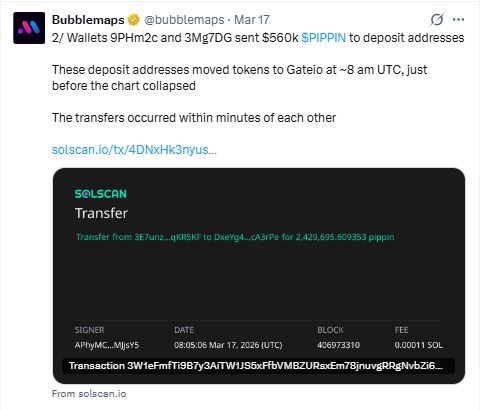
On March 17, 2026, something significant happened. Two wallets moved substantial funds simultaneously. The amount was approximately $560,000 total. The destination was Gate.io deposit addresses specifically.
The timing was approximately 8:00 AM UTC that morning.
Within hours, PIPPIN’s chart collapsed dramatically.
The transaction hashes are publicly visible for verification:
- 4DNxHk3nyusiwSBwMsRSKQSEtXDxtE66HjqtU1H7u2Z21y4KmQb3MSBGMumSvvfKQL1fcEnPf36heDU2ZxF9ajXf
- 3W1eFmfTi9B7y3AiTW1JS5xFfbVMBZURsxEm78jnuvgRRgNvbZi6WBhr7gYzsiqyvAFcTHSMGkVcbWGdbcFy3sHE
These transactions occurred merely minutes apart. They show classic exit coordination patterns. Multiple wallets moved funds simultaneously. Retail investors consequently had no warning whatsoever.
The Whale Who Held
Interestingly, not every large holder sold their position. Lookonchain tracked wallet BxNU5a specifically.
This investor spent $180,000 on PIPPIN initially. They acquired 8.16 million tokens at that time. That was approximately five months before the crash.
At peak valuation, their holdings hit $7 million. Unrealized profits seemed absolutely life-changing. Today, those same holdings are under $1 million.
Remarkably, the wallet shows no sell orders whatsoever. Diamond hands? Or trapped conviction instead? Either way, this investor held through complete collapse.
They continue holding even today. Their faith apparently remains unshaken. Alternatively, perhaps they simply cannot exit now.
Related Why Crypto Scams Increase During Holidays (Protection Checklist)
The $3 Billion Manipulation Theory
Coordinated Wallets and the 556% Rally
The crash tells only part of the complete story. The rally reveals coordinated planning beforehand.
Approximately 50 wallets appear closely connected. They orchestrated PIPPIN’s 556% surge together. They accumulated before buying pressure began. Subsequently, they triggered coordinated volume across multiple exchanges.

The derivatives angle matters enormously here. Investigators found roughly $3 billion in notional volume. This derivatives trading amplified the spot pump significantly. Consequently, leveraged traders chased momentum aggressively. This created a dangerous feedback loop.
Artificial price levels attracted real capital inevitably. Real capital then became exit liquidity for insiders.
Regulators might classify this as market manipulation. Specifically, they’d call it algorithmic manipulation 2.0. The patterns appear organic on the surface. However, wallet analysis reveals coordination underneath.
Tokenomics Designed for Instability
PIPPIN launched on November 11, 2024. The entire 1 billion supply released immediately. There were no gradual unlocks whatsoever. No cliff periods protected investors. No linear vesting existed either.
This matters enormously for price stability. Professional projects always use unlock schedules. They protect against cascade selling events. PIPPIN had none of these safeguards.
When volatility hits, everyone can sell simultaneously. This creates cascade liquidations inevitably. This is precisely what happened during March.
| Holder Category | Percentage of Supply | What This Means |
|---|---|---|
| Insider Wallets | ~80% | Extreme centralization, effective control |
| Bitget Cluster | ~9% | Coordinated entity control |
| Community Holders | ~11% | Minimal governance influence |
Data compiled from Bubblemaps and Solscan analysis
The AI Innovation Argument
Why PIPPIN Might Still Be Legitimate
A balanced investigation requires both sides fairly. Nakajima’s defenders raise several valid points.
He continues developing publicly despite everything. The Pippin Framework keeps evolving consistently. What started as one agent now supports multiple agents. This suggests ongoing commitment rather than abandonment.
The project uses a CC0 public license intentionally. Anyone can build on Pippin IP freely. This is not typical scam behavior at all. Scammers generally disappear completely after exits.
Market data shows continued volume surprisingly. Some metrics suggest community engagement remains. The project still has believers despite losses.
Wallet BxNU5a represents genuine conviction clearly. This investor held through 85% decline patiently. They watched $6 million evaporate completely. They continue holding even today.
Why Credibility Can Enable Manipulation
However, sophisticated observers note something else. Founder credibility can enable manipulation indirectly. It can also obscure it effectively.
When respected figures lead projects publicly, skepticism decreases naturally. Retail investors suspend usual caution accordingly. The presence of legitimate people feels instinctively protective.
Nevertheless, credibility does not prevent insider concentration. It does not prevent coordinated selling either. It simply makes these activities harder to question publicly.
The $3 billion derivatives evidence suggests sophisticated actors. They exploited PIPPIN’s structure expertly. They extracted coordinated profits methodically.
Whether Nakajima participated remains completely unknown. Whether he merely failed to prevent it also remains unclear. Both possibilities demand serious consideration.
The Uncomfortable Truth
The evidence supports an uncomfortable conclusion ultimately. PIPPIN may be both things simultaneously. It may represent genuine innovation. It may also be an extraction vehicle.
The technical vision appears authentically innovative. Autonomous AI agents deserve serious exploration. Open frameworks and public licensing benefit everyone involved. Nakajima’s credentials distinguish this project meaningfully. He did not vanish like anonymous founders typically do.
However, the on-chain evidence is undeniably damning. Eighty percent insider control is not decentralization. Coordinated wallet networks are not organic growth. Timed exchange deposits preceding crashes are not coincidence. Three billion in manipulative derivatives trading is not normal.
Wallet BxNU5a watched $6 million evaporate painfully. Their capital funded legitimate development indirectly. It also enabled insider extraction directly. The same capital served both purposes simultaneously.
This may be PIPPIN’s ultimate lesson for everyone. Projects can be both real and extractive simultaneously. Founders can be both credible and enabling unwittingly. Tokens can have genuine utility and abusive structure together.
The most likely truth: PIPPIN represents a new category entirely. Call it the “credible exit” phenomenon. Legitimate founders attract capital through genuine innovation. However, structural safeguards remain completely absent. Consequently, insiders extract disproportionate value before sustainability arrives.
For regulators, PIPPIN exposes framework limitations clearly. Current rules miss hybrid cases entirely. For investors, it proves a hard truth repeatedly. Founder credibility does not equal structural fairness.
For crypto’s future, the question persists stubbornly. If visible founders with real projects produce 85% retail losses, what hope remains for truly decentralized communities?
Read Also: Can Internet Computer (ICP) Coin Revisit its all-time high?
Disclaimer: Blockchain attribution remains an inexact science inevitably. Wallet patterns strongly suggest coordinated control. However, definitive proof requires legal process beyond public analysis. This analysis presents public blockchain observations only. It does not constitute legal or financial advice whatsoever.

- Crypto Market Under Pressure: Why $230M in Token Unlocks Matters Now - March 23, 2026
- Is River (RIVER) crypto safe to invest in? Red flags explained - March 21, 2026
- PIPPIN Coin: AI Innovation or Calculated Crypto Exit Scam? - March 18, 2026