
Key takeaways
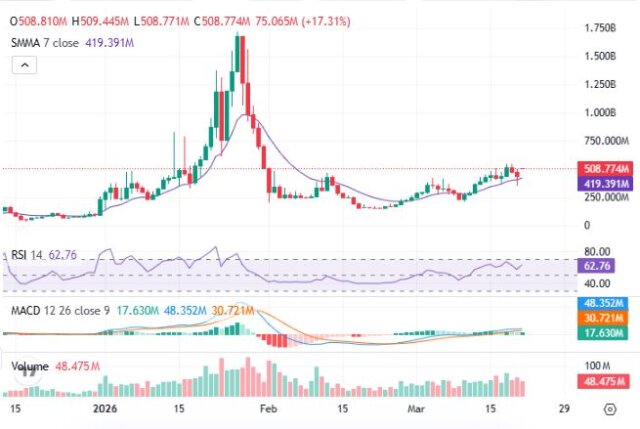
| RIVER hit an ATH of $87.79 on January 26, 2026, and has since fallen 74% to ~$22. Five wallets control approximately 94% of the Ethereum supply — extreme concentration.80.4% of the total 100M token supply remains locked and is yet to hit the market. 1.11 million RIVER tokens worth ~$25M unlock on March 22, 2026 — tomorrow. Futures open interest peaked above $235M — over 80× the spot trading volume. Backers include Justin Sun and Arthur Hayes — both with documented early-exit histories. The smart contract is verified, audited, and technically sound — the tech is not the risk. |
River (RIVER) has emerged as one of the most talked-about altcoins of 2026. The token surged from $1.14 at launch in September 2025 to a peak of $87.79 in January 2026, delivering eye-watering returns for early buyers. However, the price has since collapsed by 74%, leaving many retail investors nursing heavy losses. Therefore, before you commit any capital, you need to understand exactly what you are getting into. The question everyone is searching for right now — is River crypto safe to invest in — deserves a straight, data-backed answer.
What is River (RIVER) and how does it work?
River is a cross-chain stablecoin protocol built on Ethereum and deployed across BNB Chain, Base, and TRON. Its core product is satUSD, a Bitcoin-backed stablecoin that users can mint on one blockchain by posting collateral on another, without using traditional bridges. Additionally, the protocol offers PrimeVault and SmartVault products, which are designed to automate yield strategies with no liquidation risk. As a result, the technology is genuinely novel and addresses a real problem in decentralized finance — fragmented liquidity across blockchains.
Furthermore, the protocol completed a $12 million strategic raise in January 2026, backed by TRON DAO (led by Justin Sun), Maelstrom Fund (Arthur Hayes), and The Spartan Group. This institutional backing helped push RIVER into the top-100 cryptocurrencies by market cap and secured listings on Binance, OKX, and HTX. On the surface, these are positive signals. Nevertheless, a deeper look at the tokenomics and on-chain data reveals several serious River coin crypto investment risks that every buyer must weigh carefully.
The technology case for River
The smart contract powering RIVER is verified on Etherscan, compiled under Solidity 0.8.26, and uses LayerZero’s OFT framework for cross-chain messaging. The 100 million token supply is hardcoded — there is no admin function to mint additional tokens after the initial distribution. Consequently, the protocol receives a clean bill of health from a contract security standpoint. The satUSD stablecoin had over $290 million in total value locked by early 2026, and River secured a partnership with DIA Oracles for pricing infrastructure in March 2026. So, from a technology perspective, the fundamentals are credible.
Key protocol stats (March 21, 2026)
| Metric | Value |
| Current price | ~$22.33 (March 21, 2026) |
| All-time high | $87.79 (January 26, 2026) |
| Market cap | ~$438 million |
| Fully diluted valuation | ~$2.23 billion |
| Circulating supply | 19.6 million (19.6% of 100M) |
| Locked supply | 80.4 million tokens (80.4%) |
| On-chain holders (Ethereum) | 1,825 |
RIVER token red flags 2026: the on-chain evidence
While the protocol itself is functional, the RIVER token tells a more troubling story. Moreover, these are not speculative concerns — they are verifiable on-chain facts. Here are the most critical RIVER token red flags 2026 investors must understand before entering a position.
Red flag 1: extreme supply concentration
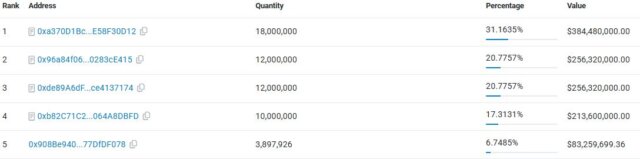
On-chain data from Etherscan reveals that approximately 94% of RIVER’s Ethereum mainnet supply is controlled by just five wallets. Furthermore, the problem is even more pronounced on subsidiary chains. Over 69% of the BNB Chain supply sits in a single address, and over 88% of the Base chain supply is held by one wallet. This level of concentration is not typical exchange custody. It is structural insider dominance.
| Critical risk signal: When a handful of wallets control nearly all the supply, they can — and historically do — dump tokens into retail buying pressure at the time of their choosing. This is not a hypothetical risk for RIVER. It is a mathematical certainty given the current distribution. |
Red flag 2: leverage-driven price action
The RIVER rally from $1.14 to $87.79 was not driven primarily by spot buyers. Instead, futures open interest on Binance peaked above $235 million, while spot volume was a fraction of that figure. In fact, futures trading volume exceeded spot volume by more than 80 times at peak. This ratio is a textbook signature of leverage amplification, not organic demand. Moreover, on-chain analysts identified that a single entity used over 2,400 addresses to accumulate approximately 50% of the token supply at an average price of $4.12, before unwinding after the all-time high and triggering cascading liquidations.
Red flag 3: the looming unlock schedule
As of March 21, 2026, only 19.6 million of the 100 million total RIVER tokens are in circulation. This means 80.4 million tokens — valued at roughly $1.8 billion at current prices — remain locked. Consequently, every unlock event introduces fresh sell pressure. The next unlock arrives tomorrow, on March 22, 2026, releasing 1.11 million tokens worth approximately $25 million. Furthermore, team and investor vesting runs on a linear schedule through 2030, meaning holders face continuous dilution for the next four years.
Related: PIPPIN Coin: AI Innovation or Calculated Crypto Exit Scam?
Red flag 4: backer exit risk
The $12 million strategic raise may look like validation. However, both Justin Sun and Arthur Hayes have well-documented histories of promoting tokens publicly while reducing positions. Their involvement was announced on January 24, 2026 — just two days before RIVER hit its all-time high. This timing is notable. At an ATH FDV of roughly $8.7 billion, early investors who entered at the $4–$5 average saw potential paper returns exceeding 700 times. The incentive to exit into retail demand is enormous.
| Analyst note: Technology and token price are two separate things. River’s satUSD protocol can be technically sound while the RIVER governance token is simultaneously manipulated. Assessing one without the other is a common mistake retail buyers make. |
River coin crypto investment risks: what the data says
Beyond the specific flags above, there are broader structural River coin crypto investment risks that apply to this asset class at this stage of the project’s development. Firstly, the FDV of $2.23 billion against a circulating market cap of $438 million implies a 5.1 times multiplier. Therefore, for RIVER’s current market cap to be justified by full dilution, the protocol would need to generate sustained demand that absorbs the remaining 80.4 million tokens. That is a significant ask for a protocol with roughly $290 million in TVL today.
Additionally, the short-seller positioning is notable. The Binance long/short ratio for RIVER recently sat below 0.6, meaning the majority of leveraged traders are net short. This suggests that sophisticated market participants are betting against a recovery, not for one. In contrast, RIVER did show one encouraging signal on March 19, 2026 — the token surged over 12% while Bitcoin fell below $70,000 following the FOMC meeting, demonstrating some resilience to macro pressure. This decoupling could indicate genuine demand from DeFi users for the satUSD product.
Who should — and should not — consider RIVER
| Consider RIVER only if you are: • An experienced DeFi user with a clear understanding of token unlocks and vesting • Willing to allocate less than 5% of your portfolio to a speculative position • Prepared to hold for two to three years through significant volatility • Able to absorb a 50% or greater drawdown from your entry price |
| Avoid RIVER if you are: • A beginner investor without experience in high-risk altcoins • Seeking price stability or capital preservation • Unable to afford a total loss of the invested amount • Entering because of social media hype or influencer promotion |
What to watch before making any decision
Rather than investing immediately, a disciplined investor monitors specific on-chain and market metrics before committing capital. The March 22 unlock is the first critical test. If the market absorbs 1.11 million new RIVER tokens without a major price break below $18, that signals meaningful organic demand. Conversely, a drop below that support level would indicate the current price is propped up by thin liquidity rather than genuine buyers.
Furthermore, watch the Ethereum holder count on Etherscan. A rising holder count moving toward 3,000 to 5,000 unique addresses would suggest genuine distribution away from whale wallets and toward a broader community. Additionally, track the satUSD TVL on DeFi Llama. If it grows past $500 million by mid-2026, the protocol is gaining real traction. If it stagnates, the token’s value proposition weakens considerably.
External resources for your own research
Use these primary sources to verify all data points independently before investing:
- CoinMarketCap RIVER page: coinmarketcap.com/currencies/river (price, supply, unlock schedule)
- Etherscan token page: etherscan.io/token/0xdA7AD9dea9397cffdDAE2F8a052B82f1484252B3 (holder concentration, transfers)
- CoinGecko RIVER page: coingecko.com/en/coins/river (market data, exchange listings)
- BeInCrypto analysis (January 2026): beincrypto.com/river-2026-altcoin-centralization-concerns (concentration analysis)
- RocketX deep dive: rocketx.exchange/blog/should-you-buy-river-token (supply manipulation findings)
The bottom line
River’s protocol is real. The cross-chain stablecoin thesis is credible. However, the RIVER token carries extreme structural risks — insider concentration, a 4-year unlock overhang, leverage-inflated price history, and backers with established exit patterns. Therefore, approaching this asset with eyes wide open is not optional. It is essential. The technology may eventually justify a much higher valuation. However, between now and then, the path is likely to include significant volatility, sharp drawdowns, and multiple unlock-driven sell events.
Disclaimer: This article is for informational purposes only and does not constitute financial or investment advice. Cryptocurrency markets are highly volatile. Always conduct your own research and consult a qualified financial advisor before investing.
Read Also: Power Protocol (POWER) Crash Investigation: Insider Wallet Activity and Founder Details

- QuFi Post-Quantum Verification Platform: A New Infrastructure Layer for Digital Assets — A Post-Quantum Verification Platform for Digital Assets - September 4, 2026
- Polygon Leads as Visa Expands Stablecoin Network for Cross-Border Payments - April 29, 2026
- Michael Saylor Quantum Computing Bitcoin Threat: Is Bitcoin Ready? - April 24, 2026