
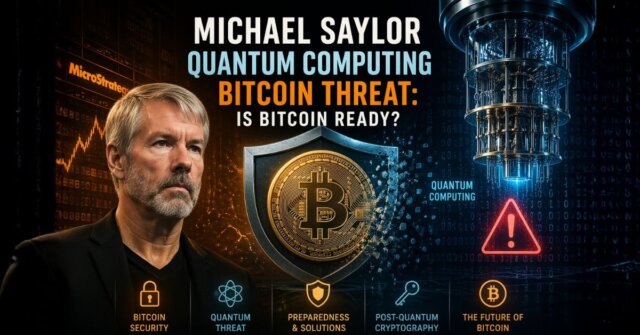
A 15-bit elliptic curve key just fell to a quantum computer. This is the same type of cryptography Bitcoin uses. The community is now locked in a high‑stakes debate about timelines. Michael Saylor calls the quantum threat “overhyped.” Is Bitcoin ready? The answer sits between next‑generation physics and a software upgrade already on the table.
Key takeaways
- Project Eleven awarded a 1 BTC bounty to researcher Giancarlo Lelli. He cracked a 15‑bit elliptic curve key on publicly accessible quantum hardware.
- This represents a 512× leap from the 6‑bit break shown in September 2025. It proves quantum attacks on ECC have moved from theory into practice.
- Bitcoin secures its wallets with 256‑bit keys. These keys are roughly 2.2×10⁷² times harder to crack than the 15‑bit key just broken.
- Michael Saylor argues a credible quantum threat is more than a decade away. He believes Bitcoin will upgrade its cryptography well before any practical attack materializes.
- Bernstein analysts give developers a 3‑ to 5‑year window to roll out a post‑quantum migration. BIP‑360 is already published as a potential soft‑fork fix.
A 15‑Bit Crack That Shook a $2.5 Trillion Security Assumption
Bitcoin’s security rests on elliptic curve cryptography. That math protects trillions of dollars in digital assets. Independent researcher Giancarlo Lelli pierced it at a scale of just 15 bits. He walked away with Project Eleven’s 1 BTC Q‑Day Prize.
Alex Pruden, CEO of Project Eleven, framed the result sharply. He said, “The resource requirements for this type of attack keep dropping. The barrier to running it in practice is dropping with them. The winning submission came from an independent researcher. He used cloud‑accessible hardware. No national lab, no private chip.”
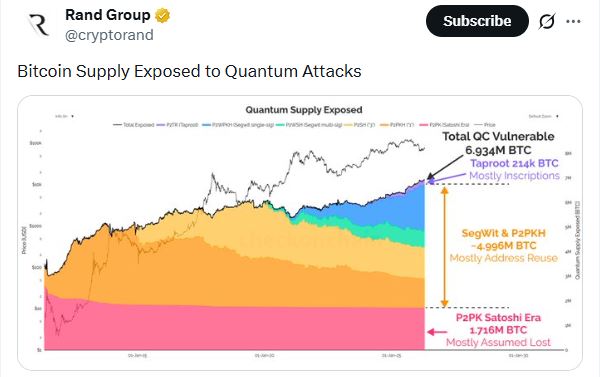
The demonstration threatens roughly $450 billion in BTC. This sum sits in older addresses whose public keys are already visible on chain. Furthermore, it places a question mark over $2.5 trillion in value. All of it is secured by elliptic curve algorithms across the digital economy.
How a Public Key Becomes a Target
When you spend Bitcoin, your public key is broadcast to the network. Before that moment, only a hashed version exists. Older addresses, however, have already exposed their keys. These funds are the most vulnerable. A quantum computer can potentially reverse the private key from that exposed data. That is precisely why the race for a solution has intensified.
The Prize That Sparked a Global Race
Project Eleven launched the Q‑Day Prize to accelerate research. They asked a simple question: How fast can an independent researcher break an ECC key? The answer came faster than many expected. Lelli’s entry demonstrated that the tools are now in the hands of everyday developers. No government agency was needed.
Michael Saylor’s Decade‑Long Timeline Versus the Labs’ Accelerating Curve
Michael Saylor has not been silent on this issue. Throughout early 2026, he repeated his stance on podcasts and earnings calls. As Strategy’s executive chairman, he treated quantum anxiety as another “existential threat.” He reminded everyone that Bitcoin has survived many such threats before.
His core argument is straightforward. A cryptographically relevant quantum computer will not arrive this decade. If the threat becomes real, global digital infrastructure will upgrade first. Accordingly, Bitcoin will upgrade with it.
Saylor’s optimism draws from Bitcoin’s software nature. The protocol is upgradeable. BIP‑360 is already sitting in the Bitcoin Improvement Proposals repository. It proposes Pay‑to‑Merkle‑Root outputs and lays groundwork for a quantum‑hardened future.
Yet data from quantum labs tells a different story. The resource estimates for running Shor’s algorithm have dropped five orders of magnitude in two decades. Google’s latest research suggests a computer with under 500,000 physical qubits could threaten Bitcoin’s 256‑bit keys. Moreover, a follow‑up paper from Caltech and Oratomic brought that number down to 10,000 qubits. They achieved this in a neutral‑atom architecture.
When asked about a nine‑minute crack window, Google’s research team pointed to the narrowing gap. Could a quantum computer crack Bitcoin signatures within a transaction’s confirmation time? Their response was not a firm no.
Bitcoin Q‑Day Preparation Is No Longer Theoretical
“Q‑Day” marks the moment a quantum computer breaks proof‑of‑ownership. It is no longer a distant hypothetical. Joshua Lim of FalconX recently mapped out how derivatives are pricing quantum risk. Long‑dated options skew and forward basis already reflect this shift.
Ark Invest broke the threat into five stages. They concluded a sudden security collapse is improbable. Instead, improvements will arrive gradually. The network will have time to prepare quantum‑resistant upgrades. Meanwhile, tracking technological advances remains crucial.
The most concrete preparation is BIP‑360. It would introduce a new output type via soft fork. The proposal avoids revealing a public key during spending. As a result, it lays the foundation for full post‑quantum cryptography integration. Developers are also evaluating SPHINCS+ and Lamport signatures. These are hash‑based schemes that Shor’s algorithm cannot touch.
Separately, Coinbase’s Quantum Advisory Board ranked the most prepared layer‑1 blockchains. Algorand and Aptos topped the list. Algorand’s mainnet had already demonstrated a live Falcon‑1024 signature.
The market is placing its own bets. The Quantum Resistant Ledger token surged nearly 49% in 24 hours during a March 2026 spike in quantum anxiety. In addition, MicroCloud Hologram committed $400 million to post‑quantum Bitcoin R&D. Tron founder Justin Sun unveiled a quantum‑resistant upgrade roadmap for his chain.
More than a technical debate, Q‑Day preparation has become a governance test. The community must decide whether to freeze vulnerable Satoshi‑era coins through BIP‑361. Alternatively, it could rely on voluntary, gradual migration. Either way, the window is roughly three to five years. The clock is already ticking.
Read Also: The Quantum Threat to Bitcoin Is Social, Not Technical
Disclaimer!!
CryptopianNews provides this information for educational and informational purposes only. You should not consider it financial or investment advice. Cryptocurrency markets are highly volatile and speculative, and they carry inherent risks. We advise readers to conduct their own research and to consult with a qualified financial advisor before making any investment decisions.

- QuFi Post-Quantum Verification Platform: A New Infrastructure Layer for Digital Assets — A Post-Quantum Verification Platform for Digital Assets - September 4, 2026
- Polygon Leads as Visa Expands Stablecoin Network for Cross-Border Payments - April 29, 2026
- Michael Saylor Quantum Computing Bitcoin Threat: Is Bitcoin Ready? - April 24, 2026