
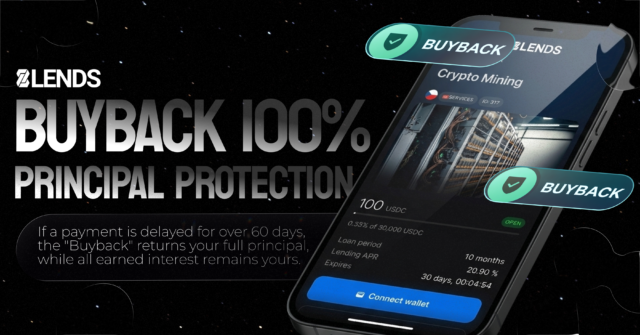
Recent industry research confirms that capital protection remains the top priority for P2P crowdlending investors. A 2025 Maclear study revealed that 58% of investors consider borrower default risk their main concern, while far fewer worry about legal protection mechanisms. At the same time, up to 85% of investors are willing to accept higher risk if returns improve—but only when platforms offer protection mechanisms such as buyback guarantees or other risk-mitigation structures.
What Is a Buyback Guarantee?
A buyback guarantee is one of the most widely used investor-protection mechanisms on P2P crowdlending platforms. Its purpose is to reduce the impact of borrower defaults by shifting a significant share of the credit risk from the investor to the loan originator or a partner institution.
The logic behind the mechanism is straightforward. If an investment offers a buyback guarantee, lenders are assured that their principal—the amount originally invested—will be returned even if the borrower fails to repay the loan according to the agreed schedule or stops paying altogether. In such cases, the outstanding loan is repurchased and the invested funds are returned to investors.
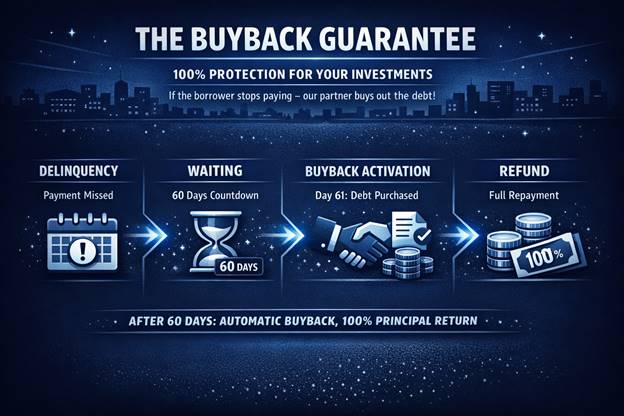
Importantly, this process is not triggered immediately after a missed payment. Platforms typically allow a grace period during which the borrower is encouraged to return to the repayment schedule. For example, on the 8lends platform, legal teams work with the borrower for up to 60 days after the first missed payment. If the loan remains overdue beyond this point, it is transferred to a partner credit risk management firm, which repurchases the debt and begins repaying investors their principal. The firm literally serves as a collector who takes over the loan, becomes a collateral manager, and receives the borrower’s RWA assets. After the assets are transferred, the collector initiates legal proceedings and asset liquidation. They can even generate profit through this process.
For investors, this structure creates a relatively balanced risk-return profile. The principal investment remains protected even in the event of borrower default, while interest already paid during the life of the loan remains with the investor as earned income. As a result, buyback guarantees allow participants in crowdlending markets to access higher-yield lending opportunities while benefiting from an additional layer of capital protection.
Buyback Guarantee vs. Collateral: Two Different Ways to Protect an Investment
To understand the difference between a buyback guarantee and collateral-backed lending, it helps to look at how each mechanism protects investors when a borrower fails to repay.
A buyback guarantee works much like a manufacturer’s warranty. When you buy a product with a warranty, the producer promises that if something goes wrong, they will repair it or replace it. In P2P crowdlending, the loan originator plays a similar role. If the borrower stops making payments and the loan becomes significantly overdue, the originator repurchases the loan and returns the investor’s principal. Because the repayment comes directly from the originator, the process is typically fast and operationally straightforward, provided the guarantor is financially strong.
Collateral-backed lending resembles a secured bank loan against property. The borrower pledges an asset—such as real estate, a vehicle, or equipment—as security for the loan. If the borrower defaults, that asset can be seized and sold, and the proceeds are used to repay investors. This approach provides tangible protection, but the recovery process may take longer because it involves legal procedures, asset valuation, and sale.
The difference lies in both the mechanism of recovery and the timing of investor repayment:
- In the collateral-backed model, the platform acts as the collateral agent, managing the recovery process directly. If a borrower defaults, funds are recovered through legal proceedings and the liquidation of pledged real-world assets, with proceeds distributed to investors proportionally. This approach is grounded in tangible asset value and provides a robust layer of security. The recovery timeline depends on legal and market processes, which can take time.
- In the buyback model, the process is structured differently. Once a loan becomes around 2 months overdue, it is sold to a debt collector, who takes over as the new collateral agent. The collector assumes control of the recovery process, including ownership of the borrower’s underlying RWA assets, and manages enforcement independently. Meanwhile, investors are repaid earlier, as the platform effectively exits the recovery cycle by transferring the defaulted exposure.
As a result, the collateral-backed model prioritizes direct, asset-based recovery managed by the platform, while the buyback model features speed and operational simplicity for investors, with recovery delegated to a third party.
Investment Infrastructure With Fund Protection In Mind
Over the past decade, the P2P crowdlending market has evolved from a niche fintech experiment into a structured financial infrastructure connecting investors with the real economy. Retail and institutional participants now fund consumer loans and small-business financing needs that would traditionally sit on bank balance sheets. As the market matured, platforms introduced a range of mechanisms designed to address the key concern of investors, capital protection. This turns P2P crowdlending into a more predictable and transparent yield-generating environment.
Within this ecosystem, buyback guarantees represent a risk-management approach focused on operational speed and predictability. Rather than relying on the liquidation of pledged assets, the mechanism shifts the responsibility for borrower defaults to the loan originator, allowing investors to recover their principal relatively quickly. Other investors may prefer collateral-backed structures that rely on asset security instead. The presence of both models reflects the growing sophistication of the market. P2P crowdlending is no longer a one-size-fits-all investment channel, but a flexible infrastructure where participants can choose the risk protection model that best aligns with their strategy and tolerance for uncertainty.
Read Also: As Bank Lending Tightens, Crowdlending Steps In
Disclaimer!! CryptopianNews provides this information for educational and informational purposes only. You should not consider it financial or investment advice. Cryptocurrency markets are highly volatile and speculative, and they carry inherent risks. We advise readers to conduct their own research and to consult with a qualified financial advisor before making any investment decisions.

- ETH Amazon Moment: Why Ethereum Could Be Undervalued - July 18, 2026
- CLARITY Act Approval Odds Drop to 50%: Bitcoin Impact - July 2, 2026
- Swell 2026 Highlights Growing XRP Institutional Momentum - June 20, 2026