
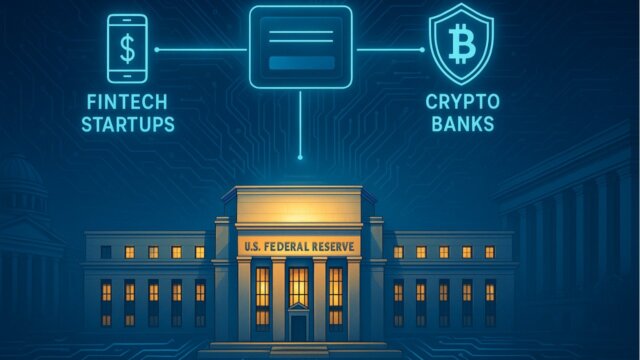
- The Federal Reserve (Fed) is exploring a new account structure called a “skinny” master account, a streamlined version of its full master account offering.
- This new model aims to grant fintech, crypto-friendly banks, and payments innovators direct access to its payment rails.
- The new model is aimed at firms that engage heavily in payments innovation but may not require the full breadth of services that traditional banks enjoy.
The Federal Reserve (Fed) is exploring a novel account structure called a “skinny” master account—a streamlined version of its full master account offering that would grant fintech, crypto-friendly banks and payments innovators direct access to its payment rails. The announcement comes from Fed Governor Christopher Waller, who on Tuesday spoke at a payments-innovation conference in Washington and indicated that Fed staff are now studying how to implement this new approach to broaden access for legally eligible institutions.
What is a “skinny” master account?
Traditionally, federally chartered banks hold a full master account with the Fed, which allows them to use the central bank’s core payment systems—such as Fedwire and the Automated Clearing House (ACH) network—directly. These full master accounts come with the full suite of Fed services (including interest on balances, overdraft privileges and borrowing access via the discount window) and are subject to rigorous eligibility and risk-control standards. Under this newly proposed model, the Fed is exploring a lighter version of the master account—dubbed a payment account or “skinny” master account—targeted at firms that engage heavily in payments innovation (including crypto firms and fintechs) but may not require the full breadth of services that traditional banks enjoy. Key characteristics of the skinny master account as outlined by Waller include:
- Access to basic Fed payment rails (so firms don’t have to rely on third-party banks) for eligible institutions.
- A streamlined review timeline, reducing the barrier of the full master-account application process.
- Limitations designed to control risk, including no interest payments on balances, no daylight overdraft privileges, and possibly balance caps.
- Exclusion of certain services—such as borrowing from the Fed’s discount window—for the new account category.
In Waller’s words:
“To that end, I have asked Federal Reserve staff to explore the idea of what I am calling a payment account … This payment account concept would be targeted to provide basic Federal Reserve payment services to legally eligible institutions that right now conduct payment services primarily through a third-party bank that has a full-fledged master account.”
The idea is still a prototype, and Waller emphasized that the proposal is not yet final. He added the Fed will seek input from stakeholders on how this new account type might work.
Why now? What’s driving this move?
Multiple forces appear to underlie the Fed’s decision to revisit how payment-rail access is granted:
1. Shift in payments landscape
Governor Waller noted in his remarks that the payments environment has changed dramatically, with distributed-ledger technologies, crypto-asset innovations, fintech disruptions and new business models no longer on the fringes—they’re increasingly integrated into the broader payment system.
2. Innovation urgency
As payments innovation moves fast, the Fed is acknowledging that its infrastructure and policies may need to evolve to keep pace. Waller remarked:
“Payment innovation moves fast, and the Federal Reserve needs to keep up.”
3. Access bottlenecks for fintech/crypto firms
For years, crypto-focused banks and fintech firms have sought full master accounts or direct access to the Fed payment rails, but many have been turned away or were forced to rely on other banks as intermediaries. The new model aims to bridge that gap.
4. Regulatory signal
The move is also seen as a regulatory and policy signal—indicating that the Fed may be more open to the crypto/fintech sector’s growth and the enabling of new payment models, though still within a framework that limits systemic risk. For example, payment-only banks that previously were blocked may now have a revived path for consideration.
5. U.S. broader crypto policy shift
Under the current U.S. administration, the policy environment has grown relatively more permissive regarding crypto and digital assets. That broader context helps explain why the Fed feels the timing is right to revisit access structures.
What institutions stand to benefit — and who might be excluded?
Beneficiaries
- Crypto-friendly banks and payments innovators: Firms that specialise in payments, crypto, or digital-asset infrastructure may gain direct access to the Fed’s infrastructure via the new account model.
- Fintech companies: Fintechs that have historically relied on partner banks to access payment rails might now apply for these slimmer accounts, gaining more autonomy.
- Innovative payment service providers: Companies pushing boundary business models (such as stablecoins, tokenization, distributed-ledger payments) may view this as a pathway to streamline operations.
Potential exclusions / concerns
- As emphasised by industry participants, only “legally eligible entities” may qualify. That means not all firms in the crypto/fintech space will automatically gain access.
- Firms which are trust companies holding crypto assets but not taking deposits may face ambiguity in eligibility. For example, Custodia Bank’s founder, Caitlin Long, noted that entities that don’t hold deposits might not qualify under the current rules.
- Because the account would come with trade-offs (no interest, no overdrafts, balance caps), for some firms the value-proposition may still be limited compared to a full master account.
- Full eligibility may still demand meeting regulatory, supervision and risk-control standards—so the “streamlined” timeline may be shorter, but not necessarily trivial.
In short: the skinny account is a meaningful step, but the fine print will matter, and not every firm will deem it sufficient for its business model.
Disclaimer: CryptopianNews shares this for learning and info only. It’s not meant to be financial or investment advice. Crypto markets change a lot and move quickly. Investing in them can be risky. You should always look into things yourself. Talk to a trained financial advisor before making any choices about investing.

- Bitcoin at a Turning Point: Investor Behavior Shifts - January 30, 2026
- Cryptocurrency Market Shock: $550M Liquidations in One Day - January 26, 2026
- Bitcoin Could Follow Silver’s Path, Says Top Analyst — What It Means for BTC Price - January 25, 2026