
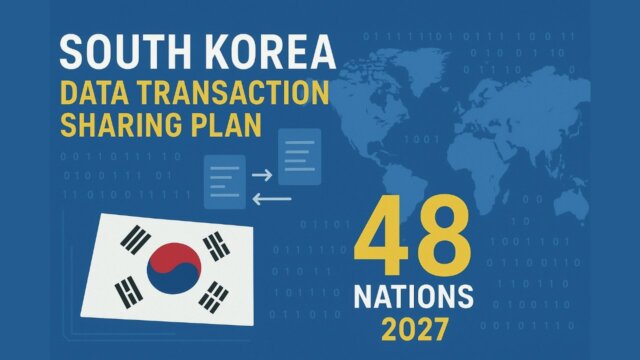
- South Korea plans to share detailed crypto data with dozens of nations starting in 2027, in line with the OECD’s Crypto-Asset Reporting Framework (CARF).
- The Ministry of Economy and Finance in South Korea has confirmed that from 2027, crypto companies will be required to submit transaction records and user tax information directly to the National Tax Service (NTS).
- The OECD’s Crypto-Asset Reporting Framework (CARF) is designed to combat cross-border tax evasion and increase transparency in global cryptocurrency markets.
South Korea is preparing to take a major step in global cryptocurrency regulation. In line with the OECD’s Crypto-Asset Reporting Framework (CARF), the country will begin collecting and sharing detailed crypto data with dozens of nations starting in 2027. This decision places South Korea among a growing number of countries working together to strengthen financial transparency, curb tax evasion, and increase accountability in digital asset markets.
South Korea’s Crypto Data Sharing Initiative
The Ministry of Economy and Finance in South Korea has confirmed that from 2027, crypto companies operating in the nation will be required to submit transaction records and user tax information directly to the National Tax Service (NTS). These records will cover both domestic and foreign investors trading on leading exchanges like Upbit, Bithumb, Coinone, and Korbit. This effort is part of South Korea’s strategy to comply with the OECD’s Crypto-Asset Reporting Framework, an international initiative that standardizes how digital asset-related tax information is exchanged between countries. The key principle behind this framework is reciprocity—South Korea will only share crypto data with countries that agree to provide the same information in return. At the start of 2025, local exchanges will already begin reporting transaction and personal information of investors to the tax office. While the international sharing aspect kicks off in 2027, the domestic reporting obligations start next year, giving regulators early access to crucial trading data.
OECD’s Crypto-Asset Reporting Framework Explained
The Organisation for Economic Co-operation and Development (OECD) designed the Crypto-Asset Reporting Framework (CARF) to combat cross-border tax evasion and bring greater transparency to global cryptocurrency markets. CARF requires participating countries to establish rules that mandate crypto service providers—exchanges, brokers, wallet services, and other intermediaries—to:
- Collect users’ tax residency details and ID numbers
- Report all transactions to local tax authorities
- Flag large, unusual, or suspicious trades
- Submit annual reports that will be exchanged internationally
By 2027, more than 48 nations will be part of this coordinated effort, with the possibility of expansion to 74 countries as seen in Switzerland’s commitment. Among the participants will be global financial powers like the U.K., Germany, Japan, and the United States. This global data-sharing system could dramatically reshape how digital assets are taxed, tracked, and regulated.
Why Is South Korea Sharing Crypto Data?
South Korea has become one of the largest cryptocurrency markets in the world, with millions of investors actively trading on local platforms. But with that growth comes challenges—particularly in areas of tax evasion, fraud, and money laundering. Government figures reveal that in 2024 alone, foreign crypto transactions amounted to KRW 11.1 trillion ($790 million), which is KRW 700 billion ($503.3 million) higher than in 2023. Such figures highlight the massive scale of digital asset flows crossing South Korea’s borders. Authorities have already taken action against illicit activities in the crypto market. Between 2021 and 2022, the government seized over $180 million worth of cryptocurrencies from tax evaders. These numbers underline why a coordinated international system is necessary.
By sharing crypto data, South Korea aims to:
- Strengthen tax enforcement ahead of its 20% crypto tax bill, scheduled to take effect in 2027.
- Align with global standards to prevent capital outflows to unregulated markets.
- Build trust in the legitimacy of crypto exchanges operating within its borders.
- Reduce the appeal of South Korea as a safe haven for tax dodgers.
South Korea’s Domestic Crypto Tax Reforms
The new crypto tax regime is set to go live in 2027, coinciding with the launch of international data-sharing. The law introduces a 20% tax on gains exceeding KRW 2.5 million ($1,800) from crypto transactions. This measure had been delayed twice due to concerns from both investors and industry groups, who argued that more preparation was needed for accurate reporting and compliance. But now, the government appears ready to enforce stricter tax measures alongside the OECD framework.
Global Impact of Data Sharing
The move to share crypto data is not just about South Korea—it’s part of a worldwide shift. Switzerland has already approved a similar plan to share data with 74 nations starting in 2026, setting an example for other financial hubs. For investors, this means that trading on an exchange in one country will no longer shield them from tax authorities in another. A South Korean resident trading on a European exchange—or vice versa—will have their records shared between governments, ensuring that tax obligations are enforced across borders.
This system could:
- Reduce anonymous cross-border crypto trading
- Expose undeclared income and tax dodging schemes
- Discourage money laundering via digital assets
- Increase investor accountability worldwide
South Korea’s commitment to share crypto data with 48 nations starting in 2027 signals a decisive move toward global cooperation in cryptocurrency regulation. By aligning with the OECD’s Crypto-Asset Reporting Framework, the country aims to prevent tax evasion, increase transparency, and secure its financial system against illicit activities. While the plan presents challenges—ranging from privacy concerns to industry compliance costs—it also represents a major step forward in legitimizing the crypto market. With countries like Switzerland already on board, it’s clear that the future of cryptocurrency will involve greater international coordination, accountability, and oversight. As South Korea prepares for its new 20% crypto tax law and steps into a new era of financial transparency, investors and exchanges alike must adapt to a world where crypto transactions will no longer go unnoticed.
Disclaimer: CryptopianNews shares this for learning and info only. It’s not meant to be financial or investment advice. Crypto markets change a lot and move quickly. Investing in them can be risky. You should always look into things yourself. Talk to a trained financial advisor before making any choices about investing.

- Bitcoin at a Turning Point: Investor Behavior Shifts - January 30, 2026
- Cryptocurrency Market Shock: $550M Liquidations in One Day - January 26, 2026
- Bitcoin Could Follow Silver’s Path, Says Top Analyst — What It Means for BTC Price - January 25, 2026