

Key Highlights
- Tether freezes $544 million Turkey investigation after Turkish authorities targeted illegal betting and laundering networks.
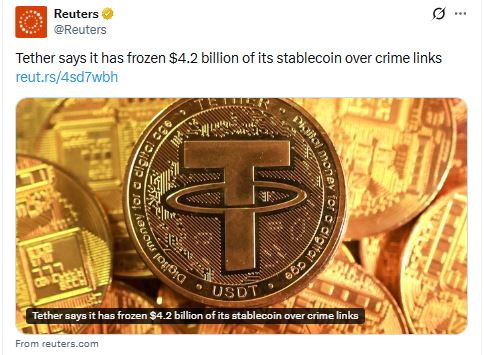
- The freeze forms part of a wider $4.2 billion global enforcement effort led by Tether against illicit crypto activity.
- Stablecoins increasingly help regulators trace cross-border financial crime through blockchain transparency.
- Thousands of wallets linked to fraud and organized crime have already been blacklisted worldwide.
Tether has frozen more than $4.2 billion in USDT linked to illicit activity across multiple jurisdictions. This figure reflects years of collaboration between blockchain firms and global law enforcement agencies. As a result, stablecoins are no longer viewed only as trading tools. Instead, they now function as compliance instruments within digital finance.
Moreover, regulators increasingly rely on blockchain transparency to track suspicious transactions. Because every transfer remains recorded on-chain, investigators can follow fund movements more efficiently than in traditional banking systems.
How Tether Blocks Funds Illegal Online Betting Turkey Operations
Tether maintains a blacklist capability that allows it to freeze tokens held in specific wallet addresses. When authorized agencies submit valid legal requests, the company can restrict transfers immediately. Therefore, funds connected to suspected crimes cannot move or exit exchanges.
In the Turkey case, prosecutors linked several wallets to illegal betting platforms operating outside national regulations. Investigators tracked transaction patterns through blockchain analytics before requesting intervention. Consequently, Tether blocked access to roughly $544 million worth of USDT connected to the network.
This process demonstrates how Tether blocks funds illegal online betting Turkey investigations through coordinated action rather than unilateral decisions. Authorities identify suspects first, while the issuer executes technical enforcement afterward.
Additionally, cooperation between crypto companies and governments has expanded significantly since 2023. Exchanges, analytics firms, and stablecoin issuers now share intelligence more frequently. Because of this collaboration, enforcement timelines have shortened considerably.
Critics sometimes argue that freezing assets contradicts decentralization principles. However, supporters claim these actions protect users and strengthen industry legitimacy. As regulatory clarity improves, compliance mechanisms increasingly become standard operational features.
International Crypto Seizure Cases Tether and the $4.2B Enforcement Trend
The Turkish investigation represents only one example within a broader enforcement landscape. Tether reported assisting authorities worldwide in thousands of cases involving fraud, scams, and organized crime networks.
Many of these cases involve “pig-butchering” scams, where criminals build trust before convincing victims to transfer crypto assets. Investigators trace wallet activity using blockchain data, and then issuers freeze identified funds. This coordinated workflow has proven effective in limiting financial damage.
Furthermore, international crypto seizure cases Tether involvement shows how stablecoins bridge traditional finance and decentralized networks. Unlike Bitcoin, USDT operates with issuer oversight, which enables intervention when courts or regulators demand action.
Cointelegraph data indicates that nearly 5,700 wallets connected to suspicious activity were blacklisted by major stablecoin issuers by late 2025. A large portion involved USDT transactions, reflecting its dominant role in global crypto liquidity.
Meanwhile, enforcement pressure appears to influence market behavior. Reports show USDT supply declined by roughly $1.5 billion in early 2026. Analysts believe compliance adjustments and liquidity shifts contributed to this contraction rather than declining adoption.
Because stablecoins facilitate trading across exchanges, any enforcement action can affect broader market flows. Therefore, traders increasingly monitor regulatory developments alongside price trends.
Why Stablecoin Enforcement Is Reshaping Global Crypto Regulation
Stablecoins now sit at the center of regulatory strategy because they combine blockchain efficiency with centralized accountability. Governments recognize that cooperation with issuers offers faster enforcement than attempting to control decentralized protocols directly.
As authorities develop stronger investigative tools, blockchain transparency becomes an advantage rather than a weakness. Every transaction leaves an immutable trail, allowing analysts to reconstruct financial networks with precision. Consequently, crypto investigations often progress faster than comparable fiat cases.
At the same time, enforcement actions signal a broader institutional shift. Regulators no longer treat crypto solely as a speculative asset class. Instead, they increasingly integrate digital assets into existing financial crime frameworks.
This evolution also changes public perception. While early narratives framed crypto as anonymous and uncontrollable, modern enforcement demonstrates measurable oversight capabilities. Industry participants now balance decentralization ideals with compliance expectations.
Looking ahead, collaboration between stablecoin issuers and global agencies will likely expand further. Cross-border investigations require coordination, and blockchain systems naturally operate beyond national boundaries. Therefore, partnerships similar to the Turkey case may become routine rather than exceptional events within digital finance.
Read Also: Inside the $61M Tether DOJ Investigation Recovery Case
Disclaimer!! CryptopianNews provides this information for educational and informational purposes only. You should not consider it financial or investment advice. Cryptocurrency markets are highly volatile and speculative, and they carry inherent risks. We advise readers to conduct their own research and to consult with a qualified financial advisor before making any investment decisions.

- QuFi Post-Quantum Verification Platform: A New Infrastructure Layer for Digital Assets — A Post-Quantum Verification Platform for Digital Assets - September 4, 2026
- Polygon Leads as Visa Expands Stablecoin Network for Cross-Border Payments - April 29, 2026
- Michael Saylor Quantum Computing Bitcoin Threat: Is Bitcoin Ready? - April 24, 2026