
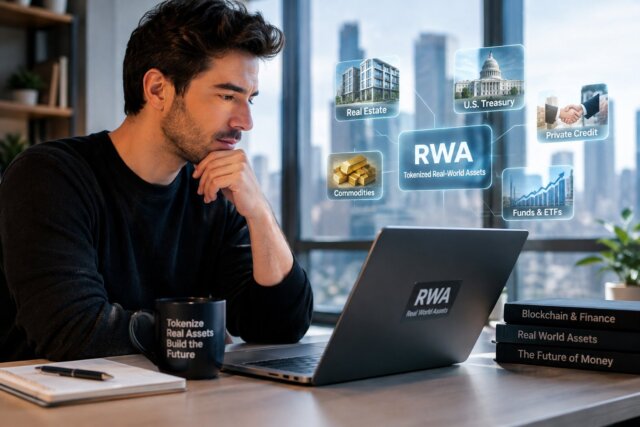
One of the key sectors of the crypto industry that has seen substantial growth is real-world assets.
The idea is simple. A token on a blockchain can be used to represent an existing asset in the real world.
This can encompass U.S. Treasury securities and funds, real estate, private credit, commodities and other financial assets.
It’s typically referred to as RWA crypto or real-world assets in crypto.
RWAs are not assets that are minted directly on a blockchain like Bitcoin but are linked to the traditional asset and blockchain infrastructure.
This market is not just experimenting, it’s moving with it in 2026. Financial companies and crypto platforms are creating products that enable the issuance, transfer and management of certain traditional assets onchain.
What Is RWA Crypto?
RWA crypto means tokens that are built on blockchain technology that represent ownership or exposure to an asset from the traditional economy.
A token, for instance, may stand for a U.S. Treasury fund. Another token could be a part of a real estate project or a claim related to private credits.
It is important to note that the blockchain does not generate the underlying asset.
Rather it presents a digital representation and management of it.
BlackRock defines tokenization as the process of converting the asset’s ownership or exposure into a digital token that can be programmed, traded and settled on a blockchain.
Unlike Bitcoin or Ether.Unlike Bitcoin or Ether. Those assets are intrinsic to the blockchain networks. By contrast, a tokenized Treasury fund is tied to an asset that already exists in the traditional finance world.
What is Real-World Asset Tokenization?
The process may differ based on asset and legal structure.
A simple illustration begins with a traditional asset.
Imagine a company has a product that it would like to introduce in the blockchain, related to Treasury. Holding the underlying assets in appropriate financial and custody arrangements.
Then a token is created to signify the holder’s ownership or economic stake.
The token may be moved over a blockchain network, consistent with the guidelines of the merchandise.
For some aspects of the process, smart contracts can be employed.
This brings together the conventional financial resources and blockchain infrastructure.
The token is not a direct asset but rather a representation of an asset. The rights are dependent on the legal framework of the product.
This is significant.
Treasury Assets: What’s their significance to the RWA market?
One of the most obvious RWA use cases is Tokenized Treasury products.
In traditional finance, U.S. Treasury securities are already popular. Treasury exposure can be moved to an onchain application, providing another layer of digital infrastructure around an existing asset.
Depending on the tokenized Treasury product and jurisdiction, investors may obtain an onchain exposure to yield through a tokenized Treasury product.
BlackRock has stated that tokenized Treasury funds are beginning to make headway, and now account for a significant share of the tokenized assets market.
Ondo Finance has also developed products based on tokenized U.S. Treasuries.
This is why RWAs are more than just about adding physical assets to a blockchain. The majority of the activity today is around existing financial assets with markets.
BlackRock and the Rise of Tokenization
BlackRock is one of the most prominent traditional financial institutions in the tokenization arena.
It introduced a tokenized money market fund structure to the blockchain market with its BUIDL fund.
The company has also been steadily growing in its tokenized financial products business.
BlackRock announced two new tokenized money market products in August 2026, one being OnChain Shares of its BlackRock Select Treasury Based Liquidity Fund.
The shift indicates that blockchain infrastructure is being put to the test for more than cryptocurrency assets.
It is also being adopted for traditional financial products.
Ondo Finance and Tokenized Assets
Another prominent player in the RWA space is Ondo Finance.
The platform has been working on onchaining traditional financial exposure, such as Treasury products and tokenized securities.
Ondo continued to diversify their product line in 2026.
In September, Ondo launched Intelligent Portfolios. They are professionally designed investment portfolios that are sent to eligible investors outside the United States as a single onchain token.
The products include exposure to baskets of tokenized assets.
This is another way of doing it than just chopping up one asset.
Rather, an entire portfolio may be represented by a single token.
RWA Crypto is Evolving from Treasuries.
While it is possible that the market for treasury products could be one of the best RWA categories today, that isn’t the end of it.
Other areas include:
Stocks and ETFs that use tokens.
Private credit
Real estate
Commodities
Investment funds
Corporate debt
There are legal and technical requirements for each category.
For instance, in real estate, the rights of ownership, property management and local regulations are all part of real estate. Those requirements are not eliminated by tokenization of the property.
It’s the same with stocks and bonds.
A blockchain token does not alter the legal rights of the asset itself.
Why Blockchain Real-World Assets?
Companies are venturing into tokenization for a variety of reasons.
One is settlement.
In traditional financial transactions there are many intermediaries, systems used. For some transactions, blockchain can provide a shared digital record through blockchain infrastructure.
The other reason is programmability.
A token can communicate with smart contracts and other blockchain applications. This opens up opportunities for automated transfers, collateral management and settlement.
Also, markets that operate around the clock are possible.
Traditional financial markets have special trading and settlement schedules, whereas blockchain networks are continuous.
This means that tokenized assets can enable a new approach to dealing with financial products, with the trading hours and limitations depending on the product.
RWA and DeFi
The relationship between RWAs and DeFi may prove to be significant.
If the corresponding infrastructure allows then a tokenized asset can be used in decentralized applications.
Collateralized lending system, for instance, might be able to use tokenized Treasury exposure.
Stablecoins may come into play as well.
A user can hold stablecoins, transfer them through a DeFi application and engage with tokenized assets on the same platform.
This opens the potential of a link between the old finance and the current cryptoeconomy.
But not all tokens are free to be used in the DeFi space. Restrictions on access to the product, transfer requirements and laws differ for each product.
What are the risks of RWA Crypto?
The risks of a traditional asset are not eliminated by RWA tokenization.
New vulnerabilities emerge from blockchain infrastructure as well.
The vulnerabilities that can occur in smart contracts can impact tokenized products. Another is custody, as investors could rely on private keys and digital wallets.
There’s a role for regulation as well.
The securities, funds, ownership and digital assets regulations vary from one jurisdiction to another.
Another one is an easily overlooked one.
A token can be traded on the blockchain, but not necessarily have a high level of liquidity.
While tokenization can simplify the transfer of an asset over the internet, it does not necessarily create buyers and sellers.
These restrictions will continue to be significant as the RWA market expands.
The significance of RWA Crypto in 2026.
The biggest change in the RWA sector is the involvement of traditional financial companies.
Nowadays, tokenization is not confined to small-scale crypto projects that are trying out blockchain technology.
Large financial institutions are experimenting with introducing funds, Treasury products and other assets to blockchain networks.
Meanwhile, crypto infrastructure is getting more adept at delivering these products.
The outcome: a gradual link between two markets that were once disconnected.
Traditional assets can access blockchain-based infrastructure, crypto users can access new financial exposure.
How to move forward with Real World Assets Tokenization?
The RWA market is still in its infancy.
Treasury products have been one of the most obvious use cases, and tokenized stocks, funds and other assets are growing the category.
The next stage could involve more connections between tokenized assets, stablecoins and DeFi applications.
Additionally, financial institutions can utilize blockchain networks for settlement and asset administration without customers seeing the blockchain.
That might be one of the most significant events.
RWA crypto doesn’t have to be a substitute for traditional finance to thrive.
It can be another layer of infrastructure that links traditional assets and digital markets.
For now, tokenization is still an emerging part of the crypto industry. However, in 2026, it is becoming more challenging to treat RWAs as an experiment in crypto.
The assets are traditional.
Infrastructure is going digital.
With $388M hacked, Bitget resumes Bitcoin Withdrawals After Stolen Crypto Moves.
BlackRock Says AI Agents Could Bring New Demand to Crypto
CryptopianNews provides this information for educational and informational purposes only. You should not consider it financial or investment advice. Cryptocurrency markets are highly volatile and speculative, and they carry inherent risks. We advise readers to conduct their own research and to consult with a qualified financial advisor before making any investment decisions.

- What Is RWA Crypto? How Tokenized Real-World Assets Work in 2026 - October 1, 2026
- BlackRock Says AI Agents Could Bring New Demand to Crypto - September 25, 2026
- Bitcoin Highest Weekly Close Signals Bullish Momentum - July 20, 2026