

Key Takeaways
- The primary question is: what caused Binance system failure during liquidations.
- Extreme liquidations (~ $19–20 billion) outpaced exchange infrastructure capacity.
- Orders were delayed, stop-losses missed, and some altcoins briefly showed zero price on Binance.
- Binance has pledged compensation for verified losses tied to technical failures.
- Users should monitor the Binance technical issues compensation guide 2025 for claims procedure.
- This incident is another instance of crypto exchange outages during market crash conditions.
On 10th October 2025, a dramatic wave of liquidations worth nearly $20 billion shook the cryptocurrency markets, and Binance suffered one of its worst outages ever. Many traders were unable to exit leveraged positions in time. This post explores what caused Binance system failure during liquidations, its consequences, and how users may claim compensation under the Binance technical issues compensation guide 2025. We also place the event in the broader context of crypto exchange outages during market crash scenarios.
What Exactly Happened During the Crash?
The Liquidation Tsunami
Between October 9–10, over $19–20 billion in leveraged positions were liquidated across centralized exchanges. Over 1.6 million traders lost their positions in just 24 hours. That volume of liquidation pressure was unprecedented.
Binance’s Systems Overwhelmed
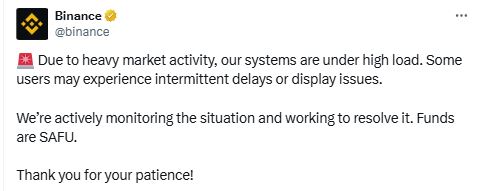
As prices plunged, Binance’s order-matching and trading infrastructure could not keep up. Some users reported:
- Transaction delays
- Frozen accounts
- Stop‐loss orders not executing
- Orders stuck in limbo
In fact, some altcoins momentarily showed zero valuation on Binance, even though they still held value on other exchanges. For example, ATOM, IOTX, and ENJ briefly hit zero on Binance while falling far less on rival platforms.
Why Did the System Collapse?
Multiple compounding factors contributed:
- Massive concurrent order flow
The sheer volume of buys, sells, and liquidations overwhelmed Binance’s infrastructure. - Collateral liquidation feedback loops
When Binance liquidated collateral tied to cross-margin positions, the aggressive sell orders further depressed market prices and compounded system load. - Liquidity drainage and maker pullback
Some market makers withdrew from Binance due to execution delays, leaving little support on the order books. - Insufficient fail-safe design
The systems lacked robust redundancy or graceful degradation in extreme volatility, exposing weak points.
Ultimately, Binance itself admitted to “transaction errors” and order delays tied to surging traffic and market fluctuations.
The Aftermath and Response
Binance’s Apology & Pledge
In public statements, Binance’s co-founders apologized to users, noting that “some users have encountered issues with their transactions.” The exchange has committed to compensating verified losses caused by technical failures, though it clarifies that losses from volatility or unrealized gains are excluded.
They urged affected users to contact customer support to file claims. Binance also said it will upgrade its infrastructure to withstand extreme stress.
Claiming Compensation — What to Know
Under the Binance technical issues compensation guide 2025, here is a practical outline:
- Only verified losses directly tied to system failures are eligible
- Volatility-driven losses or market gaps are excluded
- Users must submit supporting logs, screenshots, or trade records
- Binance will likely assess each case individually
- There may be a deadline or window to file claims
Until the formal guide is fully published and operational, affected users should retain all relevant evidence and follow Binance support instructions closely.
Broader Lessons & Patterns
Not the First Time — Crypto Exchange Outages During Market Crash
This incident is not unique. Centralized exchanges have historically buckled under stress during volatile sell-offs. The phenomenon of crypto exchange outages during market crash emerges repeatedly:
- In flash crashes, exchanges see order book fragmentation, slowness, or even suspension
- Heavy automated trading exacerbates system load
- Exchanges with weaker architecture suffer cascading failures
Thus, the Binance outage reaffirms why infrastructure resilience is crucial in crypto markets.
Risks for Traders & Exchanges
- Traders relying on exchanges face execution risk under stress
- Overleverage magnifies exposure to system glitches
- Exchanges must invest in redundancy, queue throttling, and stress testing
- Transparent compensation policies help preserve trust
Risk Mitigation Strategies for Future Crises
To guard against future collapses, the industry should consider:
- Throttled order flow in surges (rate limits, circuit breakers)
- Tiered failover systems that continue functioning under overload
- Decentralized fallback mechanisms or hybrid models
- Better user protections, such as guaranteed stop-loss execution in extreme volatility
- Clear compensation frameworks like the upcoming 2025 guide
From a trader’s standpoint, diversifying across exchanges, avoiding excessive leverage, and keeping records help reduce exposure to platform failures.
Final Thoughts
The question of what caused Binance system failure during liquidations lies at the intersection of extreme market stress, fragile infrastructure, and cascading feedback loops. The $20 billion liquidation wave simply overwhelmed Binance’s trading systems, triggering delays, missed orders, and zero-price anomalies on certain altcoins. Binance has committed to compensating verifiable technical failures under its forthcoming Binance technical issues compensation guide 2025, but the process will likely require meticulous documentation and careful judgment.
This episode underscores a recurring pattern of crypto exchange outages during market crash events. For both traders and exchanges, resilience, transparency, and careful architecture will be critical to reducing systemic risk in the future.
Read Also: Crypto Market Heat: Crypto’s New Greed Phase
Disclaimer!! The information provided by CryptopianNews is for educational and informational purposes only. It should not be considered financial or investment advice. Cryptocurrency markets are highly volatile and speculative, and investing in them carries inherent risks. Readers are advised to conduct their own research and consult with a qualified financial advisor before making any investment decisions.

- Bitcoin at a Turning Point: Investor Behavior Shifts - January 30, 2026
- Cryptocurrency Market Shock: $550M Liquidations in One Day - January 26, 2026
- Bitcoin Could Follow Silver’s Path, Says Top Analyst — What It Means for BTC Price - January 25, 2026