
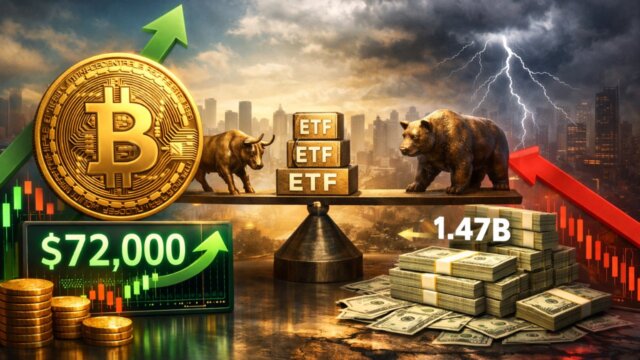
- Bitcoin market sentiment stays mixed as traders balance strong demand with market uncertainty.
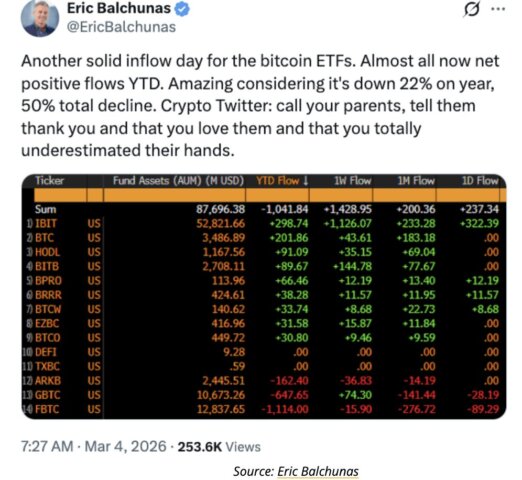
- U.S. spot Bitcoin ETFs recorded $155 million in daily inflows, extending a strong institutional buying streak.
- Over the past two weeks, ETFs have attracted $1.47 billion, signaling renewed interest from large investors.
- BlackRock’s IBIT ETF led inflows, followed by Fidelity and Grayscale products.
- While institutional demand is strong, on-chain metrics suggest underlying demand remains fragile.
The cryptocurrency market continues to evolve rapidly, and recent developments show that institutional investors are once again playing a major role in shaping price movements. Bitcoin has managed to stay above the critical $72,000 level, trading near $72,500 even as global markets remain uncertain.
This price stability comes alongside strong inflows into U.S. spot Bitcoin exchange-traded funds (ETFs). These investment products allow institutions to gain exposure to Bitcoin without directly holding the asset, which has made them increasingly popular among large investors. Over the last two weeks alone, ETFs have attracted nearly $1.47 billion in inflows.
As a result, Bitcoin market sentiment has started to shift. While retail investors remain cautious, institutional demand is helping support the market. However, analysts still warn that deeper demand signals must improve if Bitcoin is to maintain its current momentum.
Bitcoin market sentiment improves as ETFs attract institutional capital
Institutional investment has become one of the biggest drivers of Bitcoin’s price action in 2026. Over the past week, U.S. spot Bitcoin ETFs recorded about $155 million in new inflows in a single trading session. This inflow extends a two-week buying streak that has already brought approximately $1.47 billion into these funds.
Large investors often move cautiously, so sustained inflows typically signal growing confidence in the asset. In this case, institutions appear to be accumulating Bitcoin after months of market uncertainty. Consequently, the continued capital allocation into ETFs suggests that big players believe the current price range offers long-term value.
Moreover, ETFs provide an easier entry point for institutional portfolios. Many asset managers prefer regulated financial products rather than holding cryptocurrency directly. Therefore, strong ETF inflows are often viewed as a clear indicator that Bitcoin market sentiment is gradually turning positive among professional investors.
BlackRock and major ETF issuers drive the latest inflow wave
Among the various ETF providers, BlackRock has emerged as the clear leader in attracting investor capital. Its iShares Bitcoin Trust (IBIT) recorded roughly $307 million in inflows during the latest reporting period, making it the strongest performer among competing funds.
Other major financial institutions also posted solid numbers. Fidelity Investments’ FBTC saw around $48 million in inflows, while Grayscale’s Bitcoin Mini Trust attracted approximately $32 million. These inflows show that interest is spread across multiple investment vehicles rather than being concentrated in a single product.
This broad participation is important because it signals wider institutional acceptance of Bitcoin. When multiple funds see steady inflows at the same time, it usually reflects growing confidence across the investment community. As a result, ETF demand is becoming one of the most important factors shaping Bitcoin market sentiment in the current cycle.
Bitcoin increasingly viewed as a hedge during geopolitical uncertainty
Another reason for Bitcoin’s resilience is its emerging role as a geopolitical hedge. In recent years, investors have begun to consider Bitcoin alongside traditional safe-haven assets such as gold.
Unlike gold, however, Bitcoin has several unique advantages. It trades 24 hours a day, seven days a week. Additionally, it can be transferred across borders instantly without relying on banks or governments. Because of these characteristics, some investors see it as a form of digital financial insurance during periods of global tension.
Consequently, geopolitical uncertainty often pushes investors to explore alternative assets. Bitcoin fits this role well because it is decentralized and globally accessible. This growing narrative has played a role in stabilizing Bitcoin market sentiment, especially during periods when traditional financial markets experience volatility.
On-chain metrics suggest demand remains fragile
Despite strong ETF inflows, blockchain data reveals a more cautious picture beneath the surface. Analytics firm Glassnode reports that several key on-chain indicators are still weak, suggesting that the broader market may not yet be fully convinced.
For example, realized profits across the network have fallen by roughly 63% since early February. This decline indicates that fewer investors are selling Bitcoin at a profit compared to previous months. While this can sometimes signal long-term holding behavior, it may also reflect reduced trading activity.
Another notable metric shows that only about 57% of Bitcoin’s circulating supply is currently in profit. Historically, this level has often appeared during the early stages of bearish phases. Therefore, analysts warn that Bitcoin market sentiment could remain fragile until stronger organic demand returns to the market.
Market outlook: Can Bitcoin maintain momentum above $72K?
Bitcoin has rebounded significantly since February, when prices briefly dipped close to $60,000. The recovery to above $72,000 represents roughly a 20% gain in just a few weeks. This rebound suggests that buyers are stepping in whenever the market approaches key support levels.
However, investor psychology remains cautious. The Crypto Fear & Greed Index has improved slightly but still sits in the “extreme fear” zone. This means many traders remain uncertain about the next major move in the market.
Another critical level to watch is the $70,000 cost basis for short-term holders. Analysts believe this price could act as psychological resistance. If Bitcoin approaches that level again, some traders may sell to break even after previous losses. Nevertheless, continued ETF inflows could help strengthen Bitcoin market sentiment and potentially push prices higher in the coming months.
Conclusion
Bitcoin’s ability to hold above $72,000 highlights the growing influence of institutional investors in the cryptocurrency market. Strong inflows into U.S. spot Bitcoin ETFs have provided important support, helping stabilize prices after a period of uncertainty.
At the same time, macroeconomic factors and geopolitical tensions are encouraging investors to consider Bitcoin as a potential hedge asset. These trends are gradually reshaping how traditional finance views the digital currency.
However, the market still faces challenges. On-chain data shows that underlying demand remains relatively weak, and investor confidence has not fully recovered. For a sustained rally to occur, stronger organic buying activity will likely be needed.
Even so, ETF demand and institutional participation continue to play a crucial role in shaping Bitcoin market sentiment, and their influence could define the next phase of the crypto market cycle.
Disclaimer: CryptopianNews shares this for learning and info only. It’s not meant to be financial or investment advice. Crypto markets change a lot and move quickly. Investing in them can be risky. You should always look into things yourself. Talk to a trained financial advisor before making any choices about investing.

- Bitcoin tightest session: Why Traders Are Watching $65K - July 20, 2026
- Can 5x Bitcoin Still Happen This Market Cycle? - July 18, 2026
- Capital Is Chasing AI: Why Bitcoin Is Waiting Its Turn - July 2, 2026