

Key Points
- Experts forecast stablecoin market cap to reach $500B by end of 2026, up from ~$308B today.
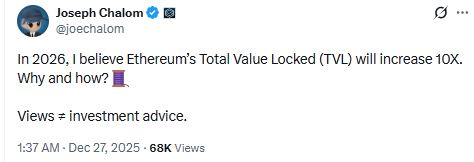
- A larger stablecoin economy could contribute significantly to Ethereum TVL growth, potentially 10X by 2026.
- Over half of stablecoin activity occurs on Ethereum, reinforcing its DeFi dominance.
- Institutional adoption, tokenization, and real-world assets are major TVL catalysts.
- Stablecoin integration into payments and settlements could spur broader adoption beyond DeFi.
Stablecoin Growth and Ethereum’s Strategic Position
The stablecoin market forecast 2026 anticipates a dramatic expansion in the stablecoin economy — with projections suggesting the total market capitalization could exceed $500 billion by the end of the year. This represents a near 62% increase from current figures and reflects broad cryptocurrency adoption across markets and use cases.
With stablecoins increasingly serving as on-chain liquidity, settlement tools, and yield vehicles, a deeper analysis of how this growth will influence Ethereum’s Total Value Locked (TVL) becomes essential. In particular, phenomena such as ethereum stablecoin dominance explained and the landscape for the best stablecoins on ethereum 2026 raise new questions about the future of DeFi, institutional capital flows, and blockchain infrastructure.
What Is Driving the Stablecoin Market Forecast 2026?
The Role of Stablecoin Utility and Adoption
Stablecoins were originally designed to offer a predictable unit of account within the volatile crypto ecosystem. As usage evolved, more traders, protocols, and institutions began employing stablecoins for liquidity provisioning, decentralized lending, and global remittances. Together, these use cases have cemented stablecoins as foundational components in crypto finance.
For example, forecasts estimating stablecoin expansion to $500 billion by the end of 2026 are rooted in both retail and institutional momentum, where stablecoins are increasingly integrated into cross-border payments, treasury management strategies, and lending markets.
Institutional Interest and Tokenized Assets
Institutional interest also plays a significant role. Many traditional financial firms are exploring blockchain tokenization and hybrid asset structures that leverage stablecoins to enhance liquidity and settlement efficiency. Tokenizing real-world assets (RWAs) could accelerate total value locked across DeFi platforms, especially on Ethereum.
How Stablecoin Growth Could Translate Into Higher Ethereum TVL
Current State of TVL on Ethereum
Today, Ethereum remains the leading chain for decentralized finance, hosting the majority of TVL across smart-contract networks. Although the exact figures fluctuate with market conditions, recent reports suggest Ethereum’s TVL rose through ongoing DeFi activity, and experts believe this number could materially increase.
Since over 50% of stablecoin transactions occur on Ethereum, a surge in stablecoin market capitalization directly reinforces capital inflows into DeFi protocols, lending markets, and decentralized exchanges that contribute to Ethereum’s TVL.
Mechanisms Through Which Stablecoins Affect TVL
Liquidity and Capital Efficiency
Stablecoins boost Ethereum’s TVL by serving as the primary medium of value in lending and liquidity pools. When more capital enters lending markets as stablecoins, TVL measures climb — and protocols can allocate more assets toward yield-bearing strategies.
They also help ensure that value remains on-chain instead of off-ramping into fiat, strengthening Ethereum as a settlement layer for global capital.
Layer-2 Integration and Cross-Chain Flows
As Layer-2 platforms grow within the Ethereum ecosystem, stablecoins act as the primary bridge currency across chains. Their prevalence improves capital efficiency and reduces friction for users and institutions transferring assets. This integration further amplifies Ethereum’s composable DeFi ecosystem.
Institutional and Macro Trends Supporting TVL Expansion
Sovereign and Institutional Participation
In 2026, large financial entities and sovereign wealth funds are expected to scale blockchain involvement. Ethereum’s established infrastructure, security, and developer ecosystem make it a leading candidate for large allocations. Expectations of increased institutional activity stem from recent trends showing growing interest from firms that are aligning blockchain with traditional markets.
Broader DeFi Usage Beyond Stablecoins
Although stablecoins are major drivers, other DeFi sectors expand TVL as well. Tokenized securities, prediction markets, NFT-linked finance, and staking derivatives are part of a broader ecosystem that complements stablecoin activity.
Risks and Challenges
Regulatory and Market Risks
Despite bullish projections, regulatory risks remain a concern. Governments and financial authorities are actively considering frameworks for stablecoins as financial instruments. Although a supportive regulatory environment could accelerate adoption, regulatory restrictions or uncertainties might slow growth trajectories.
Concentration and Protocol Risk
Conversely, centralization within stablecoin issuance raises systemic risk questions, particularly if stablecoin reserves or redemption mechanisms are not transparent. For Ethereum TVL expansion to be sustainable, protocols must maintain strong peg stability and adequate liquidity provisioning.
Interplay With Other Blockchain Trends
Emerging Competitors and Multi-Chain Growth
While Ethereum remains dominant, other blockchains and Layer-2 networks are increasingly hosting DeFi liquidity and stablecoin volume. These competitors contribute to overall crypto growth but also introduce multichain complexity that can reallocate capital flows away from Ethereum.
Looking Ahead Into 2026
With the stablecoin market forecast 2026 pointing toward a larger and more integrated ecosystem, Ethereum stands positioned to benefit from this expansion. Stablecoins — particularly those recognized as part of the best stablecoins on ethereum 2026 — will likely continue anchoring liquidity, enabling deeper DeFi markets and attracting institutional engagement.
Moreover, as stablecoin utility broadens into cross-border payments, treasury operations, and tokenized asset frameworks, networks with strong infrastructure — such as Ethereum — will remain pivotal to decentralized finance.
Read Also: Why Wall Street Calls Ethereum the Wall Street Token: Complete Analysis
Disclaimer!! The information provided by CryptopianNews is for educational and informational purposes only. It should not be considered financial or investment advice. Cryptocurrency markets are highly volatile and speculative, and investing in them carries inherent risks. Readers are advised to conduct their own research and consult with a qualified financial advisor before making any investment decisions.

- Tensor Coin (TNSR) Update: 216M Burn, Supply and 2026 Developments - October 3, 2026
- BTC stuck in a range: Large Buyers Signal Strength - July 20, 2026
- CLARITY Act Odds Drop to 35% After DOJ Warning - July 18, 2026