

At some point, everyone in crypto has chased yield. 80%, 120%, sometimes 300% APY on farming protocols that looked like easy money. The pattern is always the same: rewards come in fast, token supply expands even faster. And then the price collapses. What looks like income on paper quickly turns into capital erosion in practice.
This is no longer isolated. According to CoinGecko, 13.4 million tokens launched since 2021 are now dead by 2026, roughly half of the market. Perhaps more revealing, 11.6 million disappeared in 2025 alone, accounting for 86.3% of all R.I.P. tokens for the past five years. The few that survived majorly lost most of their value, turning high APY into real losses. The yield didn’t vanish. It turned into a loss.
Even the ‘safer’ side of DeFi follows a similar logic. Parking stablecoins for 4–6% feels rational, but in reality it barely outpaces inflation or saving accounts. In both cases, the issue is built into the speculative model. The yield looks like income, but behaves like dilution.
The problem isn’t high returns. It’s how those returns are generated. Token yield, driven by emissions and dependent on price and liquidity, is fundamentally unstable. The market is starting to recognize this and is gradually shifting toward a different model, where yield is actually earned.
Where Real Yield Up To 25% APY Comes From
Instead of asking ‘how high is the APY,’ investors are starting to ask a more important question: ‘who is actually paying it?’ DeFi does offer real yield — income that is paid, not printed. It comes from real businesses, real borrowers, and real cash flow through P2P crowdlending platforms like 8lends. And yet, it can still reach 18% to 25% APY.
At first glance, this looks unrealistic. Even suspicious. The assumption is simple: if returns are that high, something must be wrong. But the answer is not hidden. It is built into the system.
The mechanism behind real yield is grounded in how traditional finance operates. At its core is SME lending. In this model, yield is not created through token emissions or liquidity changes. It is paid directly by small businesses that are solving real financing gaps. They are willing to pay up to 25% for access to fast, flexible capital. After all, it enables them to operate and grow without the constraints of traditional crediting with unfavorable conditions. Some firms even can’t meet evolving crediting requirements and get constant loan rejections.
Investors, in turn, participate through a simple and transparent process:
- Capital is deployed in USDC, a fully backed stablecoin. It’s widely used in regulated frameworks such as MiCA in Europe. This removes exposure to currency volatility while keeping the process efficient and borderless.
- Returns are generated from loan repayments made by the borrowers. Unlike speculative token-based systems, this model makes the source of yield visible and directly tied to real economic activity.
- Payouts are automated through smart contracts. This reduces operational friction and eliminates unnecessary intermediaries and comes without extra charges. 8lends operate on the Base network, which enables low transaction costs, just a couple of cents, and efficient settlement.
In this equation, 8lends connects 33,000+ of investors directly with high-margin businesses using blockchain infrastructure. Small businesses gain access to external financing that have already surpassed €98.5 million (around ₺3.55 billion). At the same time, investors receive real yield, holding full control through transparent on-chain infrastructure.
Why Is a Real Yield Engine Safe?
Borrower default still remains a real risk. Unlike token-driven models, this risk is managed through traditional financial discipline. At 8lends, each borrower undergoes institutional due diligence conducted by the Maclear AG team. The analysts of the Swiss-based investment platform evaluate dozens of criteria including financial stability, cash flow, and business viability. Each borrower is awarded a risk score before the funding begins. This allows investors to engage with the projects that match their risk appetite.
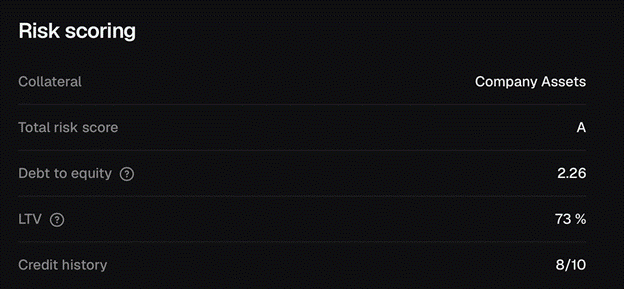
An additional layer of security is real-world collateral: equipment, inventory, or real estate. In case of default, it’s sold to repay the debt to investors. In certain cases, a BuyBack mechanism takes place. An institutional partner steps in to repurchase a failed loan and return the principal to investors in full. The gained yield isn’t counted as part of the principal in this scenario.
The Future Is Real Cash Flow Dependent
The combination of real economic activity, structured risk management, and on-chain transparency is what defines a real yield engine. It does not remove risk. But it changes its nature, making it visible, measurable, and even predictable.
Token-based yield is linked to market dynamics: price, liquidity, and demand. That is exactly where its risks originate. If demand slows, liquidity thins and prices fall, high nominal APY becomes losses even while rewards keep being paid.
After all, there are only two types of yield in crypto. The kind that depends on market sentiment, and the kind that comes from real economic activity. Only one of them continues to pay when the market turns.
Related: DeFi’s Shift From Yield to Cash Flow
Disclaimer!! CryptopianNews provides this information for educational and informational purposes only. You should not consider it financial or investment advice. Cryptocurrency markets are highly volatile and speculative, and they carry inherent risks. We advise readers to conduct their own research and to consult with a qualified financial advisor before making any investment decisions.

- ETH Amazon Moment: Why Ethereum Could Be Undervalued - July 18, 2026
- CLARITY Act Approval Odds Drop to 50%: Bitcoin Impact - July 2, 2026
- Swell 2026 Highlights Growing XRP Institutional Momentum - June 20, 2026