
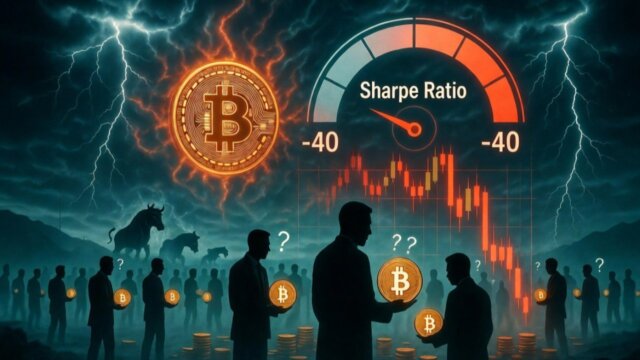
- While the BTC stress cycle hints at a potential bottom, confirmation depends on renewed volume and on-chain demand signals.
- On-chain data like Sharpe Ratio and supply in profit suggest a transitional phase.
- Smart money may already be accumulating while retail investors remain uncertain.
Bitcoin markets are once again entering a confusing phase where signals look promising, yet price action feels uncertain. The BTC stress cycle appears to be nearing its end based on historical indicators, but something still doesn’t quite add up. Investors are seeing familiar patterns from past bottoms, yet the lack of strong demand keeps many on edge. At first glance, this setup looks like a classic accumulation zone. However, deeper analysis shows mixed signals. Some metrics hint at recovery, while others suggest there’s still more consolidation ahead. So, what’s really going on beneath the surface?
Understanding the BTC stress cycle signals
The BTC stress cycle is often identified using on-chain metrics that measure market pressure and investor behavior. One key indicator is the Sharpe Ratio, which recently dropped to around -40. Historically, this level has marked strong accumulation zones where long-term investors quietly enter the market. In past cycles, similar drops have preceded major price recoveries. This happens because risk-adjusted returns look unattractive, pushing weak hands out while patient investors step in. As a result, these periods often become the foundation for the next bull run. However, things are not entirely straightforward this time. While the Sharpe Ratio suggests a bottoming phase, price action remains hesitant. This creates a disconnect between data and market sentiment. Therefore, traders are left questioning whether this is truly a bottom or just another pause in a larger downtrend.
Supply in profit and market hesitation
Another important metric to watch is the percentage of Bitcoin supply currently in profit. Right now, only about 59% of supply is profitable. Typically, this level is associated with deeper bearish conditions rather than the early stages of a bullish trend. In strong uptrends, this number usually climbs toward 75% or higher. That shift signals growing confidence and widespread participation. Until then, the market tends to feel heavy and uncertain. Consequently, many investors remain cautious and avoid aggressive buying. At the same time, this hesitation creates opportunity. Historically, these low-profit zones are where smart money begins accumulating. While retail investors wait for confirmation, experienced players gradually build positions. This behavior often goes unnoticed until prices start moving higher.
Demand recovery vs lack of confirmation
One of the more confusing aspects of the current market is the buy/sell delta. Data shows that selling pressure is easing, and buying activity is slowly picking up. On the surface, this looks like the early stages of demand returning. However, there’s still no strong confirmation of sustained buying interest. Volume remains relatively weak, and price reactions are muted. As a result, the market feels stuck in an in-between phase—neither fully bearish nor clearly bullish. This type of environment often tests investor patience. Many expect clear signals before entering, but markets rarely provide perfect timing. Instead, accumulation tends to happen quietly during these uncertain periods. That’s why the current BTC stress cycle phase feels uncomfortable—it sits right at the edge of change without fully committing to a direction.
Conclusion
The Bitcoin market is showing early signs that a bottom may be forming, but confirmation is still missing. Key indicators like the Sharpe Ratio and supply in profit suggest we are in a transitional phase rather than a confirmed uptrend. While fear and uncertainty dominate sentiment, this is often where long-term opportunities emerge. Smart money tends to accumulate during these quiet periods, even when the market feels uncertain. In the end, the BTC stress cycle reminds us that the best opportunities rarely feel obvious in the moment. Patience, data analysis, and a long-term view remain essential for navigating this phase successfully.
Disclaimer: CryptopianNews shares this for learning and info only. It’s not meant to be financial or investment advice. Crypto markets change a lot and move quickly. Investing in them can be risky. You should always look into things yourself. Talk to a trained financial advisor before making any choices about investing.

- Tensor Coin (TNSR) Update: 216M Burn, Supply and 2026 Developments - October 3, 2026
- BTC stuck in a range: Large Buyers Signal Strength - July 20, 2026
- CLARITY Act Odds Drop to 35% After DOJ Warning - July 18, 2026