

Key Highlights
- DTCC plans to tokenize U.S. Treasury securities using regulated blockchain infrastructure.
- The initiative operates under SEC guidance through a rare no-action letter.
- Tokenized Treasurys will carry the same legal rights as traditional securities.
- The Canton Network enables privacy, interoperability, and institutional compliance.
- Wall Street firms have already completed live on-chain Treasury financing pilots.
Why Treasury Market Infrastructure Is Being Rebuilt
For decades, U.S. Treasury markets relied on legacy settlement systems with limited operating hours. As a result, post-trade processes often involved delays, reconciliation risk, and operational inefficiencies.
However, financial institutions now face growing pressure to modernize infrastructure. At the same time, blockchain technology offers programmable settlement and near-instant finality. Therefore, large market operators have begun testing on-chain alternatives.
Consequently, DTCC has positioned itself at the center of this transformation.
What DTCC Tokenization Actually Represents
DTCC tokenization US treasury blockchain efforts focus on creating blockchain-based representations of existing Treasury securities. Importantly, these tokens are not new assets. Instead, they mirror traditional Treasurys already issued and settled through DTCC systems.
Moreover, the Depository Trust Company, a DTCC subsidiary, remains the official record keeper. As a result, tokenized instruments preserve legal ownership, compliance standards, and investor protections.
Meanwhile, blockchain technology enhances speed, transparency, and automation.
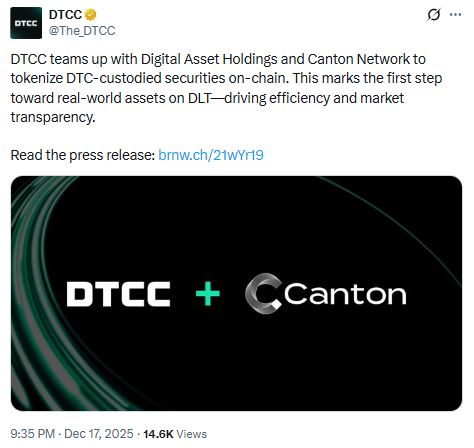
Tokenized Treasury Securities Explained for Institutions
How Tokenization Works in Practice
Tokenized Treasury securities explained simply involve issuing a digital version of a Treasury bond on a blockchain. However, the underlying asset never leaves the regulated system.
Instead, DTCC creates a blockchain “twin” that tracks ownership, settlement, and lifecycle events. Therefore, institutions can move assets between traditional and on-chain environments without changing legal structures.
Additionally, smart contracts automate settlement logic and reduce manual intervention.
Legal and Regulatory Guardrails
Critically, the U.S. Securities and Exchange Commission issued a no-action letter to DTCC. As a result, regulators confirmed they would not pursue enforcement if DTCC followed strict conditions.
Therefore, the initiative operates fully within U.S. securities law. Moreover, this regulatory clarity has encouraged banks and dealers to participate in pilot programs.
Why the Canton Network Was Selected
Canton Network Blockchain Treasury Bonds Infrastructure
The Canton Network blockchain treasury bonds use case stands out because it balances privacy with interoperability. Unlike public blockchains, Canton allows institutions to transact confidentially while remaining interoperable across networks.
Furthermore, Digital Asset designed Canton specifically for regulated financial markets. Therefore, it supports compliance requirements, permissioned access, and shared governance.
As a result, major banks view Canton as suitable for high-value assets like Treasurys.
Live On-Chain Treasury Financing
Recently, Wall Street firms completed live on-chain repo transactions using tokenized U.S. Treasurys. In these trades, both cash and collateral settled simultaneously on Canton.
Importantly, these transactions operated 24/7. Therefore, participants accessed liquidity outside traditional market hours.
Meanwhile, settlement risk declined because atomic settlement removed counterparty exposure.
How DTCC Plans to Integrate Blockchain With Legacy Systems
Bridging Traditional and Digital Markets
DTCC does not plan to replace existing infrastructure overnight. Instead, it integrates blockchain layers alongside current settlement rails.
For example, token issuance, custody, and redemption link directly to DTCC’s core systems. Consequently, firms can adopt tokenization without disrupting operations.
Moreover, standardized identifiers like CUSIPs remain unchanged.
Operational Efficiency Gains
Because blockchain automates reconciliation, firms reduce back-office workloads. Additionally, real-time settlement lowers capital requirements tied to delayed clearing.
As a result, operational costs decline while market resilience improves.
Institutional Demand Driving Adoption
Liquidity and Collateral Mobility
Tokenized Treasurys unlock faster collateral movement across markets. Therefore, institutions can reuse high-quality collateral more efficiently.
Moreover, programmable settlement enables complex financing structures to execute automatically.
Consequently, tokenization enhances liquidity across repo, derivatives, and funding markets.
Transparency and Risk Management
Blockchain records transactions immutably. As a result, firms gain real-time visibility into exposures and positions.
Meanwhile, regulators benefit from improved auditability and oversight capabilities.
Strategic Implications for Wall Street
DTCC’s initiative signals a broader shift toward institutional blockchain adoption. Rather than experimenting at the edges, core market infrastructure now supports tokenization.
Therefore, Treasury markets may become the foundation for wider adoption across equities, funds, and derivatives.
At the same time, regulated blockchain networks like Canton may define the future of institutional finance.
Read Also: Hong Kong Crypto Regulation Update: A 10-Year Vision
Disclaimer!! The information provided by CryptopianNews is for educational and informational purposes only. It should not be considered financial or investment advice. Cryptocurrency markets are highly volatile and speculative, and investing in them carries inherent risks. Readers are advised to conduct their own research and consult with a qualified financial advisor before making any investment decisions.

- QuFi Post-Quantum Verification Platform: A New Infrastructure Layer for Digital Assets — A Post-Quantum Verification Platform for Digital Assets - September 4, 2026
- Polygon Leads as Visa Expands Stablecoin Network for Cross-Border Payments - April 29, 2026
- Michael Saylor Quantum Computing Bitcoin Threat: Is Bitcoin Ready? - April 24, 2026