

- MiCA regulation is accelerating crypto adoption as Europe’s banks launch trading and custody services across the EU.
- New EU rules allow financial institutions to offer crypto products across all 27 member states with one license.
- As banks integrate Bitcoin and Ethereum trading, crypto adoption is entering the mainstream financial system.
The European financial landscape is shifting quickly as traditional banks move deeper into the cryptocurrency market. A major reason for this acceleration is the MiCA regulation, a landmark framework designed to standardize crypto rules across the European Union. For years, regulatory uncertainty kept many banks on the sidelines. However, the new framework finally provides clear guidelines for offering digital asset services. As a result, banks that once hesitated are now launching trading platforms, custody services, and even stablecoin projects. This change is not just about experimentation. Instead, it represents a structural shift in how finance and digital assets interact. With millions of banking customers gaining access to crypto through familiar apps, the barriers to entry are shrinking fast.
How the MiCA regulation Is Pushing Banks Into Crypto
The MiCA regulation creates a unified legal framework that allows financial institutions to operate crypto services across all 27 EU countries with a single license. This concept, known as “passporting,” removes the need for banks to seek approval in every individual nation. Because of this streamlined approach, major banks are rapidly expanding their crypto offerings. For example, Spain’s BBVA recently introduced retail trading for Bitcoin and Ethereum directly within its mobile banking application. This move gives millions of existing customers easy access to digital assets without needing external exchanges. Meanwhile, Santander has launched crypto trading services through its digital bank Openbank. The rollout began in Germany and Spain, but expansion across Europe is expected. As more banks follow this strategy, crypto is becoming a built-in feature of everyday banking rather than a separate financial ecosystem.
Major European Banks Expanding Crypto Services
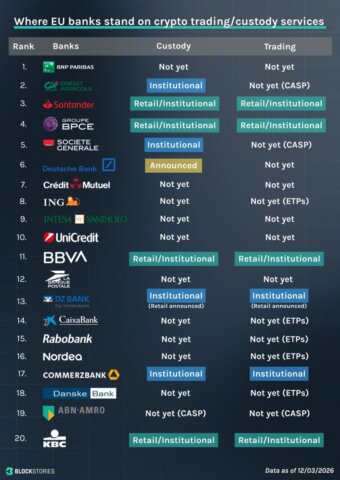
Several leading European banks are already building strong positions in the digital asset market. Germany’s Commerzbank, for instance, now provides custody and trading services for institutional investors interested in Bitcoin and Ethereum. Institutional custody is a crucial development because large investors require secure storage solutions that meet strict regulatory standards. Banks already possess the infrastructure and trust required to handle these responsibilities. Therefore, their entry into the crypto sector strengthens credibility for the entire industry. In addition to trading and custody, banks are exploring new blockchain-based financial products. A group of nine major institutions—including ING and UniCredit—are reportedly working together to develop a euro-denominated stablecoin called Qivalis. If successful, the project could launch around 2026 and provide a regulated digital euro alternative for payments and financial services.
What This Means for Crypto Adoption in Europe
The growing involvement of traditional banks signals a major turning point for crypto adoption. According to recent industry estimates, more than 55 European banks already offer some form of digital asset service. These range from trading platforms to blockchain custody and tokenized financial products. As a result, everyday banking customers are gaining easier access to cryptocurrencies. Instead of creating accounts on unfamiliar exchanges, users can now buy and manage assets directly within their trusted banking apps. This convenience significantly lowers the entry barrier for new investors. Moreover, banks bring strong compliance and risk management practices to the crypto market. Their participation helps build trust among regulators, institutional investors, and the broader public. Over time, this could encourage even more financial institutions to explore blockchain technology and digital assets. The combination of regulation, infrastructure, and institutional backing creates a powerful adoption cycle. As more banks join the ecosystem, the crypto market becomes more integrated with traditional finance.
Conclusion
Europe’s banking sector is moving quickly into the digital asset space, driven by regulatory clarity and growing demand from customers. Major institutions are launching trading services, institutional custody platforms, and even collaborative stablecoin projects. These developments show that crypto is no longer a niche experiment. Instead, it is becoming part of mainstream finance, integrated directly into the banking systems people use every day. As the MiCA regulation reaches full compliance by July 2026, the pace of innovation will likely accelerate. With large banks placing Bitcoin and other digital assets inside their apps, the bridge between traditional finance and crypto is stronger than ever.
Disclaimer: CryptopianNews shares this for learning and info only. It’s not meant to be financial or investment advice. Crypto markets change a lot and move quickly. Investing in them can be risky. You should always look into things yourself. Talk to a trained financial advisor before making any choices about investing.

- Bitcoin Highest Weekly Close Signals Bullish Momentum - July 20, 2026
- Biggest Crypto Catalysts to Watch Before the Next Rally - July 18, 2026
- Stock Market Open Could Decide Bitcoin’s Next Move - July 2, 2026