
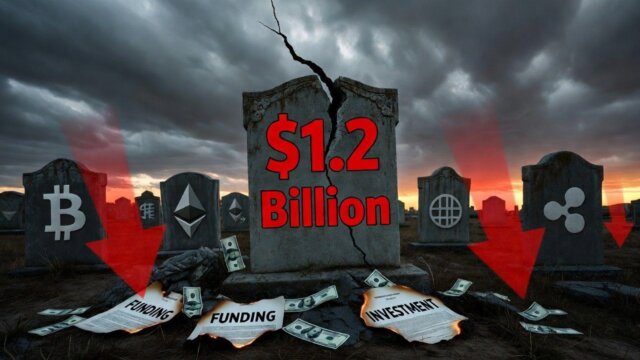
Important bullet points:
- • Over $1.2 billion raised by 10 blockchain projects combined.
- • These projects once hit a staggering $25 billion total ATH market cap.
- • Every single one dropped between 96 percent and 100 percent from peak.
- • Kadena shut down entirely after its massive raise.
- • Moonbeam now operates with only about 200 daily active wallets.
- • Scroll earns just $498 per day despite an $80 million funding round.
Why Top Crypto Projects Fail
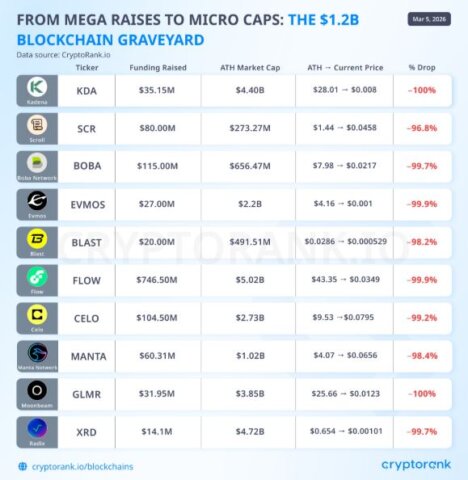
Investors often chase hype in the crypto space. Yet many high-profile projects collapse despite huge funding. Data from CryptoRank.io dated March 5, 2026 reveals a clear pattern. Ten projects raised more than $1.2 billion together. Their combined all-time high market cap touched $25 billion. However, all of them now sit down 96 to 100 percent.
Moreover, real-world usage tells an even sadder story. Kadena stopped operations completely. Moonbeam struggles with tiny daily activity. Scroll barely generates revenue. Funding alone never guaranteed success. Therefore, understanding the reasons becomes essential for smarter decisions.
The $1.2B Blockchain Graveyard Exposed
Crypto enthusiasts watched billions flow into these networks. However, the results shocked everyone. Flow raised a whopping $746.5 million yet lost 99.9 percent of its value. Kadena collected $35.15 million before full shutdown. Scroll took in $80 million but now earns pennies daily.
Additionally, Boba Network raised $115 million only to fall 99.7 percent. Evmos followed with $27 million raised and a 99.9 percent drop. These numbers come straight from March 2026 data. As a result, the entire sector questions the value of big raises.
Furthermore, market caps once soared. Combined ATH reached $25 billion across the ten projects. Today, prices hover near zero for most. Celo dropped 99.2 percent after raising $104.5 million. Manta lost 98.4 percent on its $60.31 million raise. Therefore, investors learned a harsh lesson quickly.
Why Funding Fails: Common Pitfalls in 2026
Many teams promised revolutionary technology. Yet execution often fell short. For instance, poor tokenomics led to massive sell pressure. Developers released tokens too early. Consequently, prices crashed before real adoption arrived.
Moreover, competition intensified rapidly in 2026. Newer chains offered better speed and lower fees. Older projects like Radix could not keep pace. Blast raised only $20 million but still dropped 98.2 percent. Therefore, unique value propositions matter more than hype.
In addition, regulatory uncertainty hurt growth. Teams spent funds on legal battles instead of development. Moonbeam suffered from low wallet activity partly due to unclear rules. As a result, user trust eroded fast.
Furthermore, market cycles played a major role. Bull runs inflated valuations artificially. When sentiment turned, these projects had no real utility left. Hence, survival required more than just funding.
Failed Blockchain Projects 2026: Real Examples
Kadena once led with its unique consensus. However, it shut down entirely by early 2026. The team cited unsustainable operations. Therefore, investors lost everything.
Scroll focused on Ethereum scaling. Yet daily revenue stayed at $498. Users moved to faster alternatives. Consequently, its price fell 96.8 percent.
Moonbeam targeted cross-chain compatibility. Still, only 200 wallets remain active daily. The project raised $31.95 million but hit zero value. Moreover, similar stories repeat across the list.
Deeper Look at Flow and Celo
Flow collected the largest amount at $746.5 million. Nevertheless, its price dropped 99.9 percent. Developers failed to deliver promised gaming adoption. As a result, the network lost momentum.
Celo aimed for mobile-first finance. Yet it lost 99.2 percent after raising $104.5 million. Competition from established stablecoins proved too strong. Therefore, users abandoned the platform.
Manta and Radix faced parallel issues. Both raised decent sums but could not maintain activity. Hence, their market caps evaporated almost completely.
Lessons from Crypto Fundraising Failures for Future Success
Teams must prioritize real utility over hype. Moreover, sustainable tokenomics prevent early dumps. Investors should check daily active users before buying.
Additionally, strong community governance helps projects survive. Projects without it fade quickly. Therefore, due diligence on team backgrounds becomes crucial.
Furthermore, focus on revenue generation early. Scroll shows that high raises without income lead nowhere. As a result, new founders now build products first.
In addition, adaptability to market changes saves projects. Rigid roadmaps cause failure. Hence, flexible strategies gain importance in 2026.
Finally, regulatory compliance builds long-term trust. Teams ignoring rules face shutdown risks. Consequently, smarter fundraising practices emerge across the industry.
These patterns highlight ongoing challenges. Investors now demand proof of traction. Therefore, the $1.2 billion graveyard serves as a warning for everyone involved.
Read Also: Is Bitcoin the New Safe Haven? How Crypto Defied Geopolitical Tensions in 2026
Disclaimer!! CryptopianNews provides this information for educational and informational purposes only. You should not consider it financial or investment advice. Cryptocurrency markets are highly volatile and speculative, and they carry inherent risks. We advise readers to conduct their own research and to consult with a qualified financial advisor before making any investment decisions.

- QuFi Post-Quantum Verification Platform: A New Infrastructure Layer for Digital Assets — A Post-Quantum Verification Platform for Digital Assets - September 4, 2026
- Polygon Leads as Visa Expands Stablecoin Network for Cross-Border Payments - April 29, 2026
- Michael Saylor Quantum Computing Bitcoin Threat: Is Bitcoin Ready? - April 24, 2026